
Unifying Social Spammers and Influencers: The HADISD Approach to Anomaly Detection
Heterogeneous anomaly detection in social diffusion with discriminative feature discovery
HADISD is a novel, parameter-free framework for heterogeneous anomaly detection in social diffusion processes. It identifies discriminative features across various behaviors (like spamming or influencing) using a probability-distribution-based optimization that handles dynamic network structures with an incremental update mechanism.
Executive Summary
TL;DR: This paper introduces HADISD (Heterogeneous Anomaly Detection In Social Diffusion), a parameter-free framework that treats both spammers and high-influence nodes as "anomalies" within social networks. By focusing on discriminative features—attributes that distinguish specific groups from the general population—HADISD provides a unified, efficient, and highly scalable solution for two historically separate problems.
Academic Positioning: This work bridges the gap between influence maximization and spammer detection. It moves away from supervised, parameter-heavy models toward a flexible, distribution-based optimization that adapts to the shifting dynamics of social diffusion.
The Core Challenge: Diversified and Evasive Behaviors
Social diffusion is a dynamic propagation process where information spreads through vertices (users) and edges (interactions). Detecting anomalies in these processes suffers from three primary issues:
- Behavior Variety: Modern spammers are "intelligent"; they mimic normal users to avoid simple content-based filters.
- Feature Heterogeneity: Useful features are often behavior-dependent and change over time.
- High Dynamics: Social structures evolve rapidly (e.g., trending topics, viral hashtags), rendering static models obsolete within hours.
Methodology: The Geometry of Diffusion
HADISD operates across four distinct phases to ensure both precision and computational thrift.
1. Vertex Vectors: Smart Storage
Instead of maintaining an enormous adjacency matrix, the authors propose Vertex Vectors. These store a user's neighbors weighted by their proximity (1-hop vs. 2-hop) and interaction frequency. This captures the decaying nature of social influence while keeping the memory footprint low.
2. PD-Max: Distribution-Based Detection
The "magic" happens here. The system models vertex feature frequency using a Multinomial Distribution. By analyzing the probability regions (I, II, and III), HADISD identifies:
- Region I: Normal behavior (expected frequency).
- Region II: Ambiguous (requires a sigmoid-based filter).
- Region III: Highly Discriminative (Anomaly).

3. PD-Minmax: Redundancy Elimination
Not all "abnormal" nodes are useful. PD-minmax uses a Bayesian likelihood optimization to find the minimum number of vertices that provide the maximum amount of discriminative information. This ensures that the final set of spammers or seeds is efficient and non-redundant.
Experiments: Scalability in Action
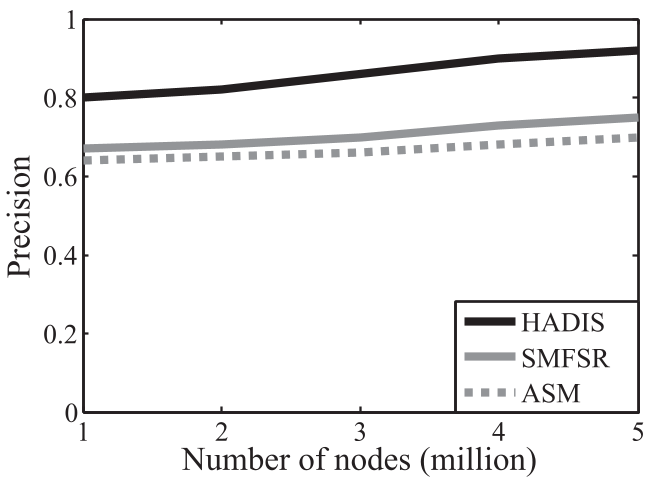
The authors tested HADISD on massive datasets, including 1TB of telecom records and Sina Weibo data (5 million nodes).
- Efficiency: While baseline methods like ASM (Bayesian) show exponential growth in processing time as data scales, HADISD's time complexity remains O(t*n log n).
- Spammer Detection: In Weibo datasets, HADISD outperformed the
COMPREXbaseline, achieving significantly higher precision and recall by focusing on behavior instead of just content. - Influence Timing: A fascinating finding was identifying "Influential Periods." For example, users are more "influenceable" during the day but prefer longer, more personal interactions at night.
Critical Insight: The "Intelligent Spammer" Evolution
One of the paper's most compelling qualitative contributions is the categorization of spammer evolution:
- Primary: Raw automated services.
- Secondary: Simple interaction bots.
- Intelligent: Accounts that effectively disguise themselves as real people.
The authors note that 7% of spammers in their study are "Intelligent," presenting a massive challenge for future R&D. Traditional content filters miss these, but HADISD's focus on diffusion patterns—how they sit relative to the network's natural probability distribution—proves to be their "Achilles' heel."
Conclusion & Future Outlook
HADISD represents a paradigm shift toward parameter-free, unified social network analysis. By treating spammers and influencers as two sides of the same coin (discriminative anomalies), it offers a robust tool for platform safety and digital marketing alike.
Future Work: The authors suggest integrating geographic metadata and community-aware features to further refine detection in hyper-local social networks.
Senior Editor's Note: The robustness of HADISD lies in its "Probability-Distribution-based" logic, which avoids the pitfalls of over-fitting often seen in supervised deep learning models for social graphs.