
Efficient OMSN Routing: Solving the Social Distance through Heterogeneous Communities
Heterogeneous Community-Based Routing in Opportunistic Mobile Social Networks
The paper introduces a social-aware single-copy routing approach for Opportunistic Mobile Social Networks (OMSNs) that utilizes static internal social features rather than dynamic contact history. The core method, a recursive 2-hop routing scheme, optimizes the forwarding set based on transition probabilities across heterogeneous community structures, achieving superior delivery rates and lower latency compared to existing benchmarks like SimBet.
TL;DR
Researchers have developed a new single-copy routing protocol for Opportunistic Mobile Social Networks (OMSNs) that ditches expensive dynamic contact tracking in favor of static Social Features (e.g., profession, nationality). By modeling routing as a recursive 2-hop process through a multi-dimensional social space, the method significantly reduces latency and overhead, outperforming state-of-the-art benchmarks like SimBet with fewer message copies.
Perspective: Why Social Features Over Mobility Patterns?
In the unpredictable world of Opportunistic Networks, nodes (smartphones) meet intermittently. Conventional logic suggests we should track who met whom to predict future meetings. However, this is a data-intensive nightmare in decentralized networks.
The authors' core Insight is that social features are the "DNA" of mobility. People with shared interests or backgrounds meet more frequently. By treating these static features as dimensions in a hypercube, routing becomes a logical process of "resolving" the distance between a source and a destination, one social dimension at a time.
Methodology: The Iterative 2-Hop Bridge
Instead of calculating a complete path to the destination (which is impossible in OMSNs), the paper proposes an Iterative 2-Hop Routing scheme.
- The First Hop: A physical encounter between the current message holder and a relay node that shares a specific social feature with the destination.
- The Second (Virtual) Hop: The estimated delay from that relay node to the final destination group.
The "Priority" of which dimension to resolve first is dictated by the Transition Probability (). If a social dimension (like "Research Group") has many small communities, the probability of meeting the right person is lower, giving that dimension higher priority in the routing decision.
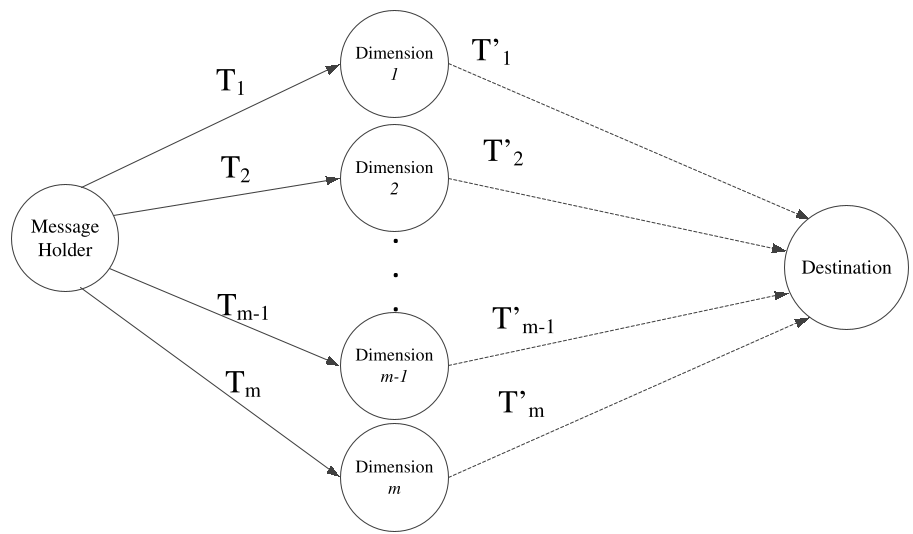 Figure 1: The Link-state graph illustrating the 2-hop resolve process from message holder to destination group.
The Power of Shortcuts
The authors further optimize the process with a Shortcut mechanism. If a encountered relay node matches multiple social dimensions of the destination simultaneously, the message "jumps" across several dimensions at once, drastically cutting down the hop count.
Experimental Validation: SOTA Performance at 1/3 the Cost
The researchers tested their algorithm using the Infocom 2006 and MIT Reality Mining traces. The results confirm a massive efficiency gain:
- Latency & Delivery: The proposed single-copy scheme outperformed SimBet (a leading social-aware protocol). In fact, the proposed method achieved similar performance to a 3-copy SimBet setup while only utilizing one-third of the network resources (one message copy).
- Scalability: In synthetic traces, as the "Social Distance" (number of differing features) increased, the protocol maintained a steady lead over random forwarding, proving its robustness in complex social environments.
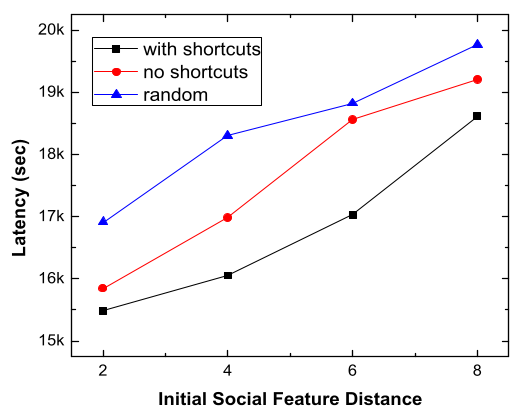 Figure 2: Performance comparison showing superior delivery rates and reduced forwardings in the Infocom trace.
Critical Insight & Future Outlook
The brilliance of this work lies in its Inductive Bias: it assumes that human mobility is not random but governed by social identity. By shifting the complexity from dynamic state tracking to static feature analysis, the authors provide a lightweight solution perfect for the limited battery and bandwidth of mobile devices.
Limitations: The model assumes that social feature distributions are somewhat uniform or known. In highly skewed real-world scenarios, the transition probability might need more complex estimation.
The Takeaway? As we move toward more privacy-conscious and decentralized communication, leveraging "Social DNA" for routing could be the key to building resilient, infrastructure-free networks.