
LBSNE: Decoding Smart City Dynamics through Heterogeneous Graph Embedding
13637_A Heterogeneous Graph Embedding Framework for Location-Based Social Network Analysis in Smart Cities.
The paper introduces LBSNE, a heterogeneous graph embedding framework designed for Location-Based Social Networks (LBSNs). It utilizes metapath-based random walks and a heterogeneous skip-gram model to represent users and POIs in low-dimensional space, achieving SOTA performance in POI recommendation and visitor prediction.
TL;DR
As smart cities evolve, the fusion of social networks and geographic data has created Location-Based Social Networks (LBSNs). In this paper, the authors propose LBSNE, a framework that treats LBSNs as heterogeneous graphs to learn dense node representations. By using metapath-based random walks and skip-gram optimization, LBSNE significantly outperforms existing methods like POI2Vec in tasks such as recommending your next favorite haunt or predicting who will visit a specific landmark.
The Challenge: Heterogeneity in Urban Data
Modern urban planning and personalized services rely on understanding user trajectories. However, LBSN data is inherently messy:
- Heterogeneity: A network contains diverse entities (Users, POIs) and relations (Friendship, Check-ins).
- Sparsity: Most users visit only a tiny fraction of available locations.
- Scale: Millions of check-ins make traditional spectral clustering computationally prohibitive.
Existing studies often oversimplify the problem by treating the network as a homogeneous set of nodes, missing the subtle "semantics" of why a user visits a specific category of POI versus another.
Methodology: Bridging Topology and Semantics
The core innovation of LBSNE is the transition from Homogeneous to Heterogeneous representation learning.
1. Metapath-based Random Walks
Unlike simple random walks (like DeepWalk), LBSNE uses a metapath scheme (e.g., ). This ensures that the generated node sequences respect the underlying logic of a social-physical network.
2. Heterogeneous Skip-Gram
The framework adapts the Skip-gram architecture to maximize the probability of observing a node's heterogeneous neighborhood .
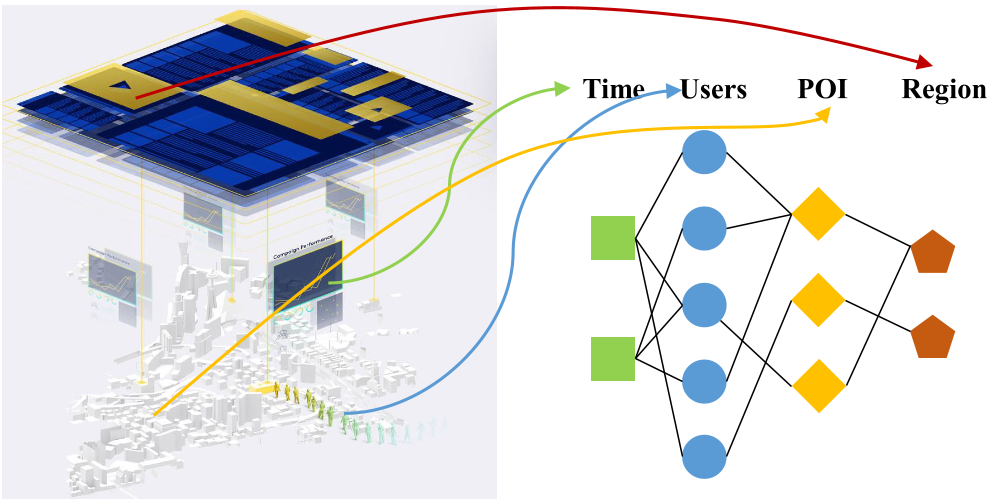 Fig 1. The Heterogeneous schema capturing the interplay between users and points of interest.
The model utilizes Heterogeneous Negative Sampling to optimize the objective function efficiently, as shown in the skip-gram architecture below:
 Fig 2. The Skip-gram model adapted for heterogeneous contexts.
Experiments and Insights
The authors tested LBSNE on two gold-standard datasets: Foursquare and Gowalla.
POI Recommendation & Visitor Prediction
The learned embeddings (vectors and ) were used to calculate scores for two primary applications:
- POI Recommendation: Predicting the next check-in location for a user.
- Visitor Prediction: Predicting the set of users likely to visit a specific POI.
Performance Gains
LBSNE demonstrated a clear lead. On Foursquare, it achieved a 16.1% improvement in Precision@5 over POI2Vec. One key insight from the ablation study is that the optimal embedding dimension is around 200, where the model reaches a plateau of maximum expressive power.
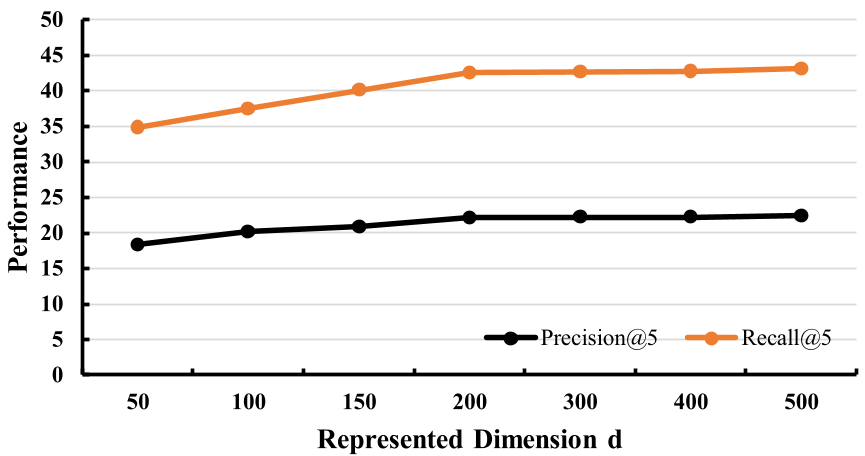 Fig 3. Performance comparison across different recommendation metrics.
Critical Analysis & Conclusion
Why it Works
LBSNE succeeds because it doesn't just look at who you are friends with; it looks at the types of places you visit through structured paths. By embedding these relationships into a low-dimensional space, the model overcomes the "cold-start" and sparsity issues of collaborative filtering.
Limitations & Future Work
The current model is primarily static. As the authors admit, Time-varying factors (seasonal trends, hour-of-day effects) are not fully integrated into the embedding process. Future iterations that incorporate temporal graphs could potentially push the SOTA even further.
Final Takeaway: LBSNE provides a mathematically rigorous yet practical blueprint for representing complex urban social data, proving that heterogeneity is the key to unlocking smarter city-wide recommendations.