
NESA: Decoding Hidden Sentiment Through Heterogeneous Graph Embedding
Heterogeneous Graph Network Embedding for Sentiment Analysis on Social Media
The paper introduces NESA (Network Embedding for Sentiment Analysis), a heterogeneous graph framework that treats sentiment analysis as a signed link prediction task. By utilizing Variational Auto-Encoders (VAE), it embeds social relationships, user/entity attributes, and sentiment polarities into a unified low-dimensional space to retrieve "hidden" attitudes that traditional text-based methods often miss.
TL;DR
The conventional approach to sentiment analysis is "reading between the lines" of text. But what if there is no text? This paper presents NESA, a framework that treats sentiment as a signed link in a social graph. Using Variational Auto-Encoders (VAE), it fuses social circles, demographic attributes, and past behaviors to predict whether a user likes or dislikes an entity, achieving BERT-level accuracy with superior computational efficiency.
The Motivation: Why Text is Not Enough
Most sentiment analysis tools are "content-hungry." They fail when:
- Context is Sparse: Tweets and comments are often too short for deep semantic analysis.
- Information is Missing: A user might have a strong opinion but hasn't posted a review yet.
- Real Attitudes are Hidden: Social pressure or sarcasm can mask true feelings in text.
The authors argue that your social identity (attributes) and your social circle (relationships) are powerful predictors of your sentiment. If your friends love a specific movie and you share their demographic profile, you likely share their sentiment—even if you haven't said a word about it.
Methodology: Fusing the Heterogeneous Social Web
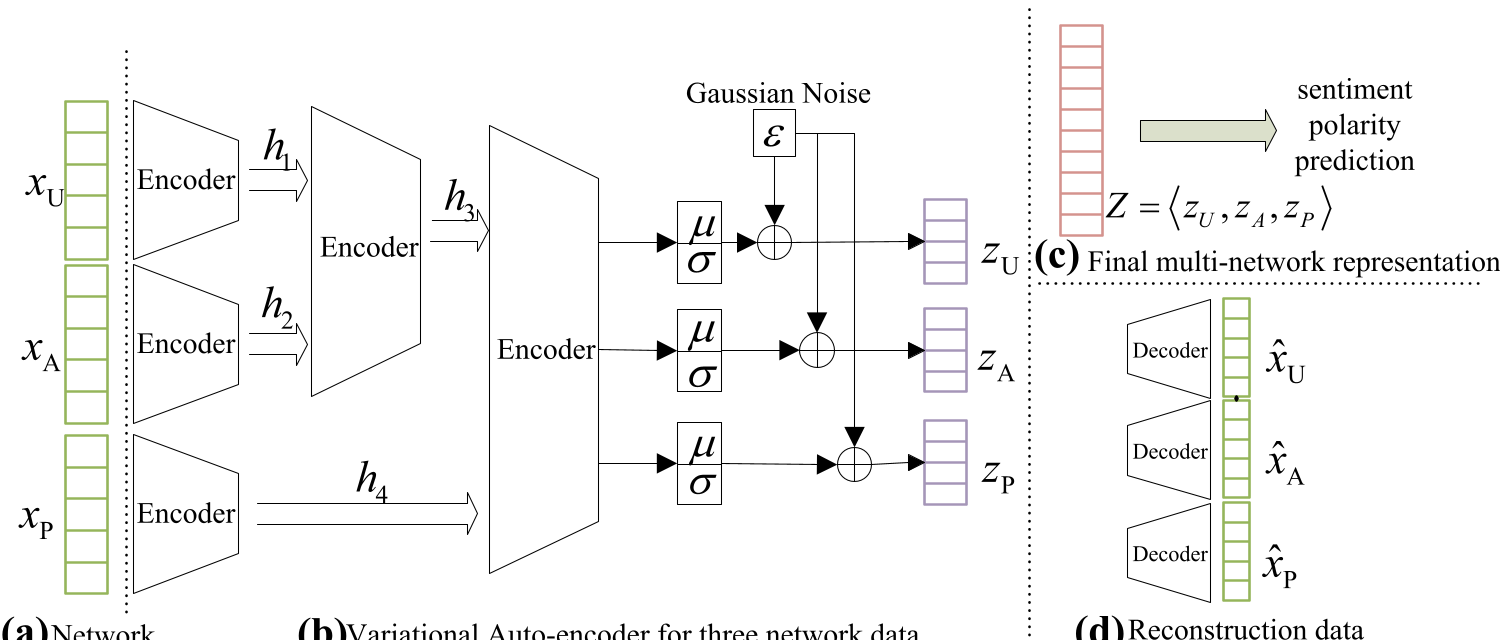
The core of the NESA (Network Embedding for Sentiment Analysis) framework is a dual-stage VAE architecture designed to handle three distinct networks:
- User-User (U-U): Social links.
- User-Entity-Polarity (U-E-P): The signed sentiment network (+1 for positive, -1 for negative).
- User-Entity-Attributes (U-E-A): Metadata like age, gender, and genre.
The Fusion Logic
Instead of just concatenating these vectors, the NESA-fus model uses a hierarchical VAE approach:
- Structural & Attribute Proximity: One VAE learns from social links and attributes.
- Multi-View Correlation: A second-level VAE takes the output of the first stage and the existing sentiment polarity network as "two views" of the same reality. This captures the non-linear interactions between who you are and how you feel.
Performance: BERT-Level Accuracy, Light-Speed Efficiency
The authors compared NESA against two heavy hitters: traditional network embedding (Node2Vec, SDNE) and modern NLP giants (ELMo, BERT).
Key Findings:
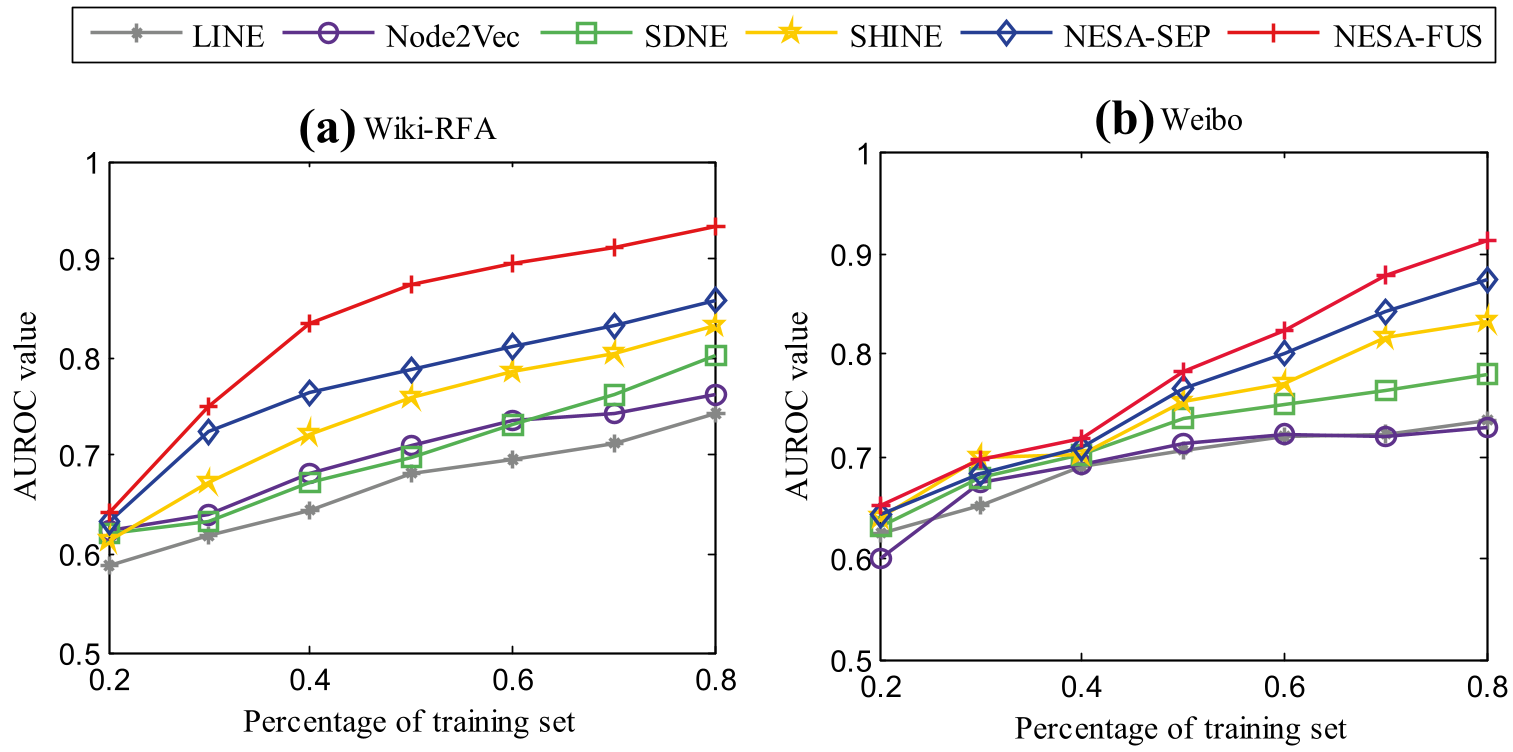
- Robustness in Sparsity: As the network becomes sparser (hiding more links), NESA-fus maintains a significantly higher AUROC compared to baselines like SHINE.
- The "Social Lift": By simply adding social link information (NESAS) or attribute information (NESAA) to the baseline graph model, F1-scores jumped by over 10%.
- Efficiency: While BERT is the "gold standard" for accuracy, it is computationally expensive. NESA-fus achieved a comparable F1-score (0.843 vs BERT's 0.857) while operating orders of magnitude faster during runtime.
Critical Analysis & Conclusion
The Breakthrough
NESA proves that sentiment analysis is not just an NLP problem; it is a Graph Topology problem. By embedding users and entities into a joint latent space, the model can "hallucinate" sentiments for cold-start users or entities by looking at their neighbors in the embedding manifold.
Limitations
- Dynamic Evolution: The current model treats the graph as static. In reality, social links and sentiments evolve rapidly.
- Attribute Dependency: The model relies on high-quality metadata (age, location, etc.), which may not always be accessible due to privacy settings.
Future Outlook
This work opens the door for Hybrid Sentiment Engines—systems that combine the semantic power of Transformers (BERT/GPT) with the topological intelligence of Graph Embeddings. For product recommendations and public opinion monitoring, this multi-modal approach is the likely future.