
HINA: Decoding the "Socio-Technical Web" of Modern Learning Processes
Heterogeneous Interaction Network Analysis (HINA): A New Learning Analytics Approach for Modelling, Analyzing, and Visualizing Complex Interactions in Learning …
The paper introduces Heterogeneous Interaction Network Analysis (HINA), an original learning analytics framework and Python tool designed to model complex interactions between diverse entities like learners, AI agents, and task designs. By treating learning processes as multi-level networks, HINA achieves SOTA granularity in capturing socio-cognitive dynamics compared to traditional sequential or homogeneous network methods.
TL;DR
Researchers from the University of Hong Kong and Monash University have unveiled HINA (Heterogeneous Interaction Network Analysis), a novel multi-level framework that treats learning not just as a sequence of events, but as a rich, multi-layered network of interactions between students, AI agents, and pedagogical tools. Unlike previous methods, HINA provides a mathematically rigorous way to quantify interaction diversity, prune "noise" from behavioral data, and automatically cluster learner profiles using information theory.
Motivation: Why Linear Sequences Aren't Enough
In the age of Generative AI, learning is no longer a simple student-to-teacher or student-to-peer exchange. It has become a distributed process involving AI chatbots, digital artifacts, and specific cognitive strategies.
Current Learning Analytics (LA) tools like Process Mining or Epistemic Network Analysis (ENA) have a blind spot:
- Process Mining focuses on the order of events but loses the relational structure between different types of entities.
- ENA focuses on relational ties but is usually limited to a single entity type (like "concepts").
HINA fills this gap by asking: How do students strategically orchestrate different resources?
Methodology: The Three Levels of HINA
HINA operates on the premise that every interaction (e.g., a student asking an AI for a definition) is a link in a Heterogeneous Interaction Network (HIN).
1. The Micro Level: Quantity & Diversity
HINA defines two critical metrics for every entity (node):
- Quantity (): The raw volume of engagement.
- Diversity (): Based on Shannon Entropy, this measures whether a student's interactions are concentrated on one target (like over-relying on AI) or distributed broadly across peers and tools.
2. The Dyadic Level: Finding the "Backbone"
Not every interaction is meaningful. HINA uses a statistical significance test (based on disparity filters) to "prune" the network. By comparing observed weights against a null model, it removes accidental interactions, leaving behind the robust "backbone" of the learning process.
3. The Meso Level: Non-Parametric Clustering
Most clustering (like K-means) requires the user to guess the number of clusters. HINA uses the Minimum Description Length (MDL) principle. It finds the grouping that "compresses" the network data most efficiently—meaning it discovers natural patterns in the data without human bias.
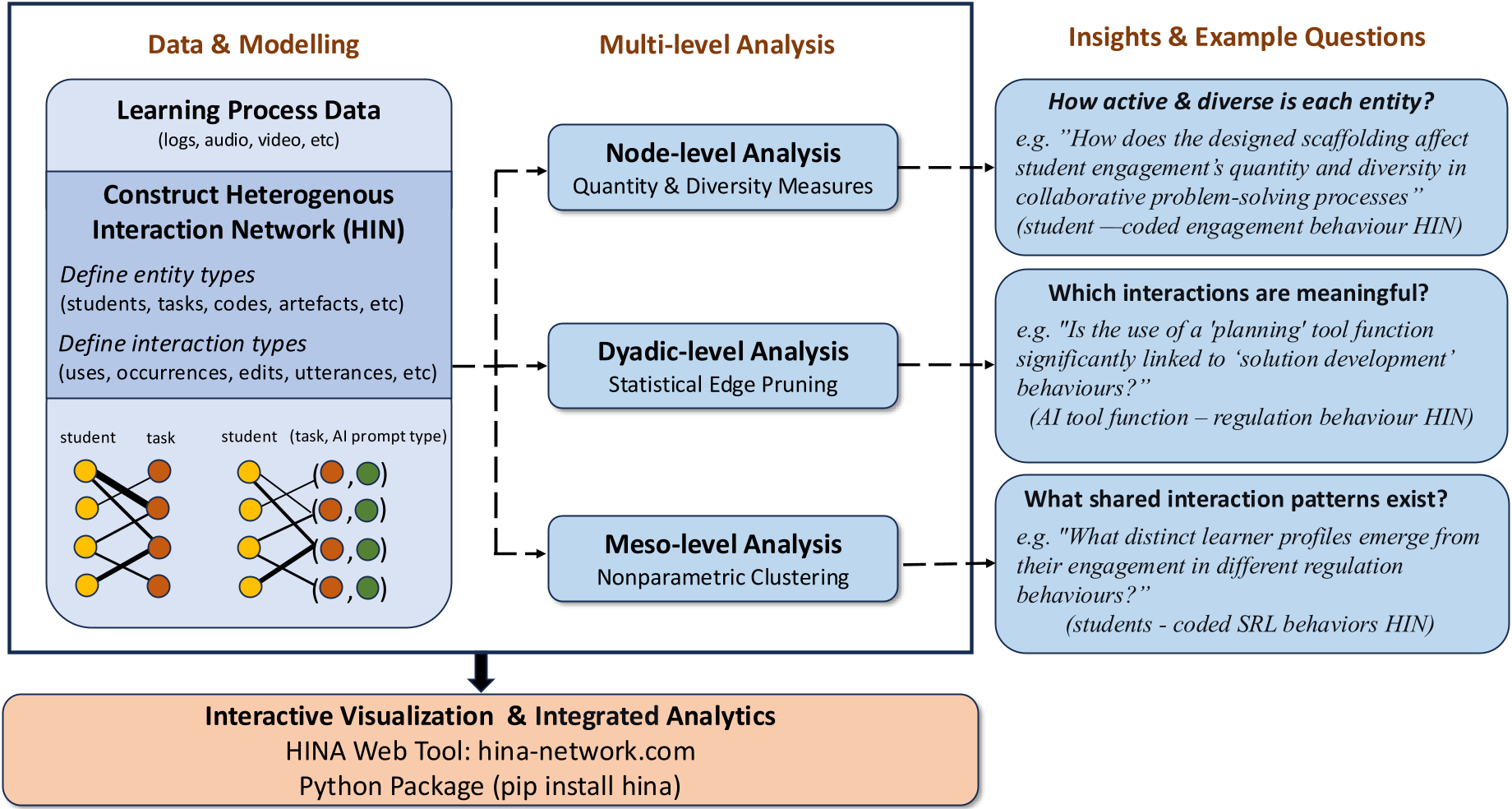 The HINA workflow: from raw logs to multi-level insights.
Case Study: Human-AI Collaboration
The authors applied HINA to a study where students used GPT-4 to solve project management problems. The analysis revealed a fascinating split:
- Cluster 1 (Peer-Dominant): These students used AI selectively (mostly for logistics) while keeping the heavy lifting of cognitive and metacognitive work within the human group.
- Cluster 2 (AI-Hybrid): These students established a "division of labor," using AI as their primary cognitive resource for questions, while humans handled coordination and socio-emotional alignment.
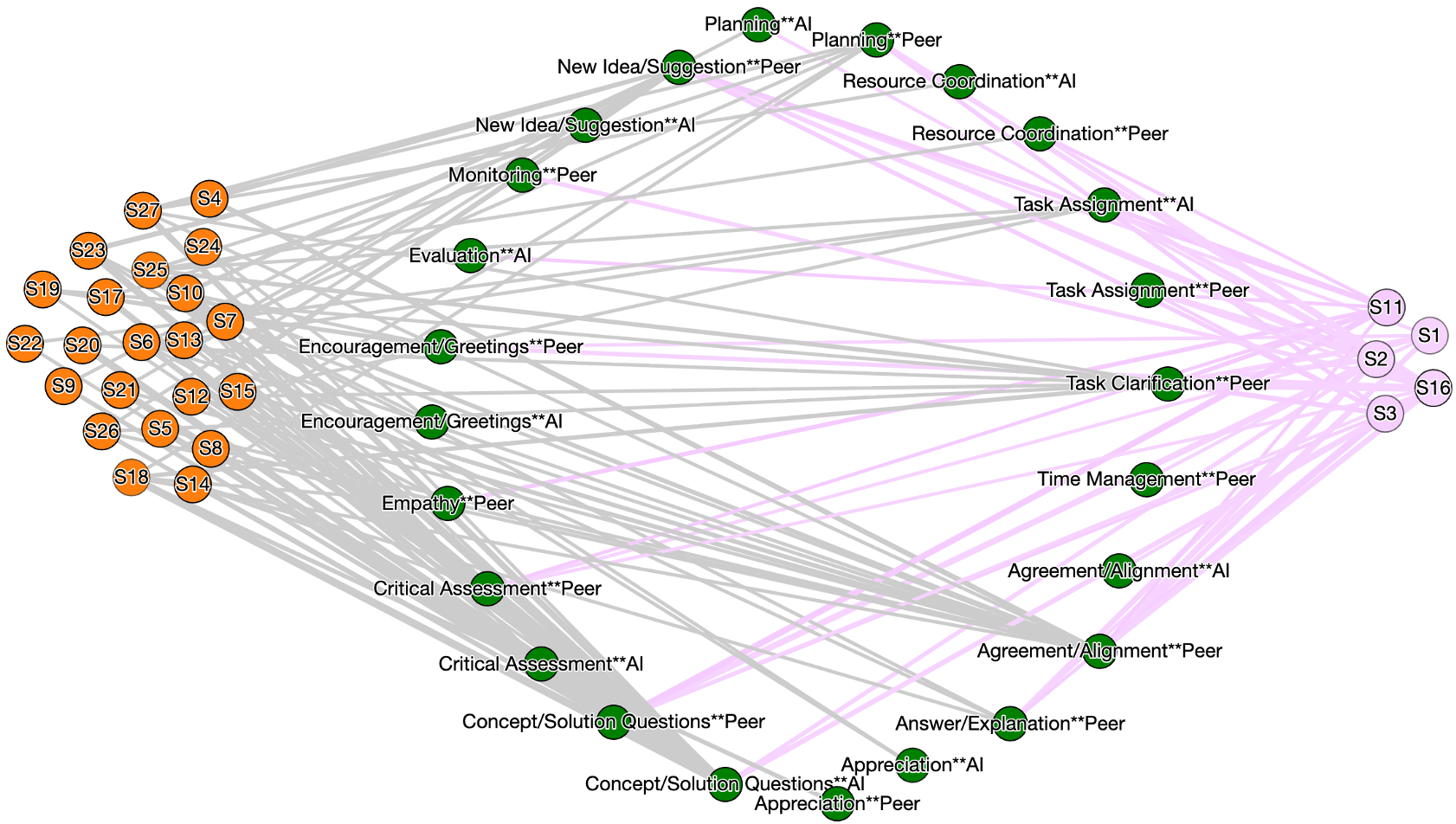 Non-parametric clustering reveals distinct strategic orientations toward AI.
Critical Insight: Beyond "AI-Centric" vs "Human-Centric"
The HINA results (visualized in the pruned projections below) show that "engagement" is not a binary. By looking at the pruned tripartite projections, we can see exactly which cognitive codes (like "Critical Assessment") are linked to which targets. This allows researchers to identify metacognitive laziness (high AI dependence) or strategic offloading in real-time.
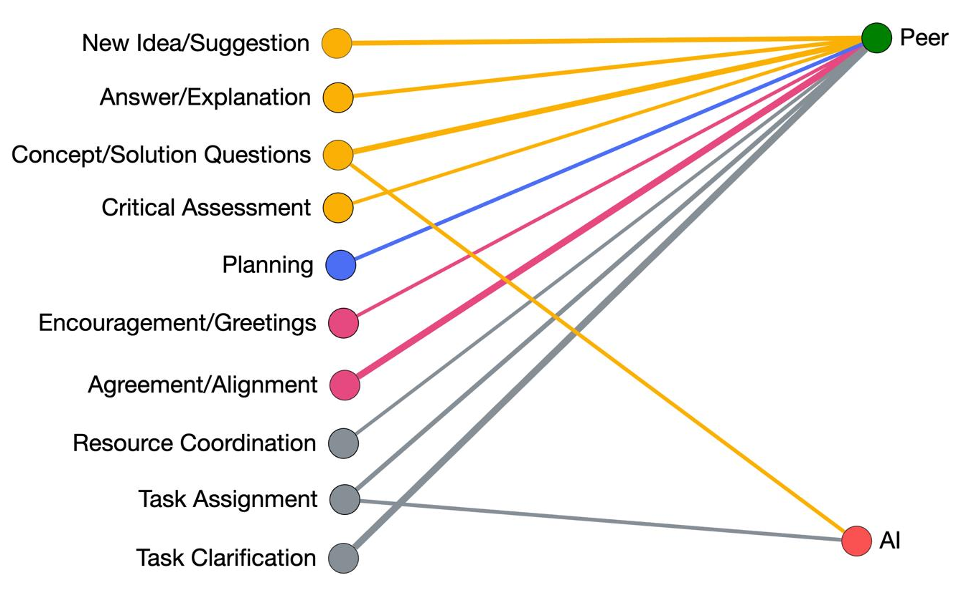 The statistical backbone shows how different clusters distribute cognitive labor.
The Future of HINA
While powerful, HINA currently models interactions in an aggregated format, meaning it doesn't yet capture the second-by-second temporal flow as well as specific sequence-mining tools. However, its ability to handle "composite nodes" (e.g., a specific student using a specific tool for a specific behavior) makes it the most sophisticated relational framework currently available for the hybrid intelligence era.
Takeaway for Practitioners: HINA is available as a Python package (pip install hina) and a web tool (hina-network.com), enabling teachers to move from "hunches" about group dynamics to data-backed interventions.