
Beyond Sensors: Leveraging Social Context for Truly Intelligent Smart Spaces
Using heterogeneous and Social Contexts to create a smart space architecture
The paper proposes a novel Smart Space architecture that integrates heterogeneous contexts, specifically augmenting traditional physical sensor data with "Social Context" harvested from social networks. It introduces a Presence and Policies Server (PPS) and utilizes semantic web standards like RDF and FOAF to create truly adaptive, context-aware environments.
TL;DR
While most smart homes focus on "where you are" and "how hot the room is," they often ignore "who you are" and "what you like." This paper introduces a framework that bridges this gap by feeding data from social networks (Facebook, Twitter) into a Smart Space architecture. By using semantic web technologies (RDF/FOAF), the system creates an environment that adapts not just to movement, but to human relationships and personal interests.
The "Unreliable Sensor" Bottleneck
For decades, the standard for Smart Spaces has been the Physical Context: temperature sensors, pressure pads, and motion detectors. However, the authors argue that this approach has reached a plateau. Sensors are notoriously unreliable, energy-hungry, and—most importantly—socially blind.
Past attempts to solve this involved asking users to fill out long forms about their hobbies. Unsurprisingly, this failed. In the world of pervasive computing, if a technology isn't "invisible," it isn't successful. The insight here is simple but powerful: The data already exists in our pockets. By linking a user's mobile device to their social network profile, the environment can automatically "know" the user without a single manual form.
Methodology: The Semantic Bridge
The core of this architecture is the transformation of "soft" social data into "hard" machine-readable context.
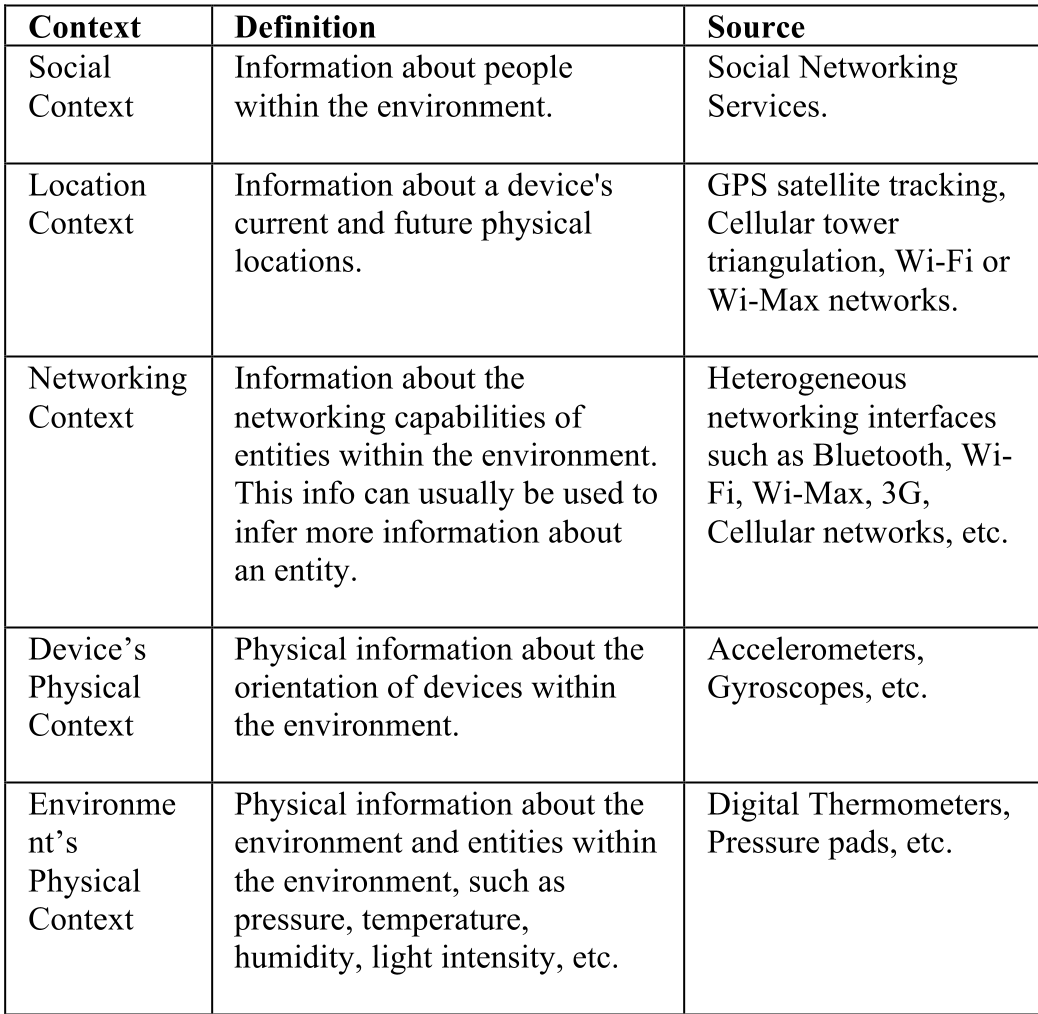
1. Heterogeneous Contextual Table
The authors define context across five dimensions, moving from the purely social to the purely physical:
2. The Presence and Policies Server (PPS)
Rather than merely tracking if a person is "at home," the PPS manages "presentities." This includes:
- Users: Their status (busy, away) and social attributes.
- Services: Environmental controls (lighting, music) that act as "users" with their own states.
- Policies: Rules that dictate how the space should react when a specific group of people (e.g., "Family" vs. "Friends") gathers.
3. Modeling Human Relationships (RDF/FOAF)
To make social data actionable, the system uses the Resource Description Framework (RDF). Humans are represented as nodes in a graph, connected by properties like foaf:knows or foaf:interest. This allows the smart space to perform logic-based reasoning: If User A and User B both share an interest in 'AI', and both are in the same 'Smart Zone', recommend a shared multimedia session.
 Figure: Using RDF to represent a member (Jane Smith) within the social network context.
Experiments and Logic Flow
The system follows a rigorous data flow:
- Entry: Mobile device connects via Wi-Fi/3G.
- Registration: User grants the Smart Space permission to access their Social Context (e.g., Facebook API).
- Classification: The system retrieves the user's social graph and categorizes others in the space as "Family," "Friends," or "Potential Friends" (based on shared interests).
- Action: The Smart Space adjusts services (media, lighting, notifications) according to the group's collective profile.
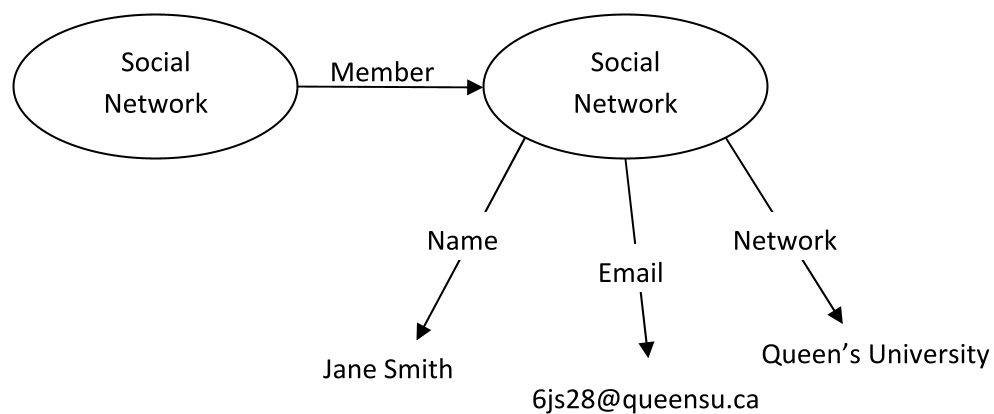 Figure: The expanded RDF model showing attributes like Name and Email linked as machine-readable nodes.
Critical Insight & Conclusion
The genius of this work lies in its Abstraction. By using FOAF and RDF, the authors haven't just built a "Facebook-integrated room"; they've built a protocol for human-centric environments.
Limitations: While the social benefits are clear, the paper sidesteps the significant Privacy concerns inherent in handing a physical environment access to one's entire social history. Furthermore, as social networks evolve (and some decline), the reliance on specific APIs (Twitter/Facebook) presents a "fragility" risk to the architecture.
Future Outlook: In an era of Generative AI, imagine this architecture paired with an LLM. The "Social Context" wouldn't just be a list of interest tags; it would be a rich behavioral history that allows the Smart Space to act as a proactive digital assistant, anticipating needs before they are even voiced.