
INSIGHT: Bridging the Gap Between Heterogeneous Sensors and Human Intelligence in Smart Cities
Heterogeneous Stream Processing and Crowdsourcing for Traffic Monitoring: Highlights
The paper presents an intelligent urban traffic management system developed under the INSIGHT project, utilizing the Streams framework and RTEC for Complex Event Processing (CEP). It integrates heterogeneous data from fixed SCATS sensors and mobile bus sensors in Dublin to detect congestions and models city-wide traffic using Gaussian Process regression.
TL;DR
Managing urban traffic in the age of Big Data requires more than just collecting numbers; it requires making sense of conflicting and sparse information. The INSIGHT project introduces a robust framework that combines Complex Event Processing (CEP), Online Crowdsourcing, and Gaussian Process Regression to turn noisy streams from buses and intersection sensors into a real-time, city-wide traffic map of Dublin.
Problem & Motivation: The Truth Behind Noisy Sensors
Urban planners today are drowning in data but starving for certainty. The authors identify two critical bottlenecks in current traffic monitoring:
- Data Veracity: What happens when a stationary SCATS (Small Computerized收 Adaptive Traffic Control System) sensor reports a jam, but a bus passing through reports zero delay? Sensors fail, and environmental factors introduce noise.
- Data Sparsity: Even the smartest cities have "blind spots"—intersections without sensors or roads without public transport.
The motivation behind this work is to create a "Unified Traffic Picture" that doesn't just report sensor values, but reasons about them logically and statistically.
Methodology: The Three Pillars of INSIGHT
1. Logic-Based Event Recognition (CEP)
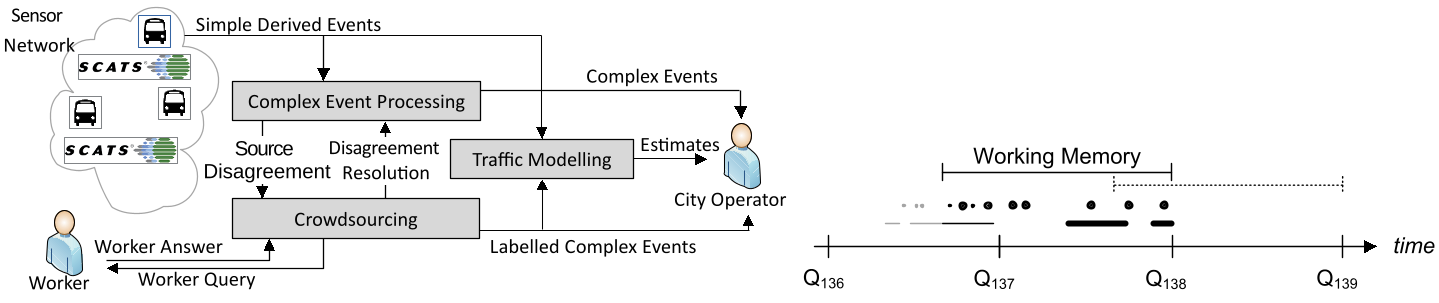
The system uses the Event Calculus for Run-Time reasoning (RTEC). Instead of simple thresholds, it uses logical predicates. For instance, a congestion event is only triggered if multiple sensors agree or if a specific increase in bus delay is detected within a temporal window.
2. Crowdsourcing as a Veracity Resolver
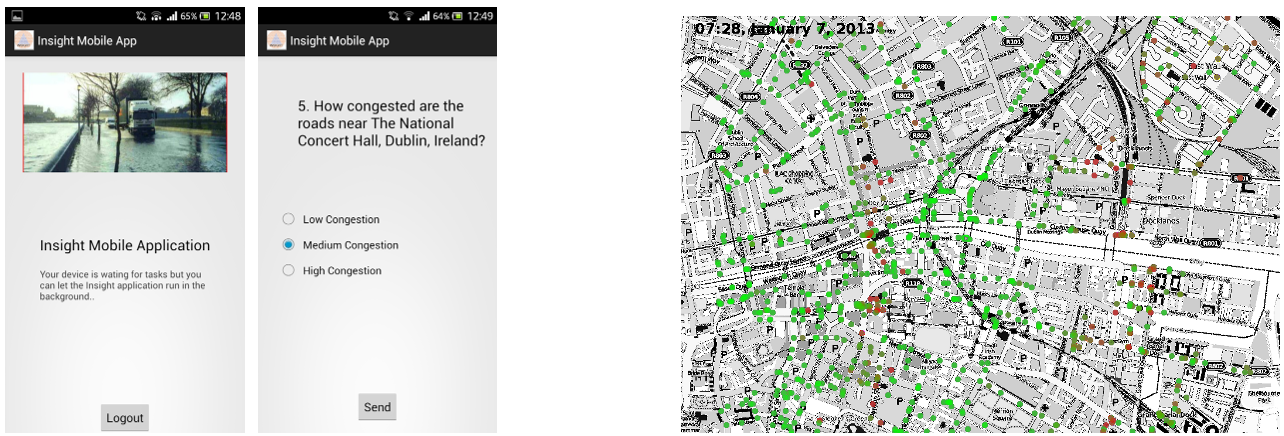
When sensors disagree, the system triggers a MapReduce-based crowdsourcing task. It pings "workers" (citizens via mobile apps) near the location. To handle unreliable participants, the authors implemented an Online EM (Expectation-Maximization) algorithm that estimates worker reliability in real-time.
3. Filling the Gaps with Gaussian Processes
To provide a complete picture of the city, the system uses Gaussian Process (GP) regression. By using a Regularized Laplacian kernel, the model treats the city as a graph where traffic flow at one junction (latent variable) is correlated with its neighbors. This allows the system to predict traffic in areas with zero sensor coverage.
Experiments & Results: The Dublin Use-Case
The system was tested using large-scale real-world data from Dublin:
- Data Scale: 13GB of data from 942 buses and 966 static sensors.
- Self-Adaptive Recognition: RTEC was able to detect and temporarily ignore "noisy" sensors that produced inconsistent data, improving the precision of congestion alerts.
- Visualization: The output provides operators with a heat-mapped graph of the city, where unobserved segments are filled in by the GP model.
Critical Analysis & Conclusion
Takeaway
The INSIGHT project demonstrates that the future of "Smart Cities" isn't just about more sensors—it's about better Sensor Fusion. By anchoring the system in formal logic (RTEC) and grounding it with human-in-the-loop validation (Crowdsourcing), the authors provide a blueprint for high-veracity monitoring.
Limitations & Future Work
While the GP regression provides excellent spatial interpolation, its computational cost can be high for massive graphs. Future iterations might benefit from Graph Neural Networks (GNNs) to handle the non-linear dynamics of traffic more efficiently. Additionally, relying on human workers requires a critical mass of active users, which might be difficult to maintain during off-peak hours.
The INSIGHT framework stands as a pioneer in combining symbolic AI (logic) with sub-symbolic AI (probabilistic modeling) to tackle the messy reality of urban infrastructure.