
HeterRank: Leveraging Information Heterogeneity for Better Social Tagging
HeterRank: Addressing Information Heterogeneity for Personalized Recommendation in Social Tagging Systems
This paper introduces HeterRank, a graph-based ranking algorithm designed for personalized tag recommendation in social tagging systems. By modeling the system as a multi-type graph, it integrates heterogeneous information—including tagging behaviors, social networks, and item content—outperforming the state-of-the-art FolkRank baseline.
TL;DR
In the era of social media, "tagging" is how we organize the web. However, recommending the right tag for a specific user and item is difficult due to massive data sparsity. HeterRank solves this by treating the entire social ecosystem—users, tags, items, and their hidden internal relationships (like friendships or word similarities)—as a single, interconnected multi-type graph. By performing a personalized random walk on this graph, it achieves significant accuracy gains over previous state-of-the-art methods.
Problem & Motivation: Beyond the Tripartite View
Standard social tagging systems are usually viewed as a simple tripartite relationship: <User, Tag, Item>. While this works for active users, it fails when data is sparse (the "Cold Start" problem).
The authors observed that we are ignoring a goldmine of auxiliary information:
- Social Networks: Users who are friends likely share tagging habits.
- Tag Semantics: Tags like "rock" and "metal" are related even if they aren't used together frequently.
- Item Profiles: Two webpages with similar text should probably share similar tags.
Existing methods like FolkRank primarily focus on tagging behaviors. HeterRank's motivation is to bridge these heterogeneous "islands" of data into a unified ranking framework.
Methodology: The HeterRank Algorithm
HeterRank leverages a Random Walk with Restart (RWR). Imagine a "surfer" starting at a specific user and a specific item. The surfer moves across the graph according to probabilities defined in a Transition Matrix.
1. The Global Transition Matrix
The magic happens in how the authors structure the matrix S. It isn't just a flat adjacency matrix; it's a block matrix where each block represents a specific type of relationship (e.g., User-to-User, User-to-Tag).
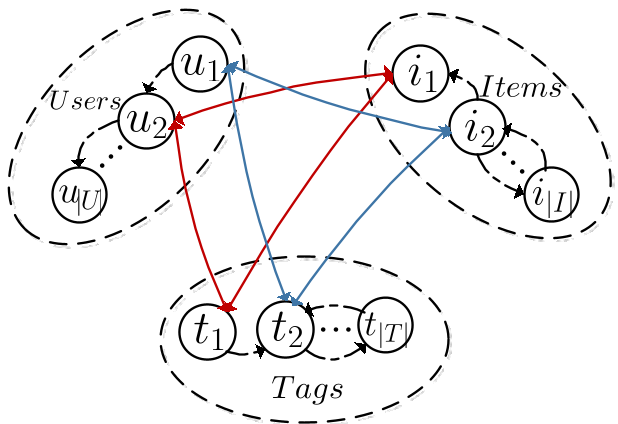
The transition is defined by the following iterative reinforcement equation:
Where:
- : The transition matrix, normalized to account for different metrics in user vs. tag networks.
- : The preference vector, which forces the "surfer" to restart at the target user and item , ensuring the recommendation is personalized.
- : The restart probability, balancing global graph structure with local personalized preference.
Experimental Results & Evidence
The authors tested HeterRank across three diverse datasets: CiteULike (academic), Last.fm (music), and Delicious (bookmarks).
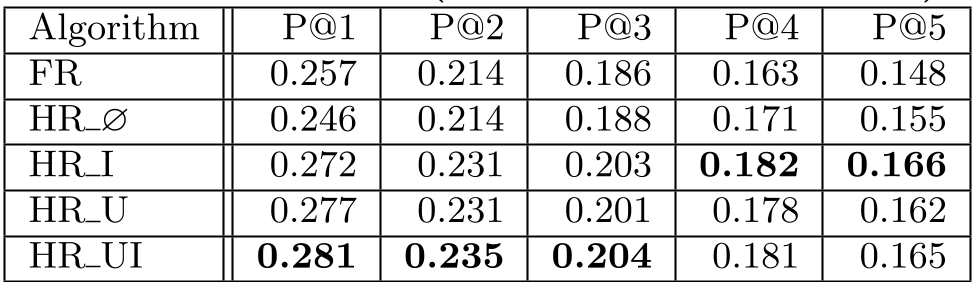
- The Power of Auxiliary Data: On the CiteULike dataset, adding tag semantic relations (HR_T) improved P@1 from 0.159 to 0.180.
- Synergy: On the Delicious dataset, combining user relations (social) and item relations (content) in HR_UI provided the best overall performance, proving that more data types lead to better context for the recommendation engine.
Depth Insight: Why it Works
The "Mutual Reinforcement" principle is key here. In HeterRank, a tag gets a high score not just because the user has used it before, but because:
- It is connected to items similar to the target item.
- It is used by users in the target user's social circle.
- It is semantically related to other tags associated with the item.
By allowing probability "fluid" to flow through these various channels, the algorithm "fills in the gaps" left by missing tagging entries in the database.
Critical Analysis & Conclusion
Takeaway
HeterRank demonstrates that recommendation isn't just about the direct interaction between User-Item-Tag; it's about the context of those entities. Integrating intra-type relationships is a robust way to combat data sparsity.
Limitations
A major challenge ignored here is computational complexity. Performing RWR on a graph with 70,000+ tags (as in the Delicious dataset) during every recommendation request could lead to high latency. In a modern production environment, one might use an offline pre-computation or an approximate Graph Neural Network (GNN) approach to achieve similar goals more efficiently.
This review was synthesized by the Senior Academic Tech Editor based on the WWW 2012 conference publication.