
HEU Emotion: Redefining Affective Computing with Large-Scale Multi-modal Evidence
HEU Emotion: a large-scale database for multimodal emotion recognition in the wild
The paper introduces HEU Emotion, the largest multi-modal emotion recognition database in the wild, featuring 19,004 video clips and 9,951 subjects. It covers ten emotion categories across three modalities (facial expression, body posture, and emotional speech) and includes a novel Multi-modal Attention (MMA) fusion module to adaptively weight features.
TL;DR
The research team behind HEU Emotion has released a massive dataset of 19,004 video clips to tackle the "In-the-Wild" emotion recognition challenge. By integrating facial expressions, body postures, and speech from nearly 10,000 subjects across multiple cultures, they have created a benchmark that far exceeds the scale of previous datasets like AFEW or CHEAVD. Their proposed Multi-modal Attention (MMA) module provides a dynamic way to fuse these signals, resulting in a significant performance boost over single-modality baselines.
Problem & Motivation: The "Lab-to-Wild" Gap
Most early progress in affective computing happened in sanitized laboratory environments (e.g., CK+). However, models trained in these settings crumble when faced with:
- Uncontrollable Lighting: Harsh shadows or dim environments.
- Occlusions: Hands covering faces or characters turning away.
- Cultural nuances: How a Thai person expresses "disappointment" vs. an American.
Existing "In-the-Wild" datasets were too small or language-specific. The authors recognized that human emotion isn't just about the face—it's a symphony of body language and vocal tone. When one channel is "noisy" (e.g., face occluded), the others must step up.
Methodology: The Power of Multi-modal Attention
To process this diverse data, the authors didn't just concatenate features; they designed an adaptive weighting system.
1. Data Collection & Filtering
The dataset is split into two parts:
- Part 1 (Internet source): 16,569 clips from Tumblr/Giphy focusing on face and posture.
- Part 2 (Media source): 2,435 clips from movies and TV shows, adding the speech modality.
2. Multi-modal Attention (MMA)
The MMA module is the technical heart of this work. It treats concatenated feature vectors from different modalities (Face, Body, Audio) similarly to channels in a convolutional neural network.
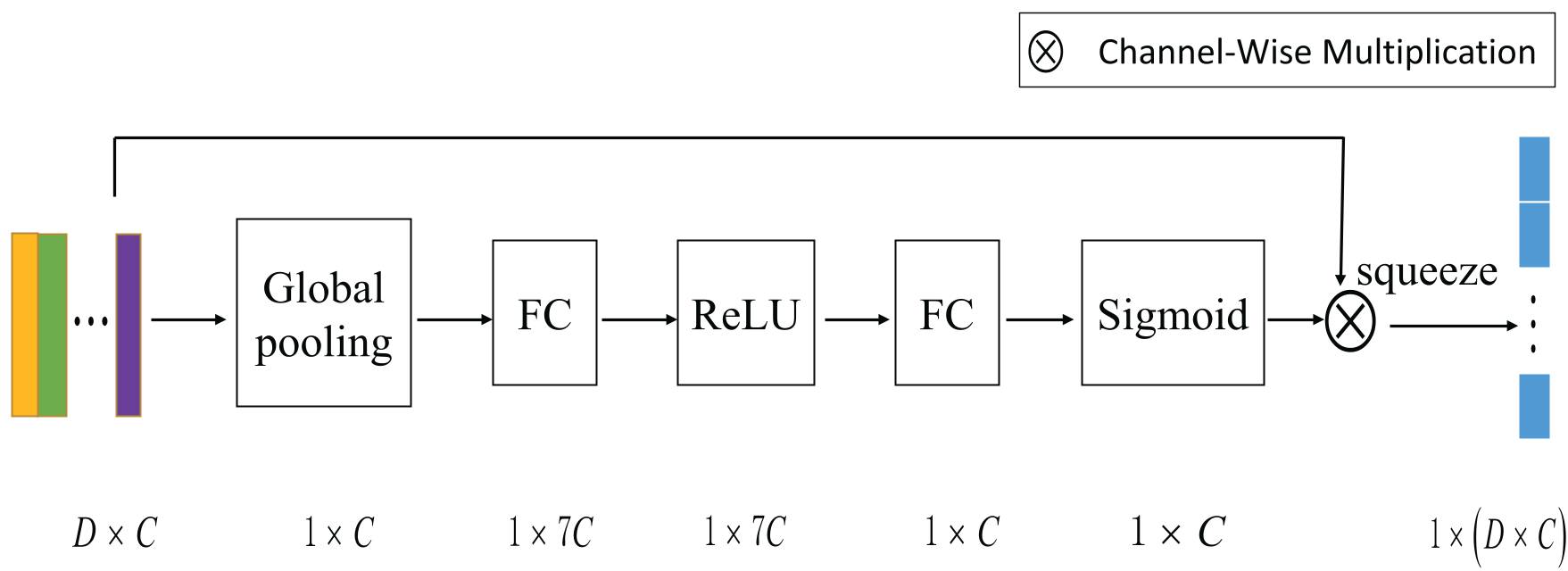
The Logic:
- Global Receptive Field: It uses Global Average Pooling to summarize each modality.
- Inter-channel Correlation: Two fully connected layers model the dependencies between modes.
- Adaptive Scaling: A Sigmoid function generates weights (0 to 1), effectively "turning up the volume" on reliable modalities and suppressing noisy ones.
Experiments & Results: Beyond Facial Recognition
The authors benchmarked several CNN architectures (VGG, ResNet, DenseNet) combined with GRUs for temporal modeling.
Key Findings:
- The Failure of Traditional Features: Hand-crafted features (LBP, HOG) achieved over 80% on lab-based CK+ but dropped significantly on HEU Emotion, proving the difficulty of the new dataset.
- Fusion Superiority: The MMA module outperformed Late Fusion and other bilinear fusion methods (Block).
- Cross-dataset Validation: Models pre-trained on HEU-part1 achieved higher accuracy on the AFEW dataset than models trained on AFEW itself, demonstrating the superior representation learning enabled by the scale of HEU Emotion.

Critical Analysis & Conclusion
Takeaway
HEU Emotion is a significant contribution because it democratizes large-scale emotion data across cultures and languages. The Multi-modal Attention module effectively addresses a long-standing issue: how to weight different sensory inputs when some are more reliable than others in specific frames.
Limitations
Despite its scale, the dataset still shows some imbalance in categories—"Happy" and "Neutral" are much more prevalent than "Disgust" or "Fear." Additionally, while it includes "mixed emotions" in the annotation process, they were not the focus of the final baseline experiments.
Future Outlook
This work paves the way for emotion AI that can function in chaotic environments—from robot assistants in public spaces to more empathetic character AI in entertainment. The inclusion of body posture is particularly valuable for far-field scenarios where facial resolution is too low for traditional analysis.