
Hierarchical Attention Networks: A Multi-Modal Shield Against Socialbots
A Hierarchical Attention-Based Neural Network Model for Socialbot Detection in OSN
This paper introduces a Hierarchical Attention-Based Neural Network (HAN) for socialbot detection in online social networks. The model integrates profile, activity, temporal, and content data using a hybrid BiLSTM and CNN architecture, achieving near-perfect detection rates (up to 100% accuracy on specific datasets) by modeling user behavior at two levels of granularity.
TL;DR
Socialbots are becoming increasingly sophisticated, evolving beyond simple spam scripts to complex actors involved in political astroturfing and disinformation. This paper presents a Hierarchical Attention-Based Deep Neural Network that detects these bots by analyzing profile, temporal, activity, and content data. By utilizing a hybrid BiLSTM-CNN architecture with dual-layer attention, the model achieves near-perfect accuracy, effectively identifying bots that try to blend in with human users.
Problem & Motivation: The Failure of Hand-Crafted Features
The "arms race" between bot-herders and researchers has exposed a critical flaw in traditional detection: feature engineering. Manual feature crafting is not only tedious but also creates a static target that bots can easily bypass by mimicking specific human attributes (e.g., filling out a bio or following a "normal" number of users).
While deep learning has been used to automate feature extraction, previous models were often "one-dimensional"—focusing either on what users post (content) or when they post (temporal). The authors argue that a robust defense must look at the entire behavioral spectrum simultaneously and, more importantly, know which signals to trust.
Methodology: The Hierarchical Approach
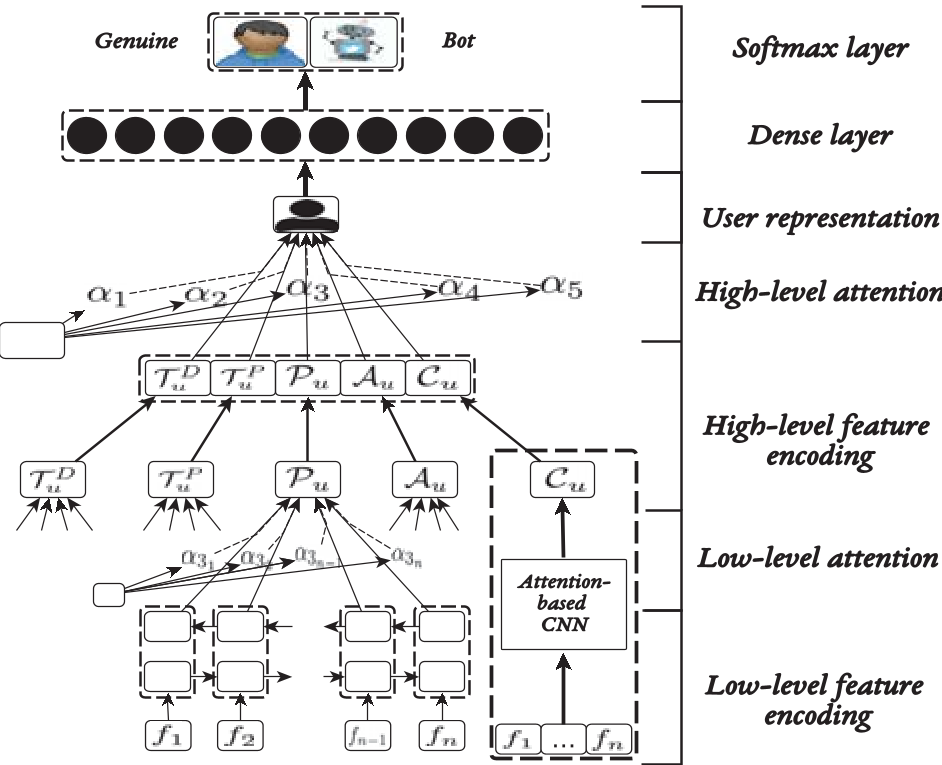
The core innovation lies in the Hierarchical Attention Mechanism, which operates at two layers of granularity.
1. Multi-Modal Feature Encoding
The model processes five distinct categories of user data:
- Profile Representation: Directly extracted raw metadata (10 features).
- Temporal Behavior: Modeled as Diurnal (daily activity cycles) and Periodic (inter-tweet time intervals) sequences.
- Activity Behavior: A sequence of action types (Tweet, Retweet, Reply, Quote).
- Content Behavior: A 3D matrix representation of the last 100 tweets.
2. The Hybrid Architecture
- BiLSTM: Used for sequential data (profile, temporal, activity) to capture context from both past and future actions.
- CNN: A 6-layer CNN processes the 3D content matrix to learn intra-tweet (internal words) and inter-tweet (evolution of topics) patterns.
3. Dual-Level Attention
- Low-Level Attention: Not every tweet or every time-interval is equally suspicious. This layer assigns weights to specific elements within a single behavior category.
- High-Level Attention: This is the "manager" layer. It looks at the outputs of all behavioral modules and decides which one is currently the most predictive of "bot-ness" for a specific user.
Experiments & Results: Setting New Benchmarks
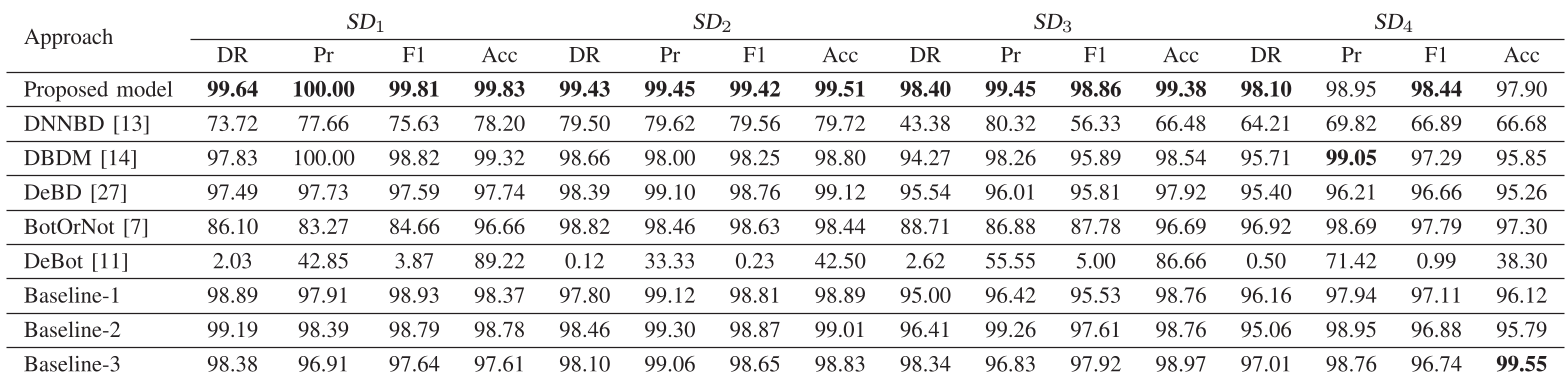
The model was evaluated against several benchmarks, including the famous BotOrNot (now Botometer) and newer deep learning models like DBDM.
Key Performance Wins:
- Accuracy: Achieved 99.83% on SD1 (Social Spambots #1).
- Imbalanced Data Mastery: In real-world scenarios where bots are the minority, the model maintained an F1-score of 98.44% on mixed datasets (SD4).
- Consistency: Unlike earlier models (like DNNBD) which showed high variance in results, the proposed HAN model is stable across multiple runs.
Ablation Insight: Why Attention Matters
The authors conducted an ablation study comparing the main model to versions without attention (Baseline-3). The version with hierarchical attention consistently outperformed the others, proving that selective focus is better than just "dumping" all data into a classifier.
Deep Insight & Conclusion
The success of this model confirms a major shift in social network analysis: Context is King. A bot might successfully fake its profile and even its posting frequency (temporal), but faking a coherent combination of profile, timing, activity types, and content over a 100-tweet sequence is computationally and logically difficult for bot-herders.
Limitations: The model requires at least 100 tweets to be highly effective, which may cause a delay in detecting "fresh" bot accounts that have just started a campaign.
Future Outlook: Integrating graph-based features (who the bot follows) into this hierarchical attention framework could potentially identify coordinated botnets even before they post a single message.