
HASC: Deciphering the Subjectivity of Image Preferences through Hierarchical Social Contexts
A Hierarchical Attention Model for Social Contextual Image Recommendation
The paper proposes HASC (Hierarchical Attentive Social Contextual model), a specialized recommendation framework for social image platforms. It utilizes a two-layer hierarchical attention network to fuse visual content, image style, and heterogeneous social contexts (upload history, social influence, and owner admiration) for personalized image ranking.
TL;DR
In the world of social image sharing (like Instagram or Pinterest), users are both creators and consumers. HASC (Hierarchical Attentive Social Contextual model) is a breakthrough framework that addresses the "data sparsity" and "content subjectivity" problems. By applying a two-layer attention mechanism over a user's upload history, social circle, and image aesthetics (content + style), it achieves a 20% performance boost over traditional ranking models.
Problem & Motivation: The Creator-Consumer Paradox
Standard Collaborative Filtering (CF) focuses on a simple user-item matrix. However, image-centric social platforms present unique challenges:
- Dual Identity: Users don't just "like" images; they "create" (upload) them. This upload history is a mirror of their latent aesthetic preference.
- Aesthetic Subjectivity: A user might like an image not because of its object (e.g., a "dog") but because of its photographic style (e.g., "vintage" or "high-contrast").
- Complex Social Gravity: We are influenced by our friends (Social Influence) but also develop brand-like loyalty to specific creators (Owner Admiration).
Previous SOTA models like VBPR or ACF only look at portions of this puzzle. HASC's intuition is that these factors are not equally important for everyone—and their importance varies per user.
Methodology: The Hierarchical Blueprint
The core of HASC is its three-pronged contextual approach, unified by a Hierarchical Attention Network.
1. Three Pillars of Context
- Upload History: Summarizes a user's own creations to define their "base" interest.
- Social Influence: Captures the strength of influence from different social neighbors.
- Owner Admiration: Accounts for the "fan effect" where users follow specific high-quality creators.
2. Multi-Modal Embeddings
HASC doesn't just use simple IDs. It incorporates:
- Visual Content: Extracted via VGG19.
- Visual Style: Encoded using Gram Matrices (capturing textures/patterns regardless of spatial content).
- Social Graph: Encoded via DeepWalk to capture global structural positions.
3. Hierarchical Attention Mechanism
The hierarchy mirrors the human decision process:
- Element-Level (Bottom Layer): Which specific image in my history is relevant? Which friend's influence matters right now?
- Aspect-Level (Top Layer): Should the recommendation favor my friends' tastes, my own history, or a famous creator I follow?
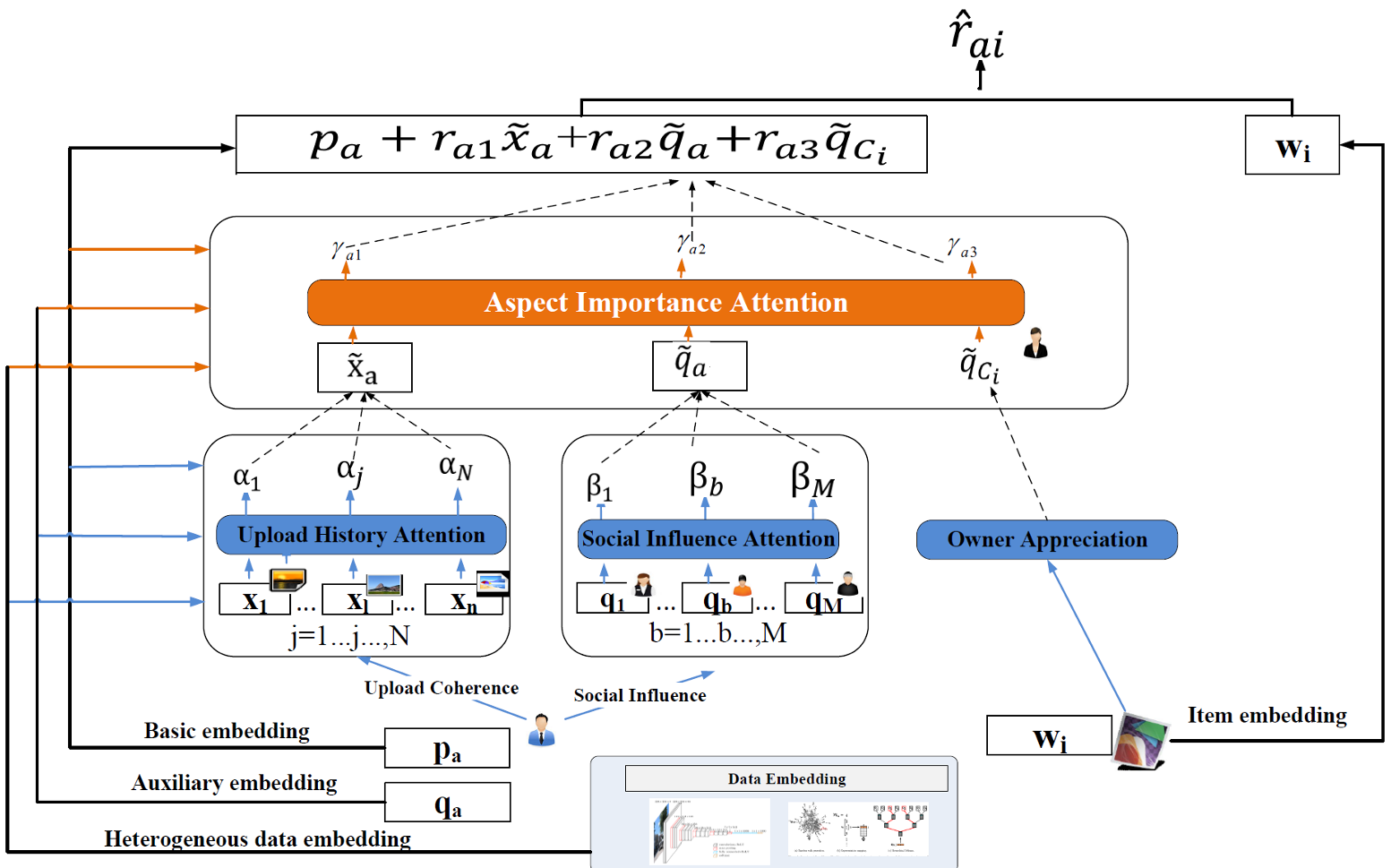 Figure 1: The architecture showing how heterogeneous embeddings flow into element-level and then aspect-level attention.
Experiments & Results: Crushing Sparsity
The authors tested HASC on two Flickr datasets (F_S and F_L).
Key Findings:
- Performance Superiority: HASC consistently outperformed BPR, VBPR, and ACF. On the NDCG@5 metric, it showed a >10% lead over the best existing hybrid models.
- The Sparsity Savior: For "cold" users with <4 ratings, the model’s ability to "borrow" information from their social circle and upload style resulted in a massive 35% improvement.
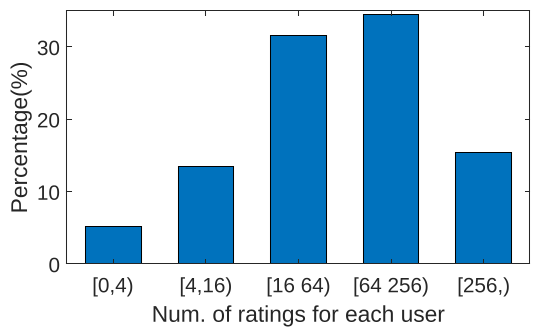 Figure 2: HASC maintains its lead particularly when user data is extremely sparse.
Ablation Study: Does style matter?
Yes. Table 5 in the paper reveals that combining Visual Content and Visual Style yields significantly better results than using content alone. This confirms that aesthetic "vibe" is as critical as "objects" in the image.
Deep Insight: Why it Works
The "magic" of HASC lies in its interpretability. By visualizing the attention weights (Figure 6 in the paper), the authors show that most users are heavily influenced by their own Upload History. This suggests that our creative output is the strongest indicator of what we want to consume—a factor previously underutilized in recommendation systems.
Conclusion & Future Outlook
HASC provides a rigorous framework for handling high-dimensional, multi-modal data in social contexts. While it excels at image recommendation, the logic could easily extend to:
- Music Recommendation: Using audio "texture/timbre" as a style embedding.
- E-commerce: Balancing a user's purchase history with "influencer" admiration.
Limitations: The model is computationally intensive due to the nested attention layers and high-dimensional Gram matrices. Future work may focus on distilling these style features into more compact representations.
Takeaway: In modern social AI, it is not enough to know what a user likes. You must understand why they like it—whether it's the influence of a friend, the style of the image, or their own history as a creator.