
Evolution in Speech: Automatically Generating Hierarchical Classifiers for Emotion Recognition
Hierarchical emotion classification using genetic algorithms
This paper introduces a novel hierarchical approach for speech emotion classification using a combination of Genetic Algorithms (GA) and Support Vector Machines (SVM). By automatically evolving a binary classification tree, the system decomposes multi-class emotion recognition into simpler, optimized binary tasks, achieving high accuracy on the Berlin Emotional Speech Database (EMO-DB).
TL;DR
Recognizing human emotion from speech is notoriously difficult due to the "clutter" of acoustic features. This paper presents an automated framework that uses Genetic Algorithms (GA) to evolve a custom Binary Classification Tree. Instead of a "one-size-fits-all" model, it builds a specialized hierarchy where each node uses a tailored subset of features to distinguish between specific groups of emotions, significantly improving accuracy and adaptability.
The "Curse of Ambiguity" in Emotion AI
Most speech emotion recognition (SER) systems attempt to classify 6-7 emotions simultaneously using a single classifier. This is mathematically taxing because the features that distinguish Sadness from Anger (intensity/energy) are vastly different from those that distinguish Anger from Happiness (often subtler spectral cues).
The authors argue that the biggest bottleneck in SER is not just the classifier used, but the structure of the classification task. While previous researchers tried to build "trees" (e.g., separating high-energy emotions from low-energy ones first), these trees were hand-crafted. If the dataset changed, the tree broke.
Methodology: Evolving the Decision Process
The core innovation lies in the use of GA to solve two missions at every branch of a decision tree:
- Class Split: Given a set of emotions, which ones "naturally" group together to make the next binary decision the easiest?
- Feature Selection: Which of the 384 extracted acoustic features (MFCCs, Pitch, Energy, etc.) are actually relevant for this specific split?
The Genetic Chromosome
Each "individual" in the GA population is represented by a bit string. One part of the string dictates the emotion grouping, while the other acts as a mask for feature selection.
Fitness and Queue Management
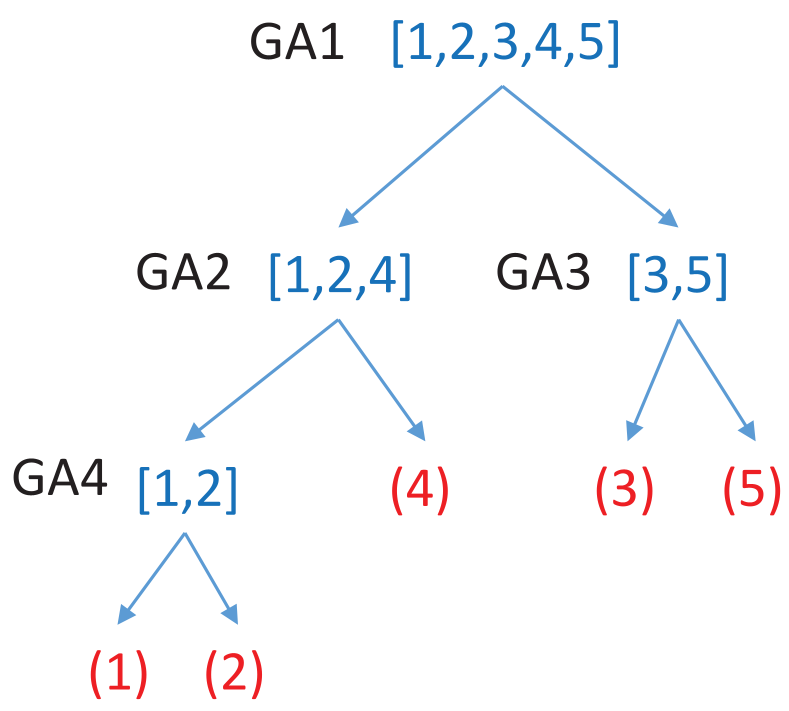
The system utilizes SVM (Support Vector Machine) to test every proposed split. The GA evaluates how well an SVM can separate the two groups; the better the accuracy (measured via k-fold cross-validation), the higher the "fitness" of that specific tree node. To build the full tree, the authors implement a GA Queue—effectively a breadth-first search that recursively spawns new GA processes for every non-leaf node.
Experiments: Validation on EMO-DB
The model was tested on the Berlin Emotional Speech Database (EMO-DB). The results validated the "Evolutionary Intuition."
Key Findings:
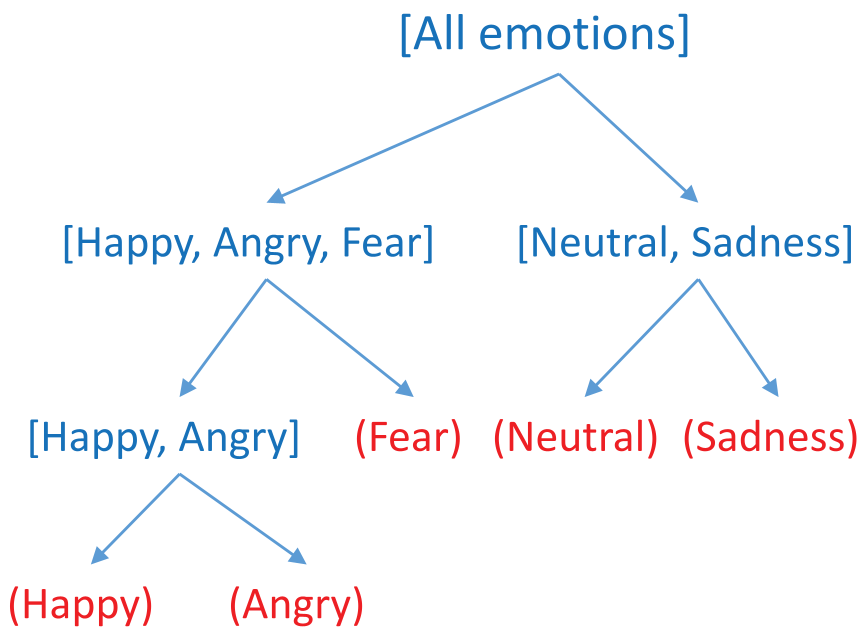
- Natural Clustering: The GA automatically discovered that Sadness should be separated first due to its distinctively low valence and activation.
- The "Confused" Pair: Happiness and Anger—often the hardest to distinguish in SER—were placed at the bottom of the tree, allowing the system to use specialized "potency" features to tell them apart after other emotions had been filtered out.
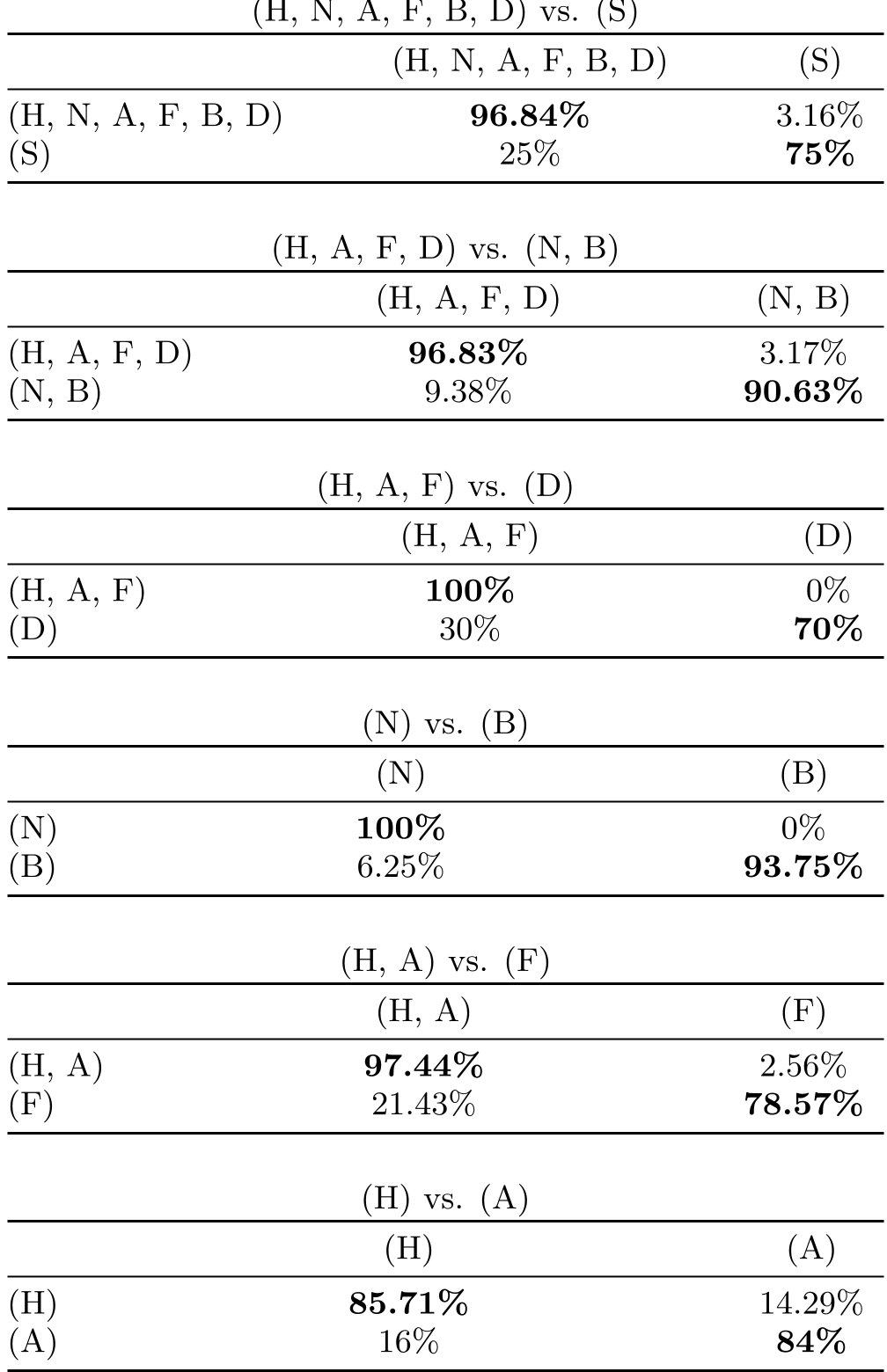
As shown in the table above, the accuracy for identifying the Sadness group reached 96.84%, while the more difficult Happiness vs. Anger split maintained a respectable ~85% accuracy.
Critical Analysis & Conclusion
Takeaway
The value of this work is its robustness. By letting the data "speak for itself" through Genetic Algorithms, the model bypasses the limitations of human psychological assumptions. It effectively matches the Inductive Bias of the tree structure to the statistical reality of the audio features.
Limitations
- Data Imbalance: The results show that smaller emotion classes (like Disgust) still suffer from misclassification when paired against larger groups.
- Computational Cost: GA is an iterative and computationally expensive process. While inference is fast (once the tree is built), the training phase is significantly longer than standard multi-class SVMs.
Future Outlook
This approach paves the way for "Individualized Emotion AI"—systems that could evolve a unique classification tree for a specific user's voice patterns, leading to much higher accuracy in personalized assistants or therapeutic tools.