
Hierarchical k-Anonymity: Rescuing Structural Motifs in Social Privacy
A Hierarchical k-Anonymous Technique of Graphlet Structural Perception in Social Network Publishing
The paper introduces a Hierarchical k-Anonymity technique specifically designed to protect social network privacy while preserving graphlet structures (specifically triangles). By partitioning nodes based on their degree distribution and applying adaptive edge modification strategies, the method achieves k-degree anonymity with significantly higher data utility than previous uniform approaches.
TL;DR
Privacy-preserving data publishing often feels like a zero-sum game: the more you hide personal identities, the more you mangle the useful structure of the data. This paper shifts the paradigm by introducing Hierarchical k-Anonymity with Graphlet Structural Perception. By recognizing that not all nodes are equal (Power-law distribution) and prioritizing the preservation of "triangles" (the basic unit of social trust), the authors provide a way to satisfy -anonymity while keeping the network's clustering and utility intact.
Problem & Motivation: The "Heavy Hand" of Uniform Anonymity
Most traditional -degree anonymity methods treat every node the same. However, real-world social networks follow a Power-law distribution: a few "celebrity" nodes have massive degrees, while the vast majority have very few connections.
If you apply the same value and edge-modification strategy to everyone, you typically:
- Over-protect high-degree nodes, introducing massive noise.
- Destroy Graphlets (Motifs): Small structural units like triangles represent real-world phenomena (e.g., "friends of friends become friends"). Standard anonymity breaks these units, making the resulting data useless for social circle analysis or path reachability studies.
The authors' insight is simple but powerful: Anonymity should be aware of the "who" (node hierarchy) and the "how" (structural motifs).
Methodology: Perception and Hierarchy
The core of the proposed method involves three sophisticated steps:
1. The Hierarchical Split
Instead of a single , the network is split into High-degree () and Low-degree () nodes. The threshold is calculated via the index of matrix multiplication, ensuring a mathematically sound division. Each group gets its own privacy level ( and ).
2. Graphlet-Aware Weighting
The algorithm weights every edge based on how many triangles it participates in. This "Graphlet Perception" ensures that when an edge needs to be deleted to satisfy anonymity, the algorithm targets edges that are least critical to the network's higher-order structure.
3. Smart Edge Modification
- Addition: When adding edges to meet -degree requirements, the algorithm prioritizes nodes with a diameter . This avoids creating unnecessary new triangles that might skew the clustering coefficient too much.
- Deletion: When removing edges, it selects those with the lowest weights (participating in fewer triangles) to minimize structural damage.

Experiments: Proving Utility
The researchers tested their approach on two benchmark datasets: WebKB (citation network) and Cora. They measured success through:
- Average Clustering Coefficient (ACC): Does the network still "clump" like a real social graph?
- One-dimensional Structural Entropy (SIE): How much uncertainty/disorder was added to the graph structure?
Key Results
The comparison against the state-of-the-art "High Utility k-degree anonymity" showed a clear lead. As increased, the Hierarchical method's ACC remained significantly closer to the original graph's ACC.
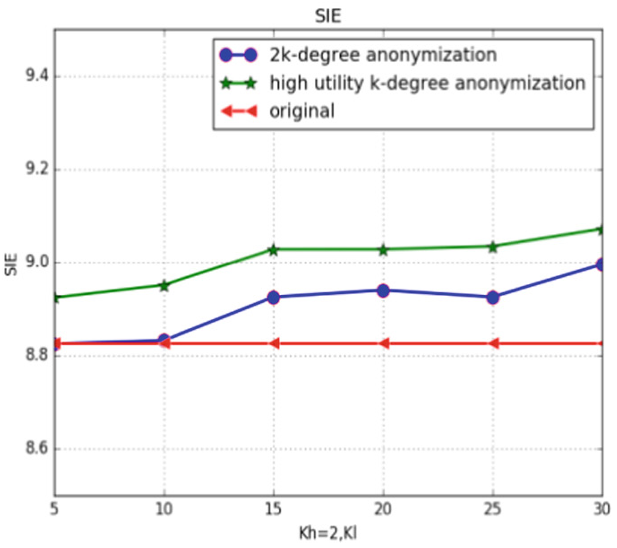 In both WebKB and Cora, the Proposed Hierarchical method (circles) outperforms existing models (stars) by maintaining a higher clustering coefficient closer to the original (triangles).
Critical Insight & Conclusion
Takeaway
The genius of this work lies in its structural sensitivity. By viewing the graph not as a collection of isolated degrees, but as a fabric of triangles and hierarchies, the authors successfully balanced the "Privacy-Utility" trade-off.
Limitations & Future Work
- Complexity: Currently, the method primarily focuses on triangles. While triangles are the most common graphlet in social graphs, other networks (like food webs) might rely on different motifs like quadrilaterals or chains.
- Dynamic Graphs: The study focuses on static snapshots. In real-time social platforms, maintaining hierarchical k-anonymity as edges appear and disappear remains an open challenge.
This paper provides a robust template for the next generation of privacy-preserving graph algorithms: Don't just hide the data; understand its architecture before you change it.