
HQC: Bridging the Gap Between Categorical Labels and High-Dimensional Context
Hierarchical Qualitative Clustering: clustering mixed datasets with critical qualitative information
The paper introduces Hierarchical Qualitative Clustering (HQC), a novel method for clustering nominal qualitative variables by leveraging the context of high-dimensional continuous features using Maximum Mean Discrepancy (MMD). Tested on Spotify and financial datasets, it effectively segments categorical entities while maintaining full interpretability of the results.
TL;DR
Hierarchical Qualitative Clustering (HQC) is a new approach designed to cluster categorical values (like "Artist Name" or "Industry") by analyzing the statistical distributions of their associated numeric data. By using Maximum Mean Discrepancy (MMD) as a distance metric, it bypasses the need for messy one-hot encoding or lossy discretization, providing an interpretable and computationally efficient way to organize mixed-type datasets.
Background: The Mixed-Data Dilemma
In real-world data science, we rarely deal with purely numeric tables. We often encounter "mixed data" where critical information is locked in nominal variables—categorical labels that have no inherent order.
The industry standard is usually to:
- One-hot encode: This explodes the feature space, leading to the "Curse of Dimensionality."
- Drop categories: This throws away precious domain knowledge.
- Discretize: Converting continuous numbers into "bins" often hides subtle patterns.
The authors of HQC argue that the context of a category—the distribution of numeric values associated with it—is the most reliable way to measure similarity between labels without losing interpretability.
Methodology: The Power of MMD
The core innovation of HQC lies in how it defines "distance." Instead of looking at the category itself, it looks at the conditional distribution of all quantitative variables linked to that category.
The MMD Metric
To compare these high-dimensional distributions, the authors employ Maximum Mean Discrepancy (MMD). Unlike the Kolmogorov-Smirnov test which is primarily univariate, MMD excels in N-dimensional spaces. It maps features into a Reproducing Kernel Hilbert Space (RKHS) to compare "feature means" that capture not just the average, but variance, skewness, and higher-order moments.
The HQC Algorithm
The process follows a modified Agglomerative Hierarchical approach:
- Step 1: Group all instances by their qualitative value (e.g., all songs by "Queen" form one initial cluster).
- Step 2: Calculate the MMD distance between every pair of clusters using their quantitative features (e.g., loudness, energy, tempo).
- Step 3: Iteratively merge the closest clusters and recalculate the MMD between the new merged distribution and the remaining ones.
 The distance formula between two qualitative values and .
Experiments & Insights
The authors demonstrated HQC’s utility across two distinct domains: Music and Finance.
1. Music Recommendation (Spotify Dataset)
Clustering 30 artists based on 14 song features (acousticness, energy, etc.), the model generated a dendrogram that reflects deep stylistic similarities. For example, The Rolling Stones and The Who were joined early, indicating high distributional overlap in their musical "DNA."
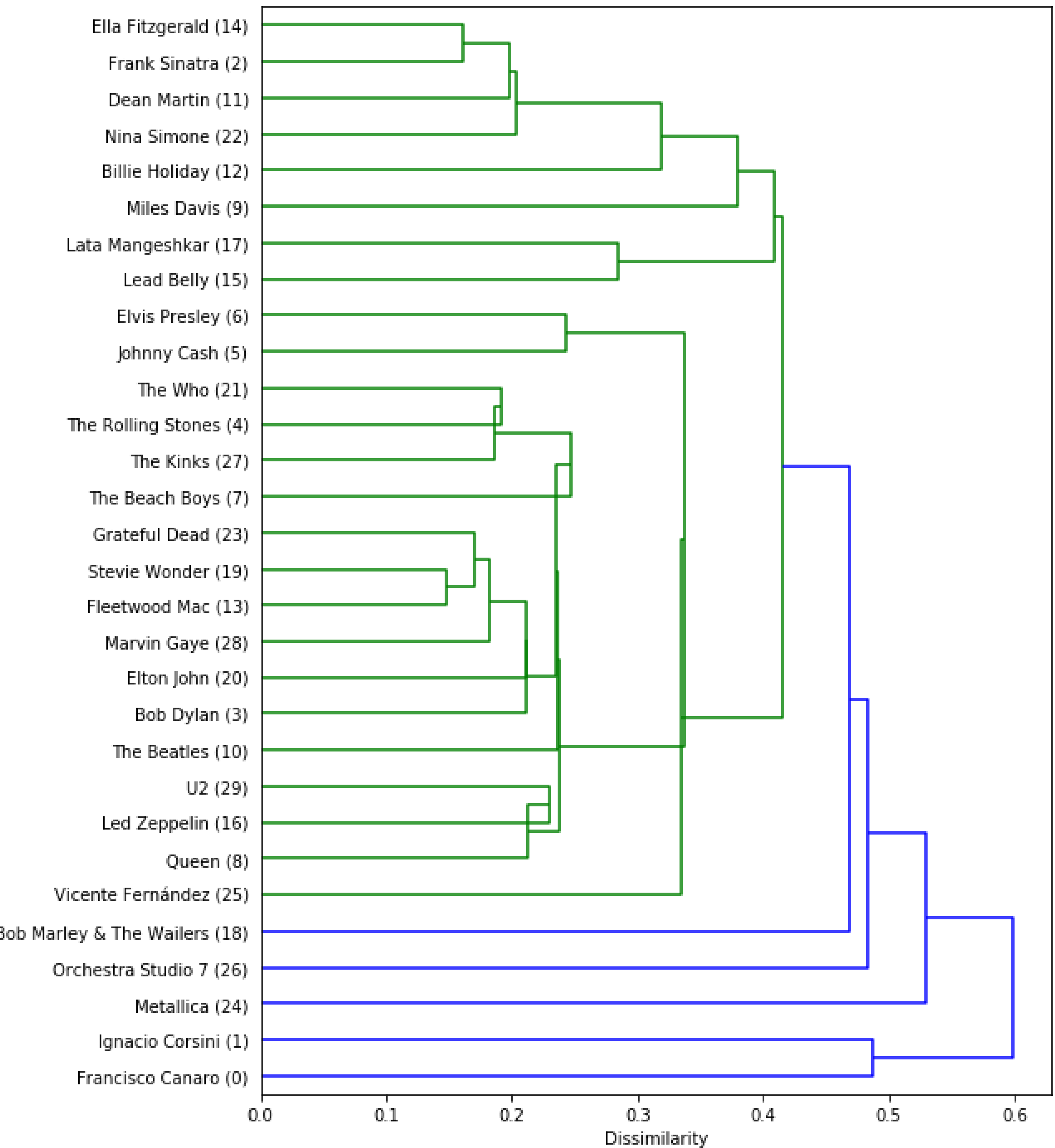 Dendrogram showing the hierarchical merging of artists based on their musical characteristics.
2. Financial Diversification
In the finance use case, HQC clustered industries based on financial statements. A fascinating finding was that certain industries from completely different "Sectors" (like Health Care and IT) showed zero MMD distance. This suggests that investors who think they are diversifying by picking different sectors might actually be buying highly correlated assets.
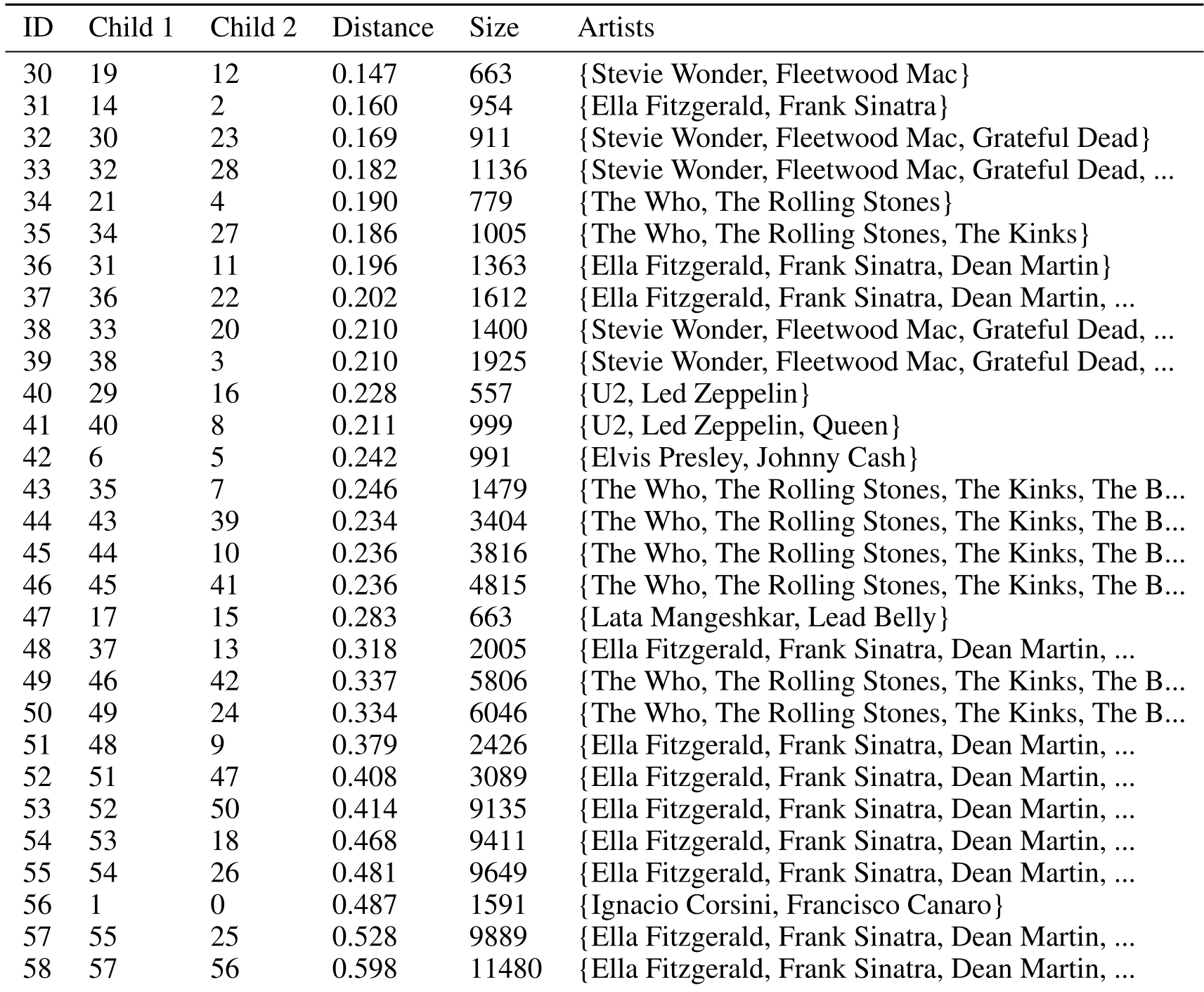 Linkage matrix for the music dataset showing how clusters evolve and the distances at which mergers occur.
Critical Analysis & Conclusion
Why it works
HQC is brilliant because it treats categories as anchors for distributions. It respects the Inductive Bias that data points with the same label should share a statistical signature. By using MMD, it handles the "High Dimensionality" problem much more gracefully than traditional Euclidean distances.
Limitations
- Sample Size: MMD estimation requires sufficient data points per category to avoid overfitting or negative squared distances.
- Computation: While faster than traditional tests, MMD's kernel matrix calculation can become expensive if the number of unique categories is massive.
Future Outlook
HQC opens doors to new "Target Encoding" methods. Imagine using these MMD-based cluster IDs as features for supervised learning, or using the dissimilarity matrix to create low-dimensional embeddings for categorical variables that are grounded in physical, quantitative reality.
Takeaway: If your dataset is a messy mix of labels and numbers, stop one-hot encoding everything. Look at the distributions through the lens of HQC.