
Hierarchical Trust Level Evaluation: Solving the Scalability Paradox in Pervasive Social Networking
Hierarchical Trust Level Evaluation for Pervasive Social Networking
The paper introduces a Hierarchical Trust Level (HTL) evaluation system for Pervasive Social Networking (PSN), integrating the (7, 3, 1)-Symmetric Balanced Incomplete Block Design (SBIBD) with a recursive tree structure. It achieves a dual-purpose framework for accurate node trust assessment and secure key agreement for authenticated communication.
TL;DR
Pervasive Social Networking (PSN) is moving from a niche convenience to a fundamental infrastructure. However, as networks grow, the cost of verifying a stranger's "trustworthiness" explodes. This paper proposes a Hierarchical Trust Level (HTL) system that leverages a specific mathematical structure called a (7, 3, 1)-design and a tree-based hierarchy to reduce communication overhead by over 99% in large-scale networks, while simultaneously providing a secure key agreement for encrypted chats.
The Problem: The High Cost of Trust
In the digital wild, the "best survival strategy when strangers meet seems to be to cheat." To prevent this, PSN needs trust evaluation. Current models typically use:
- General Trust (GT): A central server tracks everyone. Flaw: Server overload and single points of failure.
- Local Trust (LT): Peers rate each other. Flaw: In a network of nodes, the message complexity is . If you have 1,000 users, that's nearly a million evaluation exchanges—an impossible burden for mobile devices.
Methodology: The (7, 3, 1)-Design and Tree Hierarchy
The core innovation lies in applying Block Design theory to social structures.
1. The (7, 3, 1)-Symmetry
The authors use a Symmetric Balanced Incomplete Block Design (SBIBD). In a group of 7 nodes, each node only interacts with a subset of peers. Through a two-step process, every node can reconstruct the full trust matrix of the group without talking to everyone directly. This reduces the group communication cost from 42 units down to 28.
 Figure: The (7, 3, 1)-design structure mapping nodes to blocks.
2. Recursive Tree Scaling
To scale beyond 7 nodes, the system constructs a tree.
- Leaf Nodes: Groups of 7 nodes using the (7,3,1) evaluation.
- Higher Levels: Aggregate evaluations using a recursive grouping algorithm.
- Hybrid Approach: Nodes that don't fit perfectly into a 7-node block are managed via the Trusted Server (GT), ensuring no node is left unverified.
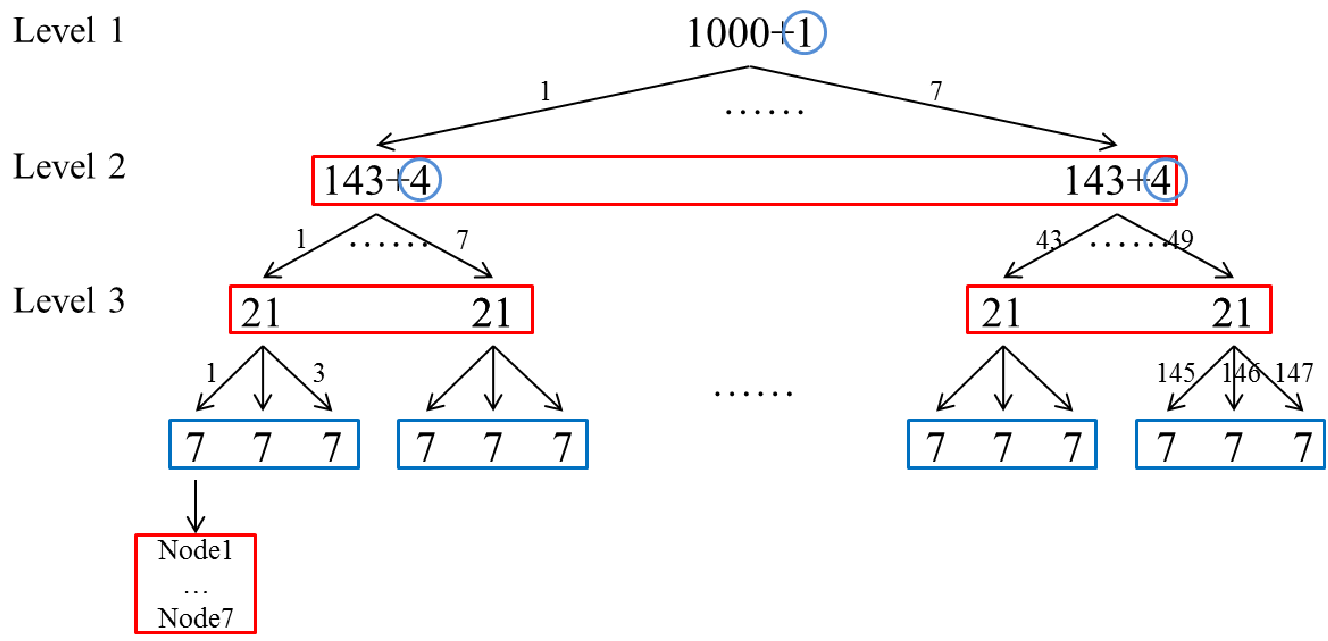 Figure: The hierarchical tree structure for scaling trust evaluation to thousands of nodes.
Security & Key Agreement
Trust is useless if the subsequent communication is intercepted. The authors integrate an Identity-Based Encryption (IBE) scheme directly into the trust evaluation steps. As nodes exchange trust values, they also exchange "partial private keys." By the time trust is established, a common Session Key is automatically derived via Bilinear Maps (Weil Pairing).
The security is anchored on the Bilinear Diffie-Hellman (BDH) assumption, providing:
- Perfect Forward Secrecy (PFS): Even if a master key is leaked later, past sessions remain encrypted.
- Resistance to Passive/Active Attacks: Eavesdroppers cannot derive the session key without solving the Elliptic Curve Discrete Logarithm Problem.
Experimental Performance
The efficiency of the HTL system is most apparent as the network grows.
| Nodes (n) | Traditional LT Cost | HTL Cost | Savings (μ) |
|---|---|---|---|
| 100 | 9,900 | 784 | 92.08% |
| 500 | 249,500 | 4,312 | 98.27% |
| 1,000 | 999,000 | 5,684 | 99.43% |
 Table: Communication overhead comparison showing the exponential advantage of HTL.
Critical Insight & Conclusion
By moving away from the "everyone talks to everyone" paradigm and utilizing the mathematical properties of SBIBD, the authors solve the scalability paradox. The most impressive aspect of this work is the synchronicity: trust evaluation and key agreement are not two separate overheads; they are two sides of the same communication process.
Limitations: The system assumes a degree of stability in group formation. In highly dynamic PSN environments where nodes join/leave every second, the re-balancing of the tree and the (7, 3, 1) blocks could introduce latency. Future work should investigate "fuzzy" block designs that can handle rapid node churn without full tree reconstruction.