
Leadership Nuclei: The Tightly-Knit Elite of Endorsement Networks
On the high density of leadership nuclei in endorsement social networks
This paper investigates the community structure of endorsement-based social networks (e.g., Flickr favorites, Twitter following) by identifying "cores"—bipartite directed cliques consisting of followers and leaders—using frequent itemset mining. It reveals that leaders in these communities don't just receive support but form highly dense, mutually endorsing "leadership nuclei."
TL;DR
Why do some communities on social media seem so much more influential than others? This research uncovers a structural secret: in endorsement networks (like Flickr or Twitter), the "leaders" of a community don't just sit at the top of a hierarchy—they form a Leadership Nucleus, a nearly perfect clique where almost every leader endorses every other leader. By applying frequent itemset mining to large-scale datasets, the authors found that these nuclei are significantly denser than the surrounding follower base, providing a "high-density" foundation for information viralization.
Problem: Friendship vs. Endorsement
In social network analysis, we often conflate "friendship" with "endorsement." However, a friendship is typically a mutual affinity (symmetric), while an endorsement (a like, a retweet, or a follow) is a unit of support or admiration (unidirectional).
Existing community detection methods often miss the unique "footprint" of endorsement. The authors argue that a community in these networks is best represented by a biclique—a structure where a group of followers () all point to a group of leaders (). The challenge lies in efficiently finding these structures in massive graphs and understanding the relationship between the leaders themselves.
Methodology: Mining the Core
The researchers define a Core as a bipartite subgraph where every node in follows every node in .
The Formalism
The density of the leader set is measured by:

The Discovery Process
- Frequent Itemset Mining: Treating each follower as a "transaction" and the leaders they follow as "items," the authors use data mining techniques to find sets of leaders followed by a minimum number of users ().
- Maximality: To avoid pattern explosion and redundancy, they focus on maximal nuclei—meaning you can't add another leader to the set without losing followers below the threshold.
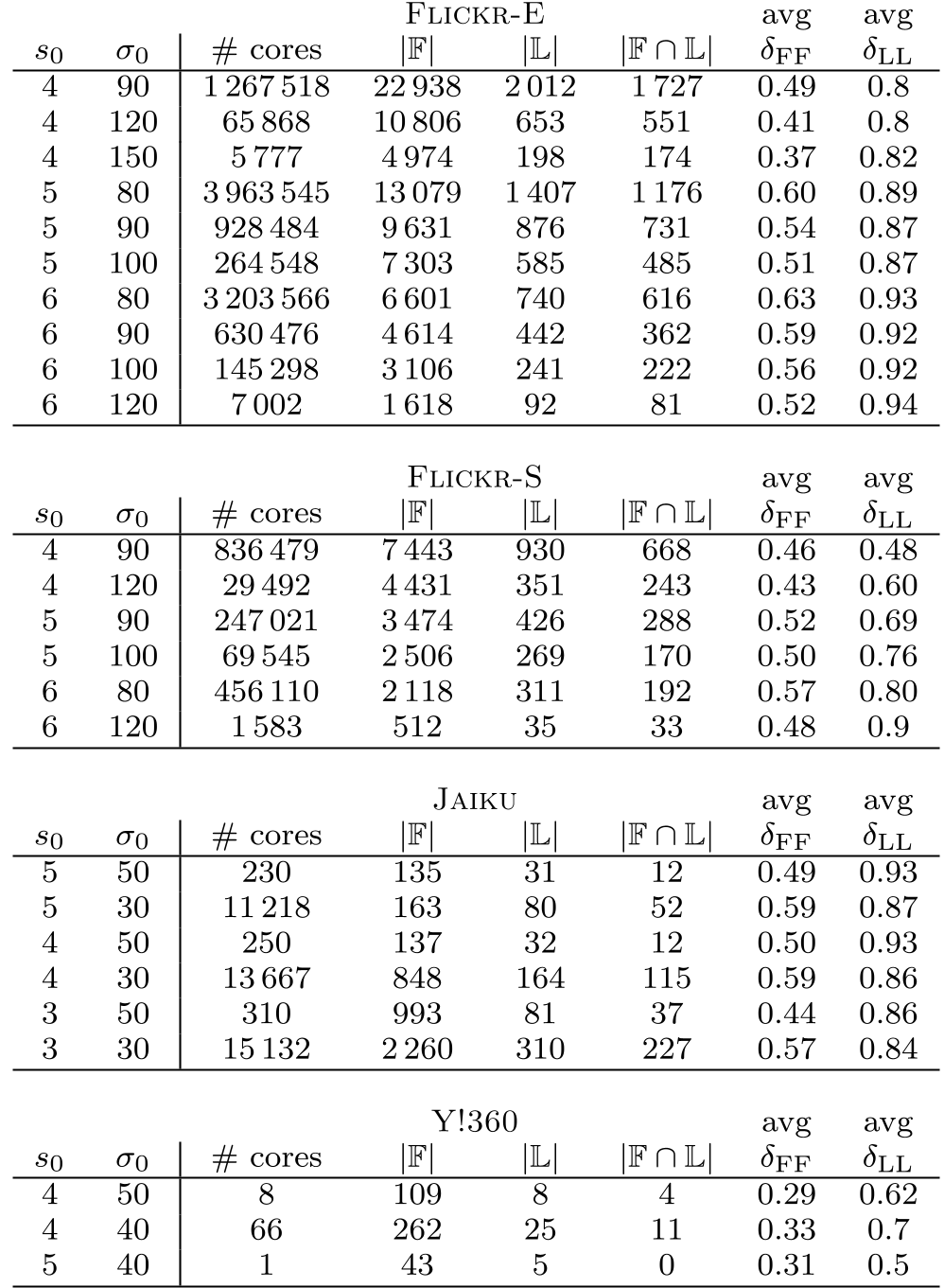
- Cross-Network Comparison: They compared "Endorsement" networks (Flickr-E, Jaiku) against "Social/Friendship" networks (Flickr-S, Y!360).
Empirical Findings: The "Nucleus" Phenomenon
The results revealed a striking disparity in how leaders interact compared to followers.

1. High Leader-Leader Density ()
In endorsement networks like Jaiku, the internal density of leader sets was frequently above 0.90. This means the leaders are almost a complete clique. In contrast, friendship networks (Y!360) showed much lower values, suggesting that "friendship" groups are more loosely organized than "endorsement" elite circles.
2. The Follower Gap
While leaders are highly connected, the density among followers () remains very low. This confirms the directionality of endorsement: followers are a disorganized mass pointing toward a highly organized, interconnected center.
Deep Insight: Why This Matters
The existence of these "Very Dense Nuclei" suggests that influence is not just individual; it is collective. If you follow one leader in a nucleus, you are highly likely to find the others because they are constantly endorsing each other.
From a marketing or political campaign perspective, this implies that targeting a "community" requires penetrating this nucleus. Because the leaders are so tightly knit, information entering this core is likely to be amplified across the entire nucleus before radiating out to the millions of followers.
Conclusion & Future Outlook
This work provides a rigorous mathematical framework for identifying the "inner circles" of the internet. However, as the authors note, their current method produces many overlapping cores. The next frontier in this research involves clustering these cores to merge similar footprints into singular, coherent communities.
As we move into an era of algorithmic feeds, understanding the "nucleus" might be the key to understanding why certain content goes viral while others vanish—it's all about who the leaders are talking to.