
Fermionic Quantum Computing: Breaking the 99.7% Fidelity Barrier with Collisional Gates
High-fidelity collisional quantum gates with fermionic atoms
The paper demonstrates high-fidelity collisional entangling gates using fermionic atoms in an optical superlattice. By leveraging controlled interactions in both spin and charge degrees of freedom, the authors achieve a gate fidelity of 99.75(6)% and realize a composite pair-exchange gate, reaching SOTA performance for neutral-atom collisional architectures.
TL;DR
Researchers at the Max Planck Institute for Quantum Optics (MPQ) have achieved a milestone in neutral-atom quantum computing, reporting collisional gate fidelities of 99.75%. By using fermionic atoms in an optical superlattice, the team successfully decoupled spin and charge dynamics to create stable, high-fidelity gates and a novel "pair-exchange" primitive. With Bell state lifetimes exceeding 10 seconds, this work positions collisional gates as a formidable rival to Rydberg-based architectures.
The "Fermion Advantage" and the Collisional Hurdle
In the race for quantum advantage, simulating electronic structures and materials is the "killer app." Most platforms use qubits that must mimic fermions through complex mappings (like Jordan-Wigner), which bloat the circuit and introduce errors. Native fermionic processors use actual fermions as qubits, naturally restricting the Hilbert space to physically valid states (conserving particle number and magnetization).
However, building these has been difficult. To entangle two atoms via collisions (the "collisional gate"), you must bring them together, let them interact, and separate them without losing their quantum state to "leakage"—where atoms jump into higher energy bands or unintended charge states (doublons).
Methodology: The Art of the Quasi-Adiabatic Pulse
The researchers addressed the leakage problem using two distinct strategies:
- The Magic Ratio: By tuning the interaction strength () and tunneling () to a specific ratio (), the system becomes "transparent" to leakage at specific pulse timings.
- Blackman Pulse Shaping: The core innovation was moving beyond rigid "quenches" (fast jumps) to smoothly shaped pulses. By ramping the tunneling amplitude quasi-adiabatically, they suppressed high-frequency excitations into the doublon-hole manifold.
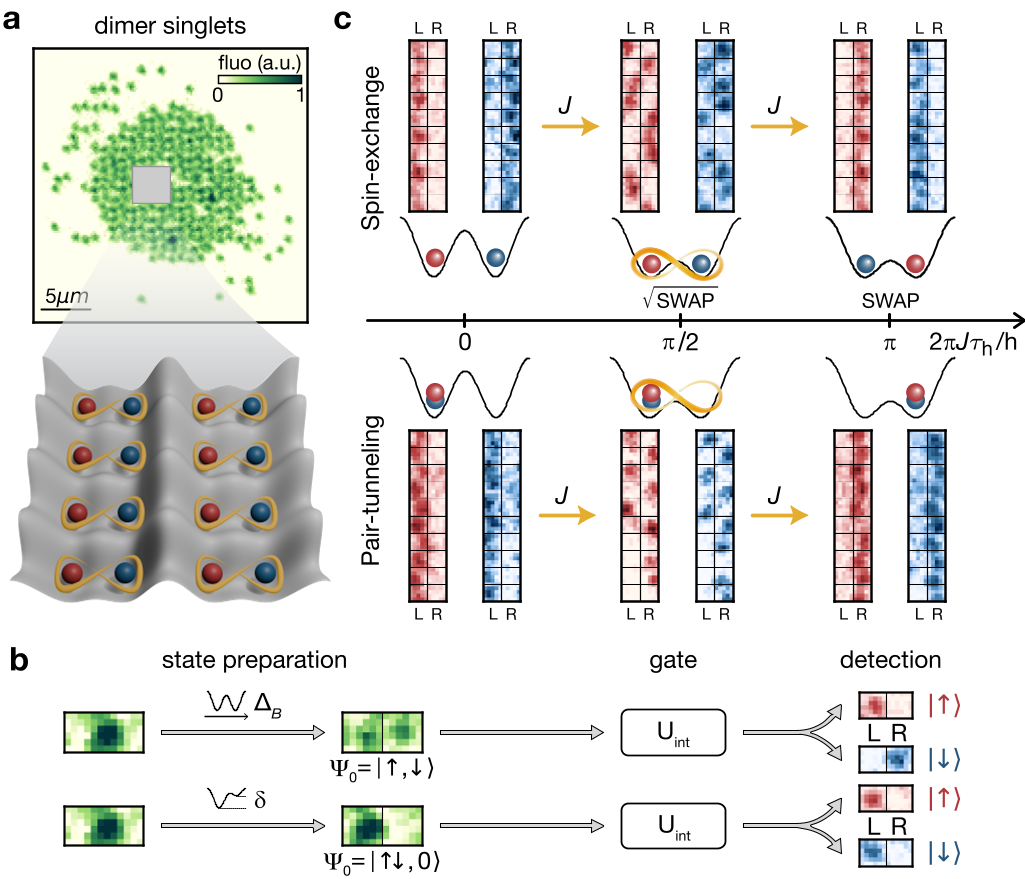 Figure 1: The optical superlattice setup and the underlying Fermi-Hubbard dynamics governing the collision.
Engineering the "Pair-Exchange" Gate
A standout contribution is the demonstration of a Pair-Exchange (PX) gate. In quantum chemistry, moving an unbroken pair of electrons between orbitals is a fundamental step. The team used a composite sequence: Interaction – Z-gate – Interaction.
- The Interaction gates handle the "mapping" between spin and charge.
- The Z-gate (a potential tilt ) accumulates phase only in the charge sector.
This allows the gate to perform a SWAP on the charge degrees of freedom (moving the pair) while leaving the spin states untouched—a crucial requirement for digital fermionic simulation.
Experimental Results: SOTA Performance
Using quantum gas microscopy, the team performed a microscopic "autopsy" on their gates:
- Fidelity: 99.75(6)% via randomized gate sequences (fitting exponential decay).
- Coherence: While the gate takes ~1.2 ms, the resulting Bell state remains coherent for s, a ratio of four orders of magnitude.
- Scalability: The high fidelity was maintained across a 64-site array, with the primary limitation being slight spatial inhomogeneities in the lattice laser intensity.
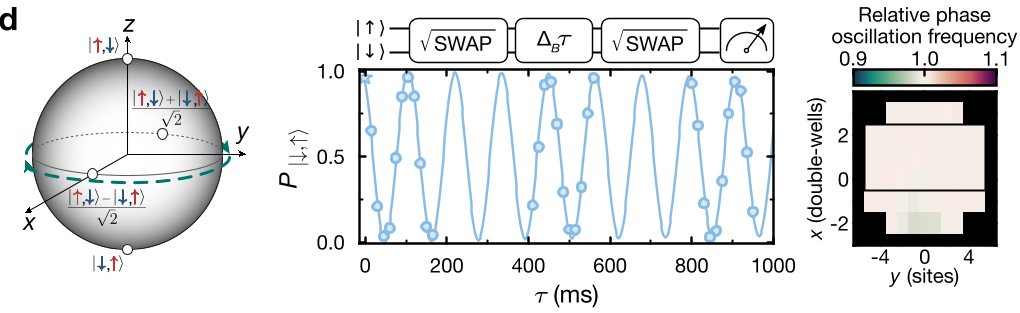 Figure 2: Two-qubit gate fidelity extraction showing the exponential decay of population over 20 consecutive gates.
Critical Insight: Why This Matters
For years, Rydberg gates (using highly excited states) have dominated neutral-atom headlines due to their speed. However, collisional gates operate on ground-state atoms, which are inherently more stable and don't require high-power UV lasers that can cause decoherence.
By proving that ground-state collisions can reach fidelity, this paper opens a path to a Hybrid Analog-Digital Simulator. Imagine an analog simulator that "evolves" a complex material state, interspersed with digital "gates" to perform precise measurements or state preparation.
Conclusion & Future Work
The primary bottleneck is currently spatial inhomogeneity—no two "wells" in the lattice are exactly identical. The authors propose moving to "flat-top" beam profiles (using DMDs) and shorter lattice spacings (383 nm) to push gate speeds into the sub-10 regime. If achieved, we could soon see fermionic processors with 10,000+ sites, capable of solving the very chemistry problems that motivated the birth of quantum computing.
Takeaway: The era of professional-grade fermionic quantum hardware has arrived, and it speaks the language of the Fermi-Hubbard model natively.