
High-Fidelity Fermionic Gates: A New Era for Collisional Quantum Computing
High-fidelity collisional quantum gates with fermionic atoms
The paper demonstrates high-fidelity collisional entangling gates for fermionic neutral atoms (6Li) in an optical superlattice. By utilizing a "quasi-adiabatic" approach with Blackman pulses, the authors achieved a two-qubit SWAP gate fidelity of 99.75(6)% and generated Bell states with historical coherence lifetimes exceeding 10 seconds, outperforming previous efforts in neutral-atom collisional gates.
TL;DR
Researchers have demonstrated a major leap in neutral-atom quantum computing by achieving 99.75% fidelity in collisional gates using fermionic lithium atoms. By refining control pulses and utilizing optical superlattices, they managed to suppress errors, achieve record-breaking coherence times (>10s), and implement complex "pair-exchange" gates—a fundamental requirement for simulating real-world chemistry.
Perspective: Why Fermions Matter
Most quantum computers today use "spins" (qubits) to represent data. However, when simulating molecules or materials, the particles involved are actually fermions. Using standard qubits to simulate fermions is like trying to write a sentence in a language that doesn't have the right alphabet; you need complex "mappings" that introduce overhead and errors.
This paper focuses on a native fermionic architecture. By using actual fermions as qubits, the system's physics (Pauli exclusion principle, particle conservation) automatically enforces the rules of chemistry. The challenge has always been making the "collisions" (the way these atoms interact) fast and clean enough to compete with other technologies like Rydberg atoms or superconducting loops.
The Core Innovation: "Quasi-Adiabatic" Control
In an optical double-well, two atoms can exchange their spins (Spin-Exchange) or hop together to one side (Pair-Tunneling). To make a reliable quantum gate, you need to control one without the other.
The authors moved away from "quench" dynamics (sudden changes), which usually excite unwanted "charge" states (doublons). Instead, they used Blackman pulses—a specific pulse shape that ramps the tunneling interaction smoothly. This "quasi-adiabatic" approach allows the gate to be fast (~1 ms) while keeping the atoms in the correct energy states, effectively "decoupling" the spin logic from charge noise.
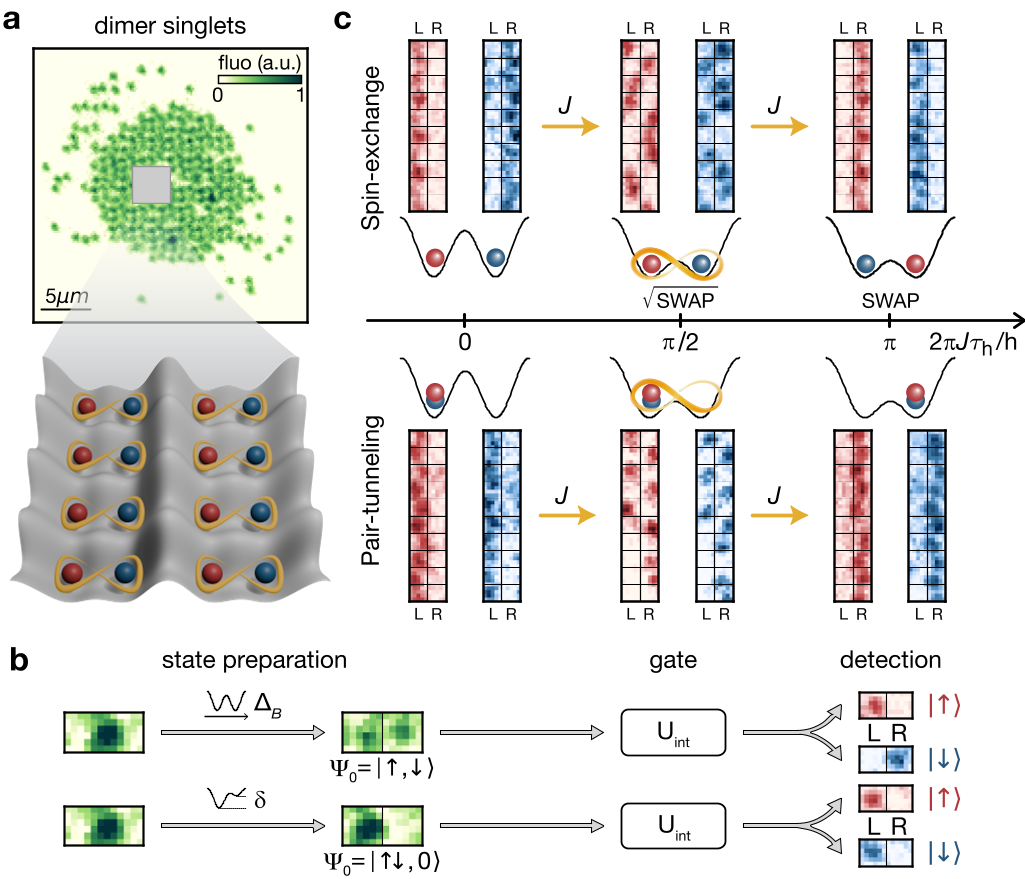 Fig 1: The optical superlattice setup and the effective Hamiltonian levels that enable spin and charge gates.
Breaking State-of-the-Art (SOTA)
The results represent a significant benchmark for the field:
- Fidelity: 99.75% is a massive jump from the previous ~96% typical for these microscopic platforms.
- Coherence: The "Bell states" (entangled pairs) lasted for over 10 seconds. In the world of quantum gates, a 10-second lifetime for a 1-millisecond gate is an eternity—allowing for thousands of operations before the "quantumness" fades.
- The Pair-Exchange Gate: For the first time, they demonstrated a composite sequence that swaps pairs of atoms, which is the "gold standard" for simulating electron movement in chemical bonds.
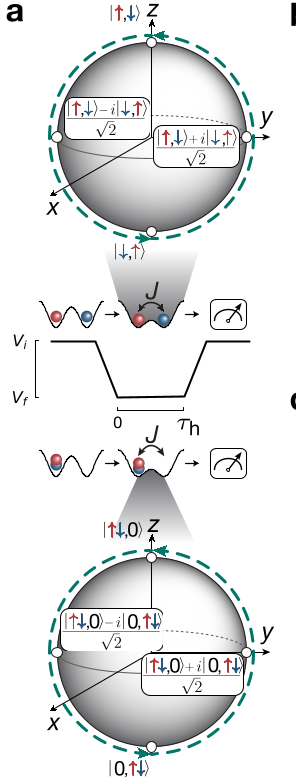 Fig 2: High-contrast coherent oscillations in the spin and charge sectors, showing 110+ coherent cycles.
Critical Analysis & Outlook
While the 99.75% fidelity is impressive, the authors honestly identify the remaining bottleneck: Spatial Inhomogeneity. The laser beams forming the lattice aren't perfectly flat across the entire array, causing atoms at the edges to "tick" at slightly different frequencies.
The Path Forward:
- Potential Flattening: Using Digital Micromirror Devices (DMDs) to "sculpt" the laser intensity could push fidelity toward 99.9%.
- Scaling: The authors predict that with shorter laser wavelengths (already proven in labs), they could scale this to 10,000 sites with gate speeds under 10 microseconds.
This work suggests that the "Native Fermionic" approach isn't just a niche for theorists anymore—it's a high-performance contender for the next generation of scalable quantum processors, particularly for the multibillion-dollar industries of drug discovery and materials science.
Conclusion
By mastering the "controlled collision" of fermionic atoms, this research provides the missing link between analog quantum simulation (watching how atoms move) and digital quantum computing (executing precise logic). It’s a roadmap for a Fermionic Quantum Computer that is both programmable and naturally physically accurate.