
Fermionic Quantum Computing: Breaking the 99.7% Fidelity Barrier with Atomic Collisions
High-fidelity collisional quantum gates with fermionic atoms
This paper demonstrates high-fidelity collisional entangling gates using fermionic atoms in an optical superlattice, achieving a record two-qubit gate fidelity of 99.75(6)%. The researchers utilize a quantum gas microscope to characterize spin-exchange and pair-tunneling dynamics, establishing a programmable platform for analog-digital hybrid quantum simulation.
TL;DR
Researchers at the Max Planck Institute for Quantum Optics have demonstrated a breakthrough in neutral-atom quantum computing, achieving a 99.75% gate fidelity using fermionic lithium atoms. By leveraging controlled collisions in optical superlattices rather than the usual Rydberg states, they've created a stable, high-fidelity environment where quantum entanglement (Bell states) can survive for over 10 seconds.
The Fermionic Advantage: Beyond Qubits
Most quantum computers today "simulate" fermions (like electrons in a molecule) using "spin" qubits. However, this requires complex mappings that often bloat the computational overhead.
The researchers in this study argue for native fermionic encoding. By using fermions as the actual qubits, the system's Hilbert space is naturally restricted to physical states that obey the Pauli exclusion principle and conservation laws. This inherently prevents "gate errors" from drifting into non-physical states, providing a more robust foundation for simulating quantum chemistry.
The Problem: Speed vs. Coherence
Collisional gates work by bringing two atoms together in a double-well potential and letting their wavefunctions overlap (the Fermi-Hubbard model). Historically, this has been a double-edged sword:
- The "Speed" Trap: Making gates fast (increasing tunneling ) usually leads to unwanted excitations (doublons).
- The "Precision" Trap: Balancing the interaction energy and tunneling typically requires extreme fine-tuning of lattice depths.
Methodology: The Quasi-Adiabatic Solution
The core innovation lies in the use of quasi-adiabatic Blackman pulses. Instead of a "sudden quench" (which causes noise) or a "slow adiabatic" move (which is too slow), the authors shaped the lattice potential ramps to suppress doublon excitations to below 5-8%.
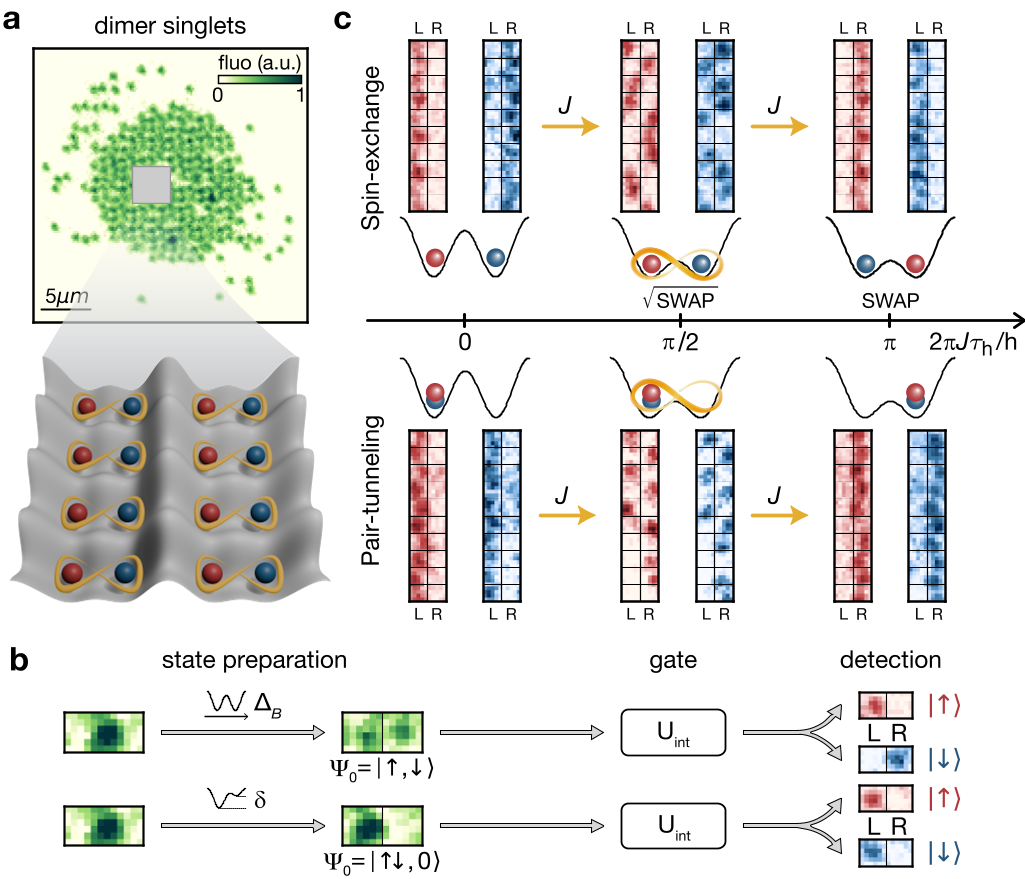 Figure 1: (a) Proposed hybrid analog-digital simulator. (b) Energy levels of two fermions in a double-well, showing the spin-exchange and pair-tunneling pathways.
This allowed them to implement:
- Gates: The fundamental entangling unit for spin-based computing.
- Pair-Exchange (PX) Gates: A composite sequence that swaps pairs of atoms while ignoring their spin—crucial for high-efficiency chemistry simulations.
Experimental Milestones
Using a Quantum Gas Microscope, the team achieved site-resolved imaging of the atoms. This allowed them to measure the "Truth Table" of their gates with unprecedented accuracy.
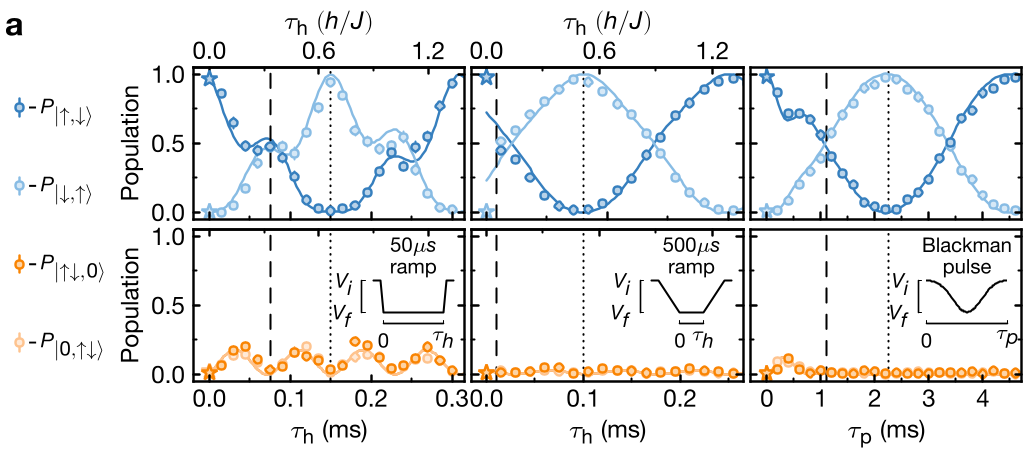 Figure 2: Performance metrics showing the suppression of unwanted states and the Truth Table for the SWAP gate.
Key Achievements:
- Record Fidelity: 99.75(6)% average gate fidelity across 64 sites.
- Extreme Coherence: Bell states showed a 1/e lifetime of over 10 seconds, thanks to the low magnetic sensitivity of the hyperfine states in the Paschen-Back regime.
- Scalability: The setup is compatible with arrays of up to 10,000 sites with further optical flattening.
Critical Analysis & Outlook
While 99.75% is a standard-setting result for collisional gates, a few hurdles remain for a "Fully Digital" fermionic computer:
- Inhomogeneity: The main source of infidelity was the slight variation in oscillation frequencies across the lattice. This can be solved via better "optical flattening" (using DMDs).
- Gate Speed: At ~1.2 ms, these gates are slower than Rydberg-based gates (~ns to μs). However, the 10-second coherence time means you can perform nearly 10,000 operations before decoherence hits, a ratio that rivals the best platforms available.
Conclusion
This work proves that collisional gates are no longer the "underdog" of neutral-atom architectures. By mastering the motion of fermions at the single-site level, the team has opened the door to a new class of analog-digital hybrid simulators that could finally crack the secrets of high-temperature superconductivity and complex molecular bonding.