
High-Fidelity Fermionic Gates: A New Frontier for Quantum Chemistry
High-fidelity collisional quantum gates with fermionic atoms
The paper demonstrates high-fidelity collisional quantum gates using fermionic 6Li atoms in an optical superlattice, achieving a SWAP gate fidelity of 99.75(6)%. By leveraging quantum gas microscopy, the authors realize both spin-exchange and charge-sector (pair-exchange) entangling operations, establishing a robust architecture for analog-digital hybrid quantum simulation.
TL;DR
Researchers at the Max Planck Institute have demonstrated a breakthrough in neutral-atom quantum computing, achieving 99.75% fidelity in entangling gates using fermionic atoms. By precisely controlling collisions within an optical superlattice, they realized not just spin-based gates, but also specialized pair-exchange gates—a critical building block for simulating real-world chemistry and materials science.
Why Fermions Matter: The "Native" Advantage
Most quantum computers today use qubits (spins) to represent everything from financial markets to nitrogen fixation. However, the universe is fundamentally made of fermions (electrons). Simulating fermions with spin-based qubits usually requires complex mappings (like Jordan-Wigner) that consume extra resources and can drift into "unphysical" states.
This paper advocates for a native fermionic architecture. By using actual fermionic atoms (6Li), the system is naturally restricted to physical states that obey the Pauli exclusion principle and particle conservation. It’s not just a simulation; it’s a mapping of one fermionic system onto another.
The Problem: The Spin-Charge Tussle
In a Fermi-Hubbard system—the mathematical heart of this experiment—two atoms in a double-well potential can exchange spins or tunnel in pairs. The challenge has always been speed vs. purity.
- If you go too fast (high tunneling ), you accidentally excite "charge" states (doublons), ruining the spin gate.
- If you go too slow, decoherence eats your signal.
Previous attempts capped at ~96% fidelity because they couldn't perfectly isolate these dynamics.
The Solution: Quasi-Adiabatic Blackman Pulses
The team solved this using a "Goldilocks" strategy. They didn't just "quench" the system (turn it on suddenly); they used Blackman-shaped pulses. These pulse shapes ramp the tunneling smoothly enough that the system stays in the desired "spin" subspace, effectively decoupling it from the "charge" noise.
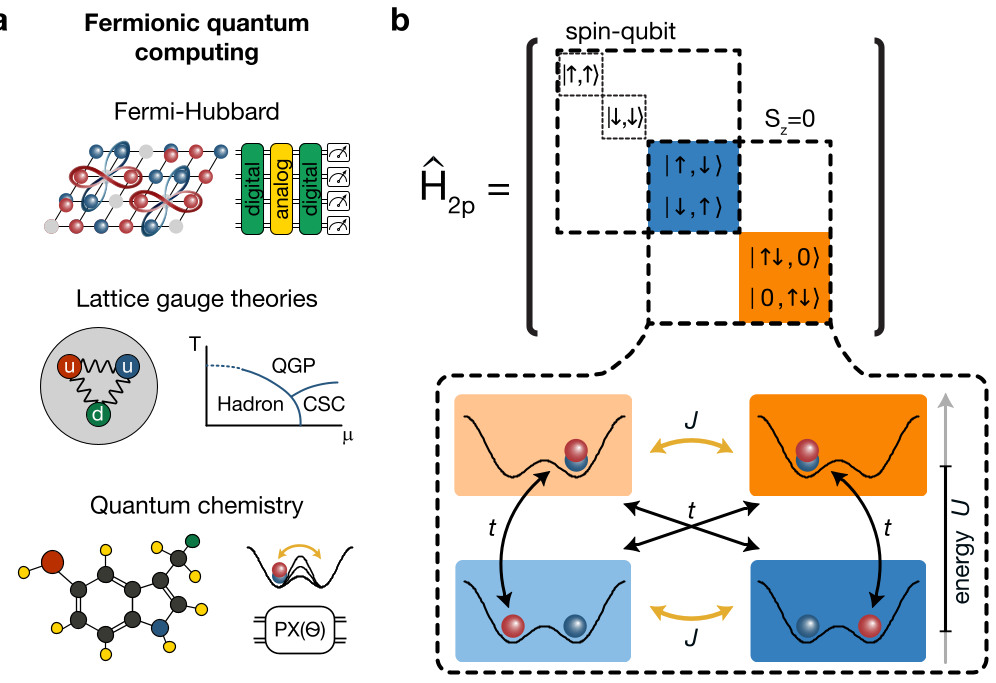 Figure 1: (a) Perspectives of fermionic quantum processing. (b) The energy levels of the Fermi-Hubbard double-well, showing the separation of spin and charge sectors.
Breakthrough Results: 99.75% Fidelity
Using quantum gas microscopy—a technique that allows doctors (or in this case, physicists) to see individual atoms at specific lattice sites—the team measured the gate performance with unprecedented precision.
- Fidelity: 99.75(6)% average gate fidelity across the array.
- Coherence: They produced Bell states (entangled pairs) that lasted for 10 seconds. For a gate that takes 1 millisecond, this is a massive operational window.
- Quality Factor: 110 coherent oscillations—shattering the previous records for superlattice platforms.
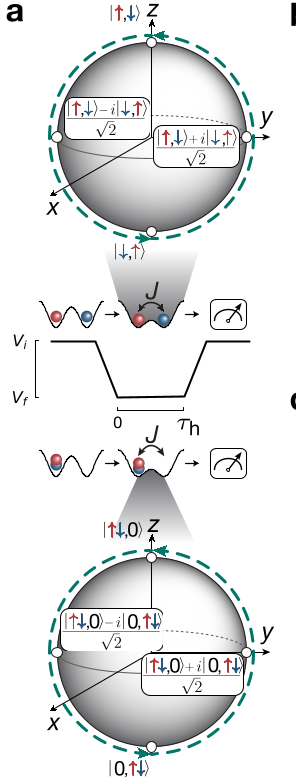 Figure 2: Observation of long-lived, high-contrast oscillations in both spin-exchange and pair-tunneling regimes.
Engineering the Pair-Exchange Gate
One of the most impressive feats in the paper is the realization of the Pair-Exchange (PX) gate. In quantum chemistry, molecules are often defined by the movement of electron pairs. The researchers designed a composite pulse sequence () that specifically Swaps the charge states (doublons) while leaving the spin states untouched. This is a crucial "primitive" for future digital quantum chemistry processors.
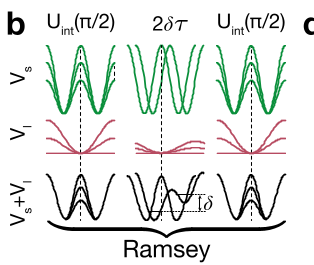 Figure 3: The truth table for the pair-exchange gate, showing successful swap of charge degrees of freedom.
Critical Insight: Scaling Up
While these experiments were done on isolated pairs (dimers), the architecture used (optical superlattices) is inherently parallel. The authors project that by shortening the lattice spacing and using better beam flattening, they could achieve sub-10 microsecond gates on arrays of 10,000+ lattice sites.
Limitations: Currently, the fidelity is limited by spatial inhomogeneities in the laser beams (the "tilt" of the wells). However, the authors note that technologies like Digital Micromirror Devices (DMDs) can "flatten" these potentials to push fidelities even higher, potentially reaching the thresholds required for fault-tolerant quantum computing.
Conclusion
This work elevates neutral-atom collisional gates from a "promising alternative" to a "leading contender." By providing a high-fidelity path to native fermionic simulation, it opens the door to solving the most stubborn problems in materials science—right where they live: in the fermionic Hilbert space.