
Fermionic Quantum Computing: Breaking the 99.7% Fidelity Barrier with Collisional Gates
High-fidelity collisional quantum gates with fermionic atoms
The paper demonstrates high-fidelity collisional entangling gates using fermionic atoms in an optical superlattice, achieving a record two-qubit gate fidelity of 99.75(6)%. By leveraging controlled exchange interactions, the authors realize robust and pair-exchange gates, accompanied by Bell state lifetimes exceeding 10 seconds.
TL;DR
Researchers at the Max Planck Institute for Quantum Optics (MPQ) have reached a milestone in neutral-atom quantum computing. By manipulating fermionic atoms in optical superlattices, they demonstrated entangling gates with 99.75% fidelity and 10-second coherence times. This work moves beyond simple spin-qubit simulation, offering a "native" fermionic architecture that is intrinsically safer and more efficient for simulating chemistry and materials.
Perspective: Why Fermions Matter
Most quantum computers today use qubits (like superconducting loops or trapped ions) to represent spins. However, when we want to simulate an electron (a fermion) in a molecule, we have to perform a complex mathematical transformation (like Jordan-Wigner) to map those fermions onto spins. This mapping is "leaky"—a single gate error can shift the system into a state that is physically impossible in nature.
This paper takes a different route: Native Fermionic Encoding. By using actual fermions as qubits, the Hilbert space is naturally restricted to physical states. Particle number and magnetization are conserved by the laws of physics, not just by software, making the architecture inherently robust.
The Problem: The Speed-Fidelity Trade-off
Collisional gates—where atoms interact by "touching" in a potential well—have long been a candidate for high-fidelity operations. However, early attempts were plagued by:
- Spatial Inhomogeneity: Differences in laser intensity across the lattice decohere the gates.
- Leakage: The "Spin" sector (where we store information) often leaks into the "Charge" sector (creating unwanted double-occupancy or "doublons").
Methodology: Engineering the Multi-Particle Bloch Sphere
The authors solve the leakage problem through an intermediate-speed strategy. Using smoothly shaped Blackman pulses, they ramp the tunneling () slowly relative to the interaction (), but fast relative to the exchange rate (). This allows them to execute a gate in just 1.2 ms while keeping doublon excitations below 5%.
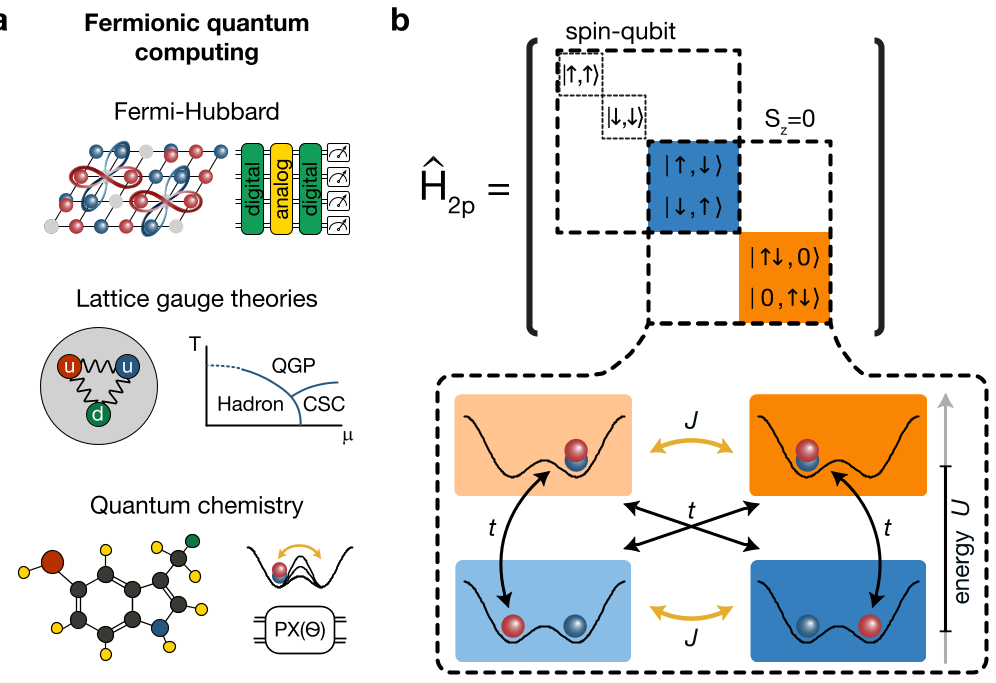 Figure 1: The optical superlattice setup. By splitting single sites into double wells, the researchers create isolated "dimers" of atoms that interact via the Fermi-Hubbard Hamiltonian.
One of the most impressive technical feats is the Pair-Exchange (PX) gate. By interleaving interaction pulses with a "Z-gate" (a tilt in the potential), they created a composite gate that swaps atom pairs without disturbing single-spin states—a critical primitive for quantum chemistry simulations.
Experimental Breakout: SOTA Results
The researchers used a Quantum Gas Microscope to see every single atom. This allowed them to perform "Randomized Benchmarking-style" analysis, applying up to 20 consecutive gates to measure the exact decay of fidelity.
- Fidelity: 99.75(6)%, placing it among the best in neutral-atom platforms.
- Coherence: The Bell states survived for over 10 seconds. In the world of quantum computing, a gate that takes 1 ms and lasts for 10,000 ms is an exceptional "duty cycle."
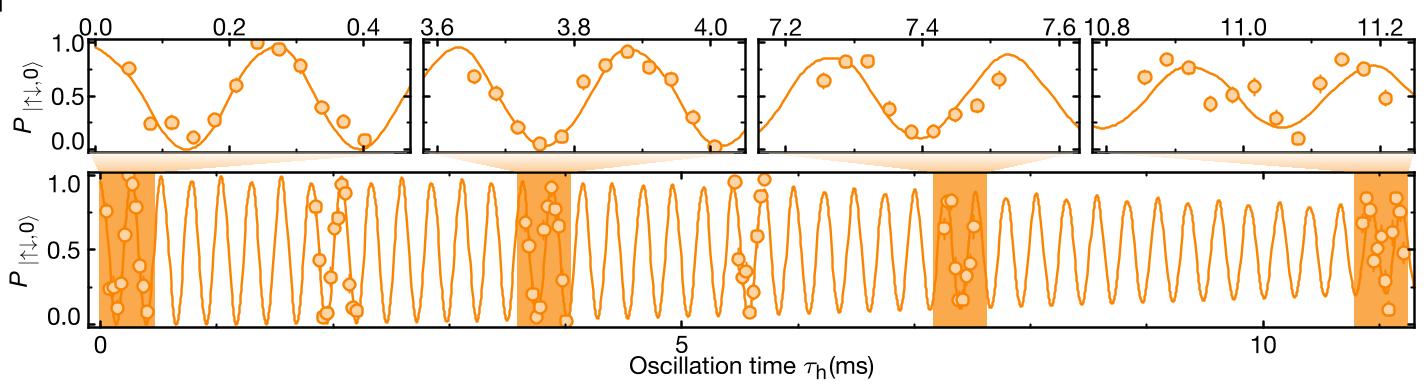 Figure 2: Coherent spin-exchange oscillations. The high quality factor is evident in the long-lived sinusoidal population transfer between the left and right wells.
Critical Insight: The "Potential Flattening" Future
Despite the record fidelity, the authors honestly identify the current bottleneck: Spatial Inhomogeneity. The "edges" of their laser beams have different intensities than the center, creating a slight "chirp" in gate frequencies.
The roadmap to 99.9% and beyond involves Optical Potential Flattening—using Digital Micromirror Devices (DMDs) to sculpt the laser beams into a perfectly flat "top-hat" profile. Combined with shorter lattice spacings (UV lasers), they predict gate speeds could drop below 10 , enabling deep circuits for industrial-scale chemistry.
Conclusion
This work proves that collisional gates in optical lattices are not just a theoretical curiosity but a competitive, high-fidelity alternative to Rydberg arrays. By providing a native home for fermions, this platform is uniquely positioned to solve the Schrödinger equation for complex molecules—the "Holy Grail" of quantum computing.