
Intercalating Cross-Linked PVA into MoS2: A Low-Cost Ceramic-Supported Membrane for Dye/Salt Fractionation
High-performance MoS2-based composite membrane for efficient dye-salt separation in textile industry.pdf
This work fabricates a MoS2/PVA composite membrane in which cross-linked polyvinyl alcohol is intercalated between MoS2 nanosheets and vacuum-filtered onto a low-cost natural pozzolan ceramic substrate. The optimized M05 membrane (0.5 wt% MoS2) reaches a water permeability of 31.4 L m-2 h-1 bar-1 with rejections of 91.6 percent for methylene blue and 96.4 percent for direct red 80, while fractionating a DR80/NaCl mixture and surviving 7-day immersion at pH 3 and pH 11.
TL;DR
Textile wastewater contains soluble dyes that are chemically stable and poorly biodegradable, and membrane filtration is one of the few separation routes that can recover both water and salts without destroying the dyes. This paper builds a composite membrane by intercalating cross-linked polyvinyl alcohol (PVA) between MoS2 nanosheets and vacuum-filtering that mixture onto a natural pozzolan ceramic substrate. The optimized formulation with 0.5 wt% MoS2 (labelled M05) delivers a water permeability of 31.4 L m-2 h-1 bar-1 with 96.4 percent rejection of direct red 80 (DR80) and 91.6 percent rejection of methylene blue (MB), while in a DR80/NaCl mixture it keeps 92.3 percent of the dye but lets 99.3 percent of the salt pass. After 7 days of immersion at pH 3 and pH 11, the membrane still rejects between 95.1 and 98.3 percent of DR80.
Background and Positioning
This is an applied materials and membrane-engineering contribution rather than a new theory or a new benchmark. Its position in the literature is best described as a consolidation play: many groups have already demonstrated MoS2-based nanofiltration membranes, and many have already demonstrated ceramic-supported composite membranes, but the specific combination of a 2D MoS2 selective layer, a commodity polymer intercalant, and a natural low-cost ceramic support had not been systematically optimized over MoS2 loading with dye/salt fractionation and pH stability measured together. The paper's own comparison table places M05 against thirteen reported 2D-material membranes, so the claim being advanced is competitive-but-not-revolutionary performance combined with a much cheaper and simpler fabrication route. The absence of any deep-learning, modeling, or theoretical component confirms that the novelty rests on processing and formulation rather than on mechanism discovery.
What Was Missing Before
The failure mechanism that motivates the work is spelled out in the introduction: MoS2 nanosheets interact with each other and with the substrate mainly through van der Waals forces and hydration forces, and MoS2 alone "does not form strong adhesion with ceramic surface, particularly under extreme conditions". In practical terms, a stacked MoS2 layer on a ceramic support has no covalent anchor, so under acidic or alkaline exposure the interlayer spacing can swell or the whole selective layer can redisperse into the permeate, destroying selectivity. The existing fixes each carry a cost. Depositing MoS2 on polymeric substrates such as PVDF, polysulfone, polyethersulfone, or polyacrylonitrile removes the ceramic durability advantage. Coating MoS2 onto ceramic substrates via vacuum filtration, layer-by-layer polyelectrolyte assembly, or in-situ hydrothermal growth improves durability but adds ionic polyelectrolytes or hydrothermal processing steps. Polyethyleneimine-based MoS2 composite membranes on TiO2 hollow fibers achieve only 4.6 L m-2 h-1 bar-1 permeability with 95.5 percent MgCl2 rejection, and PDDA@MoS2 membranes reach 16.3 L m-2 h-1 bar-1 with 97.2 percent MB rejection, so the trade-off between adhesion chemistry and permeability is real.
The authors' research intuition is that a cheap, water-soluble, hydroxyl-rich polymer which is already cross-linkable can serve double duty: physically filling the interlayer galleries to hold nanosheets together, and chemically bonding to both the MoS2 sulfur atoms and the ceramic surface. This intuition is supported partly by prior literature on PVA as a membrane binder and partly by the FTIR evidence the authors later collect, so it sits between a literature-driven and an experimentally validated design choice.
Core Technical Content
The baseline architecture and what it does not solve
The performance of any pressure-driven membrane is first defined by Darcy's law, and the authors use it explicitly as the validation of their permeability measurement:
Here is the permeate flux in L m-2 h-1, is the collected permeate volume in liters, is the active filtration area in m2 (5.3 cm2 in this setup, per Section 2.4), and is the filtration time in hours. This equation is purely definitional: it converts a volume collected over time into a flux, and its role in the paper is to establish the raw observable before any normalization by pressure. Because it contains no pressure term, on its own it cannot distinguish a membrane that is intrinsically permeable from one that is simply being driven harder; that distinction is exactly what the next equation supplies. If the membrane were non-porous or completely fouled, would stay near zero and would collapse regardless of the applied pressure, which is the degenerate case the authors later check against in the flux-versus-time curves of Fig. 10.
The permeability normalization follows:
where is the water permeability in L m-2 h-1 bar-1 and is the transmembrane pressure in bar, varied between 0 and 3 bar in this study. The purpose of this second equation is to strip out the operating pressure so that membranes tested at different pressures become comparable, and the authors' Fig. 9a shows that all flux-versus-pressure curves are linear across the tested range, which is the empirical check that Darcy's law holds and that the reported values are meaningful constants rather than artifacts of a nonlinear regime. The boundary condition matters here: above some threshold pressure, concentration polarization or compaction would break the linearity and would drift, but the authors only verified linearity up to 3 bar, so nothing above that pressure can be inferred from this data.
Rejection is defined separately:
with and the feed and permeate concentrations in mg L-1, giving in percent. This equation defines what "selectivity" means throughout the results section, and it is measured for 50 mg L-1 dye solutions over 120 minutes at 3 bar, with dye concentration quantified by UV-Vis absorbance at each dye's maximum absorption wavelength and salt concentration quantified by conductivity. The equation says nothing about mechanism; it only states how much solute was retained. The important implicit boundary is that a high for one solute does not imply a high for another solute of different charge or size, which is precisely the point the paper exploits when it reports DR80/NaCl fractionation.
Intercalating cross-linked PVA: the central design change
The core architectural innovation is described qualitatively in Section 2.3 and shown schematically in Fig. 1. A 3 wt% PVA solution is first cross-linked with glutaraldehyde (GA) and hydrochloric acid catalyst at 60 Celsius for 2 hours, using the reaction reported by Blanco-Covian and co-workers; separately, MoS2 nanosheets are dispersed ultrasonically, then mixed with the cross-linked PVA solution and stirred at 60 Celsius for 1 hour before vacuum filtration onto the pozzolan substrate. Three formulations were prepared with MoS2 loadings of 0.2, 0.5, and 1.0 wt%, all keeping cross-linked PVA at 0.5 wt%, as listed in Table 3.
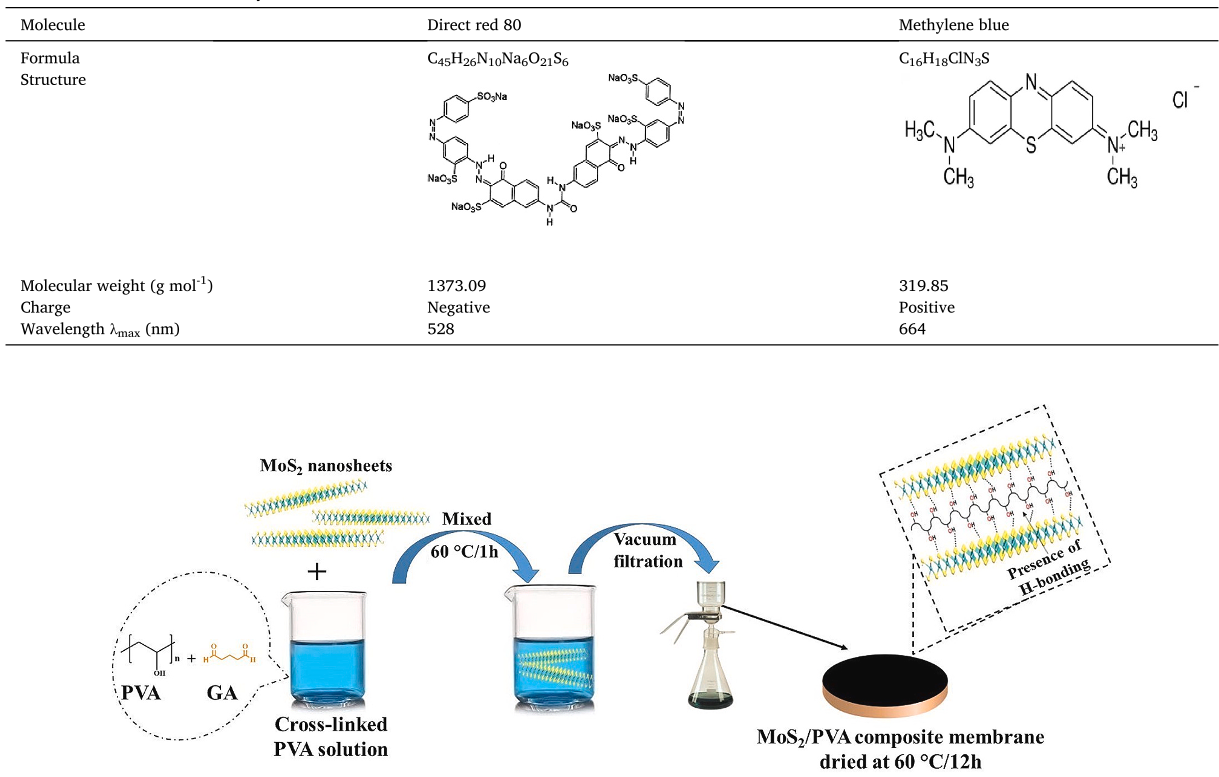
The evidence that this actually bonds comes from XRD and FTIR. The XRD pattern of the pure MoS2 (Fig. 4a) shows a (002) reflection at 14.1 degrees, corresponding through the Bragg relation to an interlayer distance of 0.63 nm. After intercalation with cross-linked PVA, that same (002) peak shifts to 11.4 degrees, and the authors compute a new interlayer spacing of 0.74 nm. This 0.11 nm expansion is the direct structural signature that PVA chains have entered the galleries between MoS2 layers rather than sitting on top of them. On the FTIR side (Fig. 4b), the cross-linked PVA spectrum shows the characteristic acetal bridge bands between 1000 and 1140 cm-1 assigned to C-O and C-O-C vibrations, confirming that the PVA/GA cross-linking reaction (drawn in Fig. 5) actually occurred. The composite spectrum matches cross-linked PVA but shows a noticeable reduction in intensity of the hydroxyl band at 3373 cm-1 relative to pure cross-linked PVA, which the authors attribute to hydrogen bonding between PVA hydroxyl groups and MoS2 sulfur atoms. So there are two distinct bonds being formed: covalent acetal bridges locking PVA to itself, and hydrogen bonds anchoring PVA to the MoS2 surface.
The design question worth asking is why PVA was chosen over the obvious alternatives that already appear in the literature, namely polyelectrolytes such as PDDA and PSS, or polyethyleneimine. The paper's answer is cost and simplicity: PVA is described as a flexible, hydrophilic, widely used membrane material, and glutaraldehyde cross-linking is a standard, well-characterized reaction. What the paper does not provide is a controlled comparison of PVA against a polyelectrolyte intercalant under identical vacuum-filtration conditions; the comparison to PDDA@MoS2 and PSS/PDDA-MoS2 appears only as literature values in Table 4, measured at different pressures, dye concentrations, and substrates. This is a real gap: the claim that PVA is the better binder is supported by plausibility and by the structural characterization, not by a head-to-head ablation.
How loading trades permeability against rejection
The effect of MoS2 content on water permeability is reported in Fig. 9b: as MoS2 increases from 0.2 to 1.0 wt%, permeability drops steeply from 44.0 to 16.5 L m-2 h-1 bar-1. The cross-sectional SEM images in Fig. 6b explain why, showing that the selective layer thickness grows from 2.38 to 5.19 micrometers as MoS2 content rises. A thicker layer means longer transport pathways, which the authors invoke as the reason for the flux decline.
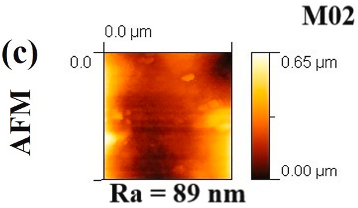
Rejection moves in the opposite direction, and this inverse relationship is the trade-off the paper calls out explicitly. The authors also report that surface roughness increases with MoS2 loading, with mean roughness rising from 89 nm for M02 to 127 nm for M10, and that contact angle rises from 63.6 to 76.2 degrees, which they attribute to the intrinsic hydrophobicity of MoS2 (reported in the literature at 84.0 degrees) and to the consumption of surface hydroxyl groups by MoS2 coordination. Zeta potential becomes more negative with loading, moving from -17.2 mV for M02 to -28.3 mV for M10, which the authors link to electronegative sulfur on the surface. This chain of characterization is what justifies selecting M05 as the compromise point: enough MoS2 to form a defect-free selective layer, but not so much that permeability collapses.
The separation mechanism itself is decomposed in Fig. 10e. For the anionic DR80 (solution pH 5.34), rejection is attributed to the combined action of electrostatic repulsion from the negatively charged surface and size exclusion. For the cationic MB (solution pH 5.75), electrostatic attraction to the negative surface would actually favor adsorption, so the authors conclude that size exclusion dominates, and MB is large enough relative to the membrane pores to be excluded regardless of the charge interaction. Molecular weight differences matter too: DR80 is described as having roughly four times the molecular weight of MB, and its flux is correspondingly lower.
Experiments and Evidence
Main performance and literature comparison
Table 4 in the paper compares M05 against a range of reported 2D-material and composite membranes, tested at differing dye concentrations and pressures:
| Membrane | Permeability (L m-2 h-1 bar-1) | Dye concentration (mg L-1) | Pressure (bar) | Dye rejection (percent) |
|---|---|---|---|---|
| PSS/PDDA-MoS2 | 16.3 | 200 | 2 | 97.2 (MB) |
| TA-MoS2 | 55.8 | 100 | 4 | 98.0 (MB) |
| MoS2/PSF | 32.0 | 200 | 5 | 99.0 (DR80), 9.0 (MB) |
| Ti3C2Tx-GO | 25 | 10 | 5 | 93.5 (MB) |
| MoS2-Ethanol/ceramics | 33.2 | 100 | 2 | 6.4 (MB) |
| GO/Gr | 27.44 | 10 | 4 | 92.6 (MB) |
| GO/NH2-Fe3O4 | 15.60 | 100 | 5 | 70.0 (MB) |
| PDDA@MoS2-PDDA/PSS | 19.44 | 200 | 4 | 98.4 (MB) |
| PVDF@GO-MWCNTs/TiO2 | 36.29 | 10 | 2 | 86.69 (MB) |
| GO/CPVA | 2.6 | 10 | 5 | 76.92 (MB) |
| MoS2/PES | 50.0 | not reported | 4 | 40.0 (MB) |
| GO/kaolinite | 5.6 | 50 | 3 | 90.0 (DR80) |
| MoS2/PVA (M05) | 31.4 | 50 | 3 | 96.4 (DR80), 91.6 (MB) |
Reading this table carefully is important because the comparison is not like-for-like. M05 is tested at a lower dye concentration (50 mg L-1) and lower pressure (3 bar) than several entries, both of which tend to favor measured rejection. Its permeability of 31.4 sits below TA-MoS2 at 55.8, PVDF@GO-MWCNTs/TiO2 at 36.29, and MoS2-Ethanol/ceramics at 33.2, but it beats PSS/PDDA-MoS2, GO/NH2-Fe3O4, PDDA@MoS2-PDDA/PSS, GO/kaolinite, and GO/CPVA. The most striking contrast is M05 versus MoS2/PES: near-comparable permeability (31.4 versus 50.0) but rejection of 91.6 versus 40.0 percent for MB. The most dangerous-looking entry for M05 is MoS2/PSF, which reports 99.0 percent DR80 rejection at 32.0 permeability, essentially matching M05 on both axes; however, that same membrane reports only 9.0 percent MB rejection, so it is a dye-selective membrane of a completely different character, not a directly competing one.
Fractionation, antifouling, and fouling mechanism
The fractionation test uses a feed of 50 mg L-1 DR80 plus 1000 mg L-1 NaCl at 3 bar, shown in Fig. 11. Adding salt reduces the permeate flux from 56.9 to 49.8 L m-2 h-1, which the authors attribute to salt-promoted dye dispersion leading to more dye absorbing into membrane pores. DR80 rejection falls from 96.2 to 92.3 percent, a drop of about 4 percentage points, because the high salt concentration shields the electrostatic interaction between the charged membrane and the dye; the same shielding is what allows 99.3 percent of the NaCl to transmit. This is the behavior expected of a loose nanofiltration membrane and is the basis for the claim of "sustainable resource recovery" from saline textile wastewater.
Antifouling is quantified in Fig. 12b using four standard flux ratios. The flux recovery ratio (FRR) reaches 92.7 percent for DR80 and 90.0 percent for MB, and the irreversible flux ratio (IFR) stays below 10 percent for both. The paper attributes the better DR80 performance to electrostatic repulsion between the negative surface and the negative dye, and the slightly lower MB recovery to adsorption of the cationic dye into pores, which is harder to wash out. The mechanistic explanation for the generally good antifouling behavior is that MoS2 lacks conjugated structures, so cation-pi and pi-pi interactions with aromatic dyes are avoided, and the relatively smooth M05 surface offers fewer attachment sites.
The fouling mechanism itself is identified by fitting Hermia's models adapted for cross-flow filtration:
where is the permeate flux, is a phenomenological coefficient for cross-flow filtration, and is the steady-state permeate flux. The exponent selects among four mechanisms: complete blocking at , standard blocking at , intermediate blocking at , and cake layer formation at . This single equation is the paper's entire mechanistic model, and its cleverness is that the four candidate fouling modes differ only in one exponent, so fitting all four and comparing residual sums of squares is a discrete model-selection problem rather than a continuous parameter search. The boundary of the model is that it assumes a single dominant mechanism; real fouling often transitions between mechanisms over time, and the fit would be poor if that happened here, but the authors report that experimental fluxes closely track the complete-blocking prediction, so the single-mechanism assumption holds for these systems. Table 5 shows the fitted parameters and residuals: the sum of squared deviations is 3.37 for DR80 at and 3.67 for MB at , both far below the next-best values of 20.29 (DR80, ) and 16.07 (MB, ). The physical interpretation the authors draw is that dye molecules are large relative to the interlayer spacing, so they plug the channels completely rather than depositing as a cake or adsorbing inside the pores.
Stability and the limits of the evidence
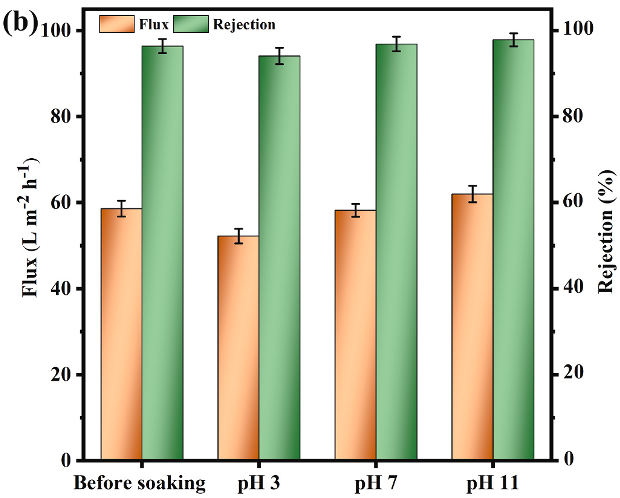
The 7-day stability test is what most strongly distinguishes this work from polymer-supported MoS2 membranes. Photographs in Fig. 14a show the fully hydrated M05 membrane after soaking at pH 3, 7, and 11, with no visible defects or leaching; Fig. 14b quantifies the post-soak DR80 flux and rejection. The initial flux is 58.6 L m-2 h-1 with 95.1 percent DR80 rejection. After acid exposure the flux drops slightly to 52.2 L m-2 h-1, and after alkaline exposure it rises to 61.5 L m-2 h-1 with rejection improving to 98.3 percent, which the authors attribute to stronger electrostatic repulsion at higher pH, consistent with the zeta potential data in Fig. 8b. Neutral water produces minimal flux change with consistently high rejection.
The quality of this evidence needs to be assessed honestly. Every performance number in the paper comes from a single membrane chemistry on a single substrate material from a single source, tested in a laboratory cross-flow cell with 5.3 cm2 of active area. The authors state that each data point is the average of three repetitions and that standard deviations were computed, but the reported standard deviations are not tabulated in the main results, so the reader cannot judge run-to-run variability of the rejection values. The fouling and antifouling tests use only DR80 and MB as single-solute feeds for the mechanism fitting, and only one dye/salt binary mixture; there is no test with a real multi-component textile effluent containing surfactants, heavy metals, or organic compounds, which the introduction itself lists as present in textile wastewater. The pH stability test is 7 days, which is a meaningful but not industrially long duration, and no mechanical or abrasion test of layer adhesion is reported despite adhesion being the paper's central claim. Most importantly, there is no ablation in which cross-linked PVA is omitted or replaced, so the causal attribution of improved durability to PVA intercalation rests on structural characterization and literature reasoning rather than on a controlled performance comparison.
Deep Insights and Conclusion
The contribution that will survive scrutiny is not a record permeability or a record rejection; it is the demonstration that a commodity polymer processed by a standard cross-linking reaction can replace specialized intercalation chemistry for 2D-material ceramic membranes. By showing a 0.11 nm interlayer expansion from XRD, acetal bridge formation from FTIR, and stable operation across pH 3 to pH 11, the paper assembles a coherent chain from molecular bonding to macroscopic durability. The vacuum-filtration route plus a natural pozzolan substrate also matters economically: the substrate permeability is 889 L m-2 h-1 bar-1 with a 2.36 micrometer pore size, so it is a cheap support whose intrinsic resistance is far below that of the selective layer, meaning the cost of the substrate does not dominate the overall transport penalty.
The limitations are specific. First, the claim that PVA is a superior intercalant is not tested against polyelectrolyte intercalants under matched conditions, so the design choice is justified by literature inference rather than by ablation. Second, all selectivity numbers come from single-dye or binary dye/salt feeds at 50 mg L-1 dye and up to 1000 mg L-1 NaCl, whereas real textile effluent is far more complex and often far more concentrated; whether the 92.3 percent DR80 rejection and 99.3 percent NaCl transmission hold under those conditions is untested. Third, the 7-day pH stability test measures flux and rejection but not mechanical adhesion, so the central "strong adhesion" claim is verified functionally rather than mechanically.
The most useful follow-up directions are therefore concrete rather than generic. One is to run the same vacuum-filtration chemistry with a polyelectrolyte intercalant and with no intercalant at all, keeping substrate, MoS2 loading, and test conditions fixed, to isolate exactly how much of the durability and rejection comes from PVA. Another is to test the membrane against a real or synthetic multi-component textile effluent at industrially relevant concentrations and with cross-flow operation over hundreds of hours, since the complete-blocking fouling mechanism identified here implies that pore plugging, not cake formation, will govern long-term behavior. A third is to transfer the same selective layer to tubular ceramic supports, because flat 5.3 cm2 discs cannot be directly scaled to the module geometries used in textile plants.