
High Precision Agriculture: Elevating Vineyard Detection with Enhanced Decision Tree Ensembles
High Precision Agriculture: An Application Of Improved Machine-Learning Algorithms
This paper introduces an advanced vineyard object detection framework for high-precision agriculture using a Decision Tree Ensemble (DTE) based on Random Forests. Applied to UAV-captured aerial imagery, the method achieves a state-of-the-art accuracy of 94.27%, significantly optimizing automated flight plans for targeted crop spraying.
TL;DR
High-precision agriculture demands identifying exactly where crops are to minimize chemical waste. This study presents a machine-learning approach using Decision Tree Ensembles (DTE) and Backward Feature Elimination to detect vineyards in UAV imagery with 94.27% accuracy, outperforming previous intensity-based methods by over 4%.
Background: The Complexity of the Vineyard
Precision agriculture isn't just about taking photos from a drone; it’s about converting those pixels into actionable flight plans for automated spraying. However, vineyards present a unique challenge:
- Landscape Interference: Vines are often grown on steep slopes or complex mountain terrains.
- Spectral Noise: The mixture of leaves, wooden trunks, and metal wires used for support creates a chaotic spectral signature.
- Infrastructure Confusion: From a bird's-eye view, dirt paths and roads can easily be mistaken for vineyard rows.
The Problem with Traditional Baselines
Previous SOTA methods (the "Baseline") relied heavily on Image Intensity Variation and the Hough Transform. While effective at finding linear patterns, they are prone to failure when color intensities fluctuate due to lighting or when roads exhibit similar visual patterns to vine rows. This results in "missed spots" where the drone fails to spray necessary pesticides.
Methodology: Beyond Simple Pixels
Instead of simple pixel-based classification, the authors adopted an Object-Oriented Classification (OOC) strategy.
1. Data Processing
The vineyard maps are subdivided into 30x33 pixel tiles. This specific size was chosen through experimentation to be small enough for precision but large enough to capture "texture."
2. Feature Engineering & Selection
The core "secret sauce" of this paper lies in its feature extraction. They utilized 86 features across three domains:
- First-order Statistics: Basic distribution data (Mean, Variance, Skewness).
- Tamura Features: Capturing visual textures like granularity and contrast.
- Haralick Features: Leveraging the gray-level co-occurrence matrix for spatial relationships.
To prevent overfitting and reduce computational load for drone hardware, they used Backward Feature Elimination, whittling the 86 features down to the 16 most impactful ones.
 Fig 2: Vineyard subdivision into 13,005 tiles for targeted classification.
Experiments and Results
The researchers tested their DTE model against the baseline across multiple Swiss vineyards. The findings were conclusive:
- Accuracy Boost: The DTE reached 94.27%, while the Hough-based baseline trailed at 90.07%.
- Reliability: In the "Vineyard" class, DTE correctly classified 136 out of 143 tiles, whereas the baseline only caught 124.
 Table II: Comparative performance of Baseline vs. DTE across different vineyard environments.
By reducing misclassifications, the DTE ensures that the automated flight plan covers the entire crop area, preventing untreated zones that could harbor diseases or pests.
Critical Insight: Why Ensemble Models?
In a world currently obsessed with Deep Learning, why use Decision Tree Ensembles? The authors argue (and demonstrate) that for smaller, high-resolution datasets where spatial structure and "rules" are more important than generic feature learning, DTEs provide superior stability and interpretability. Furthermore, the light computational footprint of a 16-feature DTE is much better suited for real-time edge processing on UAVs than a heavy convolutional neural network.
Conclusion & Future Outlook
The study proves that refined Machine Learning techniques can drastically improve the reliability of UAV-based agriculture. By accurately distinguishing between "Vineyard," "Road," and "Other," we move one step closer to fully autonomous, high-efficiency farm management. Future developments will likely integrate these models directly into drone firmware for real-time, on-the-fly adjustment of spraying patterns.
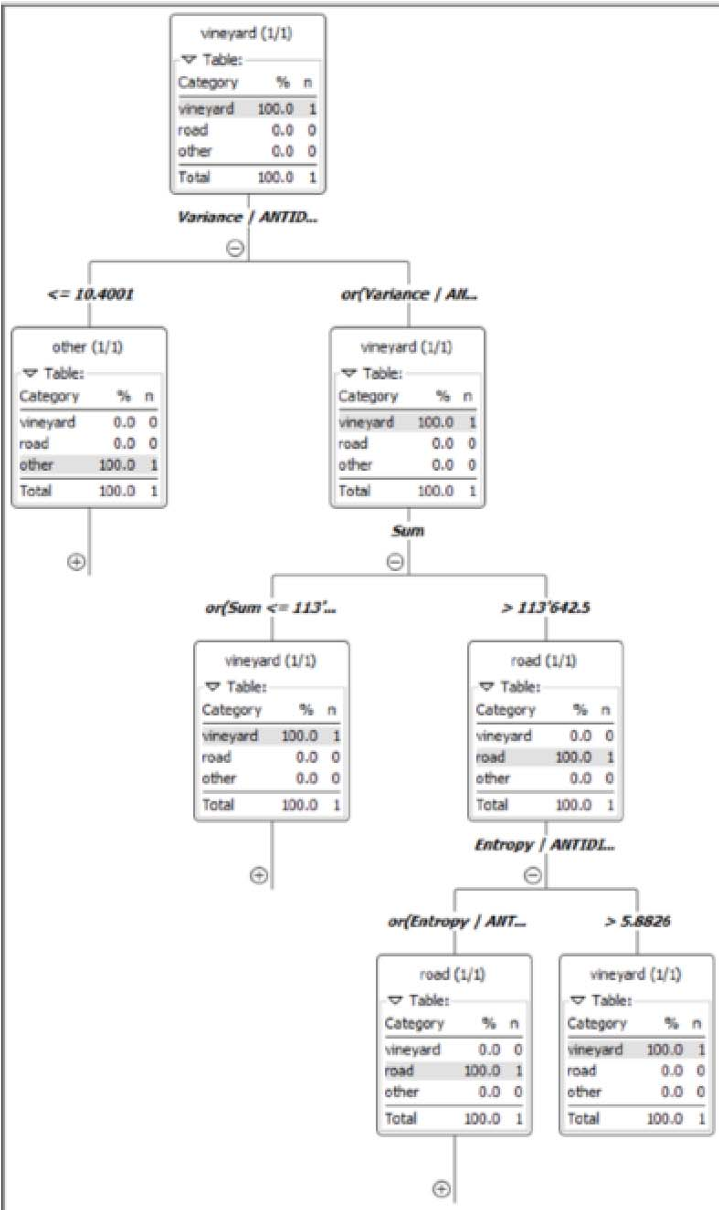 Fig 7: An extract of the DTE decision logic showing the path to high-precision classification.