
High-Quality Vehicle Crowdsourcing: Moving Beyond the "Current Location" Trap
High quality participant recruitment in vehicle-based crowdsourcing using predictable mobility
This paper introduces a novel participant recruitment strategy for vehicle-based crowdsourcing that leverages predictable mobility. By shifting from current-location-only recruitment to a trajectory-aware model, the authors propose two algorithms—Greedy-SC and GA-TC—to maximize spatial and temporal coverage while significantly outperforming traditional smartphone-based recruitment methods.
TL;DR
Vehicles are more than just "smartphones on wheels." Their movement is highly predictable due to road networks and navigation. This paper breakthroughs the limitations of static recruitment by using predicted trajectories to optimize crowdsourcing. By introducing Greedy and Genetic algorithms, the authors achieve a 15% improvement in coverage quality compared to traditional methods that only look at where a vehicle is right now.
Background: The Predictability Advantage
In the world of mobile crowdsourcing, location is everything. Most existing systems treat participants as stochastic points on a map. However, vehicles follow deterministic paths—buses have schedules, and private cars use GPS navigation.
The authors argue that ignoring this predictable mobility is a massive missed opportunity. If you recruit a vehicle because it is in a target area now, but it drives away 30 seconds later, your "temporal coverage" fails. Conversely, a vehicle currently outside a zone might be the perfect candidate if its path intersects that zone for the next ten minutes.
The Problem: Two Flavors of Quality
The paper identifies that "Quality" isn't a single metric. They define two distinct NP-hard optimization problems:
- SC-VPR (Spatial Coverage): Aimed at sparse scenarios. Focuses on covering the maximum number of unique regions across all time slots.
- TC-VPR (Temporal Coverage): Aimed at dense scenarios. Focuses on the "weakest link"—ensuring that the region with the least coverage still meets a minimum service duration.
Methodology: Bridging Math and Movement
The core of the methodology is the Participant Trajectory Matrix (P). Instead of a single snapshot, the recruiter looks at a matrix where rows are vehicles and columns are discrete time steps.
1. The Greedy-SC Algorithm
To solve Spatial Coverage, the authors developed a Greedy algorithm based on Cost Effectiveness (CE). Instead of just picking the "best" vehicle, they pick the vehicle that provides the highest marginal increase in spatial coverage per unit of budget.
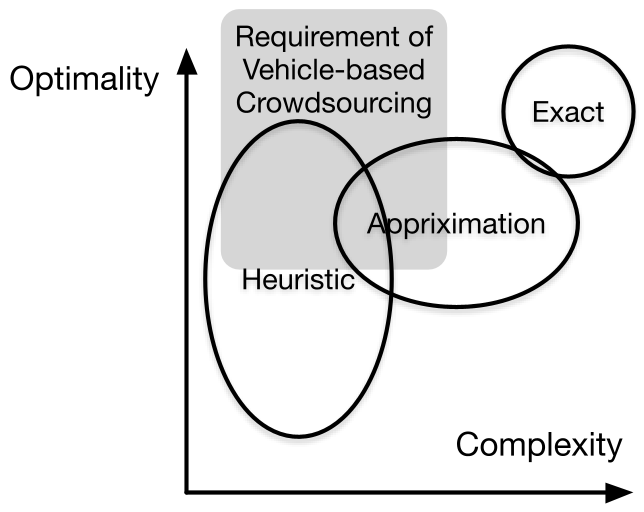 Fig 1: The decision framework for choosing between Approximation and Heuristic approaches.
2. The GA-TC Algorithm
For Temporal Coverage, where the search space is often larger, they utilize a Genetic Algorithm (GA). The GA treats different sets of recruited vehicles as "chromosomes," using crossover and mutation to find near-optimal configurations that ensure every target region stays "covered" for as long as possible.
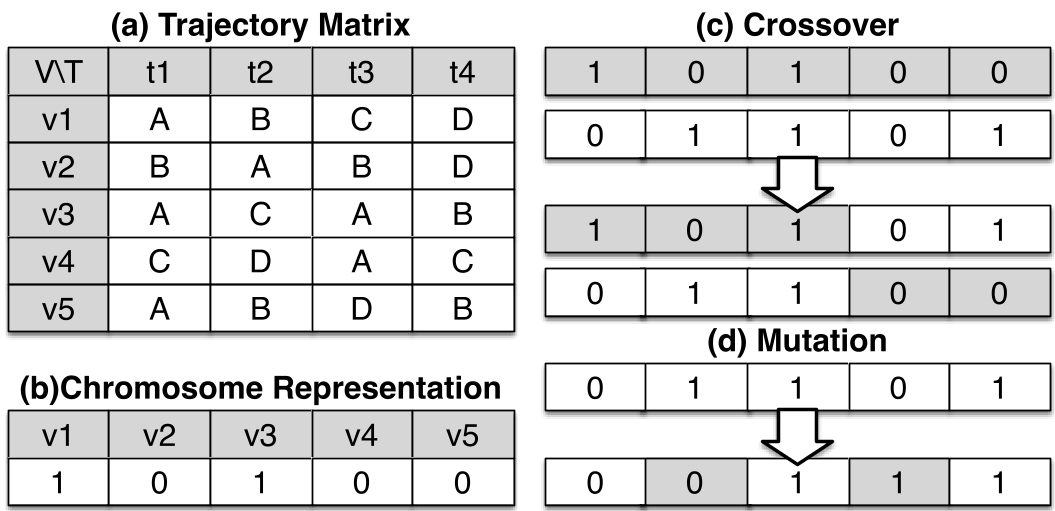 Fig 2: Genetic representation of participant sets, facilitating efficient search in dense vehicle environments.
Experiments: Real-World Validation
Using the TAPAS-Cologne dataset (a massive trace of urban traffic in Germany), the researchers simulated traffic monitoring tasks.
Key Findings:
- Performance Superiority: The trajectory-aware algorithms consistently outperformed current-location-based "Unpredictable" models.
- Resilience to Error: A common critique of trajectory-based models is: "What if the prediction is wrong?" The authors proved that even with 50% error in trajectory prediction, their method still beat the baseline by 10%.
- Scalability: The Greedy algorithm maintains polynomial time complexity , making it feasible for real-time recruitment in smart cities.
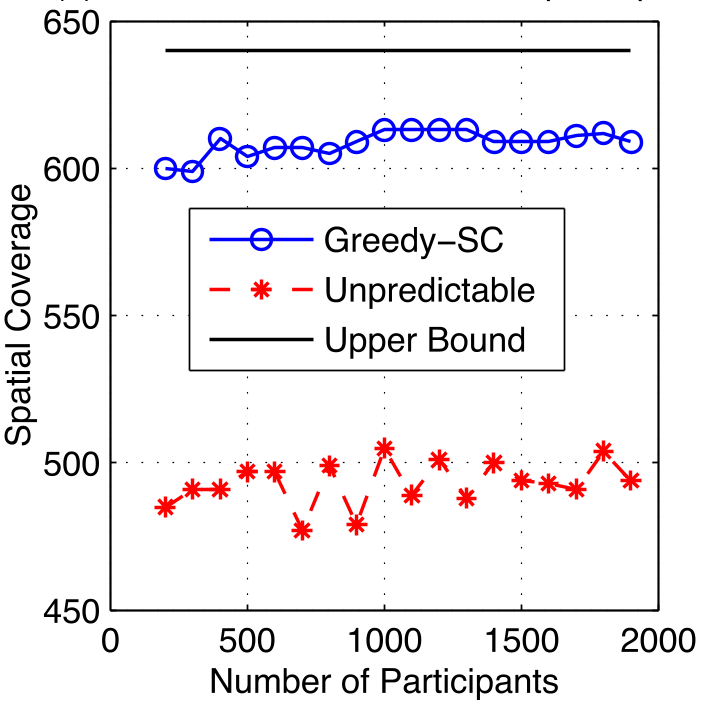 Fig 3: Results showing that predictable mobility-based recruitment stays closer to the theoretical upper bound of quality.
Critical Insight & Conclusion
This paper shifts the paradigm of recruitment from reactive (where are they?) to proactive (where will they be?). The -approximation factor provides a solid theoretical floor, but the empirical results suggest the practical floor is much higher.
Limitations: The model assumes that "online bidding" or static costs are provided upfront. In a real-world Uber/Lyft-like scenario, costs might fluctuate wildly based on traffic density or driver preferences, which would add another layer of complexity to the cost-effectiveness calculation.
Ultimately, this work lays the foundation for more efficient smart city sensing—using fewer vehicles to achieve better results by simply "knowing where they're going."