
Amorphous Alumina: Redefining Plasticity in Nuclear-Grade Coatings
High-temperature behavior of amorphous alumina coatings: Insights from in-situ nanoindentation and X-ray diffraction studies
This study investigates the high-temperature mechanical and structural behavior of pulsed laser deposition (PLD)-grown amorphous Al2O3 coatings for nuclear applications. Using in-situ nanoindentation, X-ray diffraction (XRD), and Molecular Dynamics (MD) simulations, the authors demonstrate that the material retains its amorphous structure up to 650 °C, exhibiting a gradual decrease in hardness but maintaining a constant Young's modulus.
TL;DR
Researchers have uncovered that amorphous Al2O3 coatings, intended for Gen IV nuclear reactors, exhibit a unique "ductile" response at high temperatures. Unlike their crystalline counterparts, these coatings maintain constant bond stiffness (Young's modulus) while becoming significantly more plastic as they approach 650 °C. This behavior suggests that these coatings are far more damage-tolerant under operational heat than previously assumed.
Background: The Quest for Corrosion Resistance
In Lead-Cooled Fast Reactors (LFR), fuel claddings must survive the corrosive "bite" of liquid lead at temperatures exceeding 500 °C. While traditional steels fail, PLD-grown amorphous alumina (Al2O3) stands as a primary defense. However, the academic community has long debated: Does the amorphous state survive the heat, and if so, does it become too soft to protect the substrate?
The "Bond-Switching" Insight
This study provides a fascinating look at the mechanical "Why." Standard materials usually soften because their atomic bonds weaken with heat (lowering both hardness and modulus). But amorphous alumina is different.
The authors observed that while Hardness (H) dropped by nearly half at 550 °C, the Young’s Modulus (E) remained rock-solid. This suggests the fundamental bond strength isn't failing; instead, a mechanism called Bond-Switching is at play. Atoms shift neighbors without losing their local coordination, allowing the material to dissipate energy through plastic flow rather than cracking.
Methodology and Architecture
The team combined high-temperature nanoindentation with advanced structural probes to track these changes in real-time.
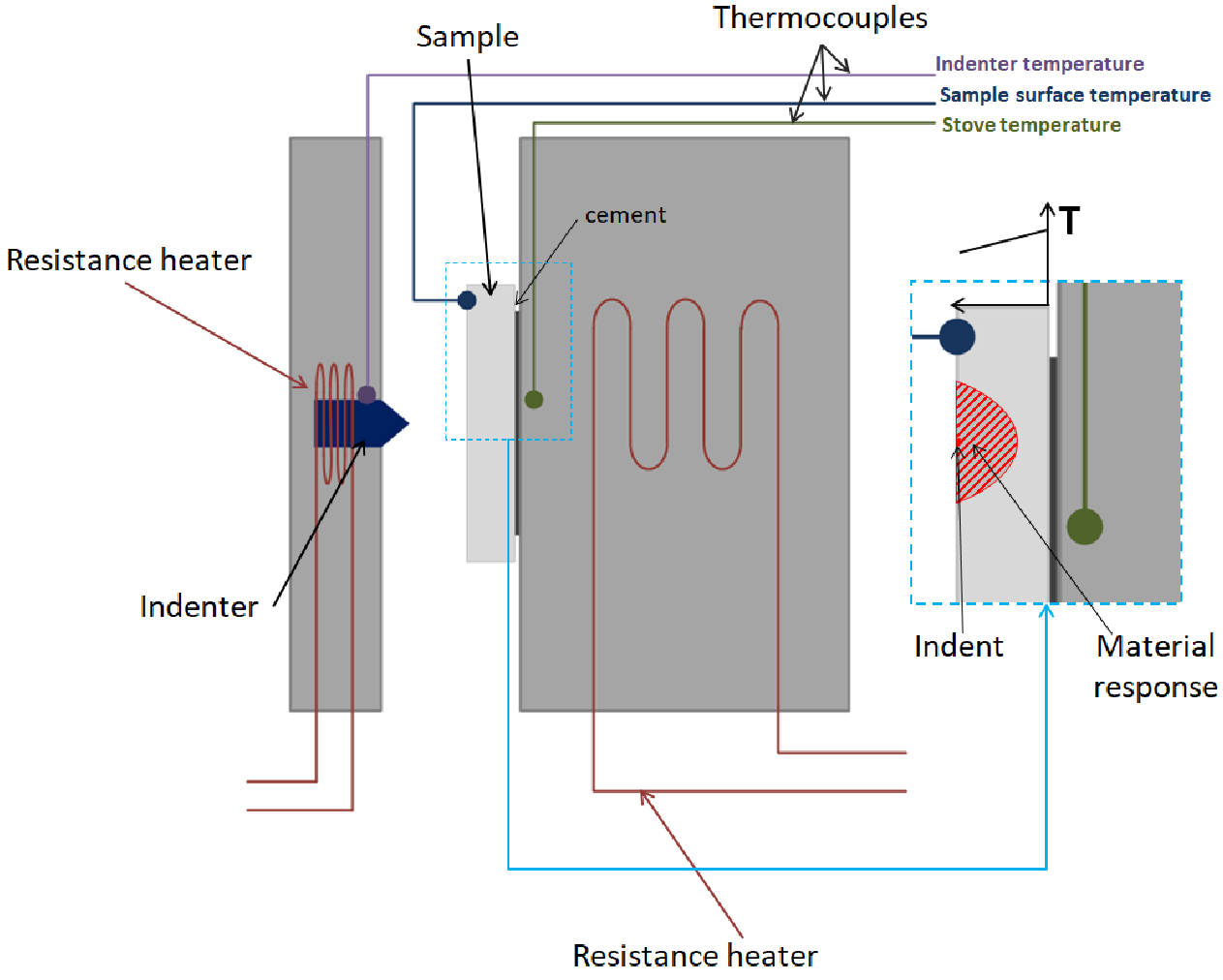 Fig 1: Schematic of the in-situ high-temperature nanoindentation setup, utilizing c-BN tips to withstand oxidative stress.
To validate the experimental findings, Molecular Dynamics (MD) simulations were used to model the nanocontact behavior of ~3.3 million atoms.
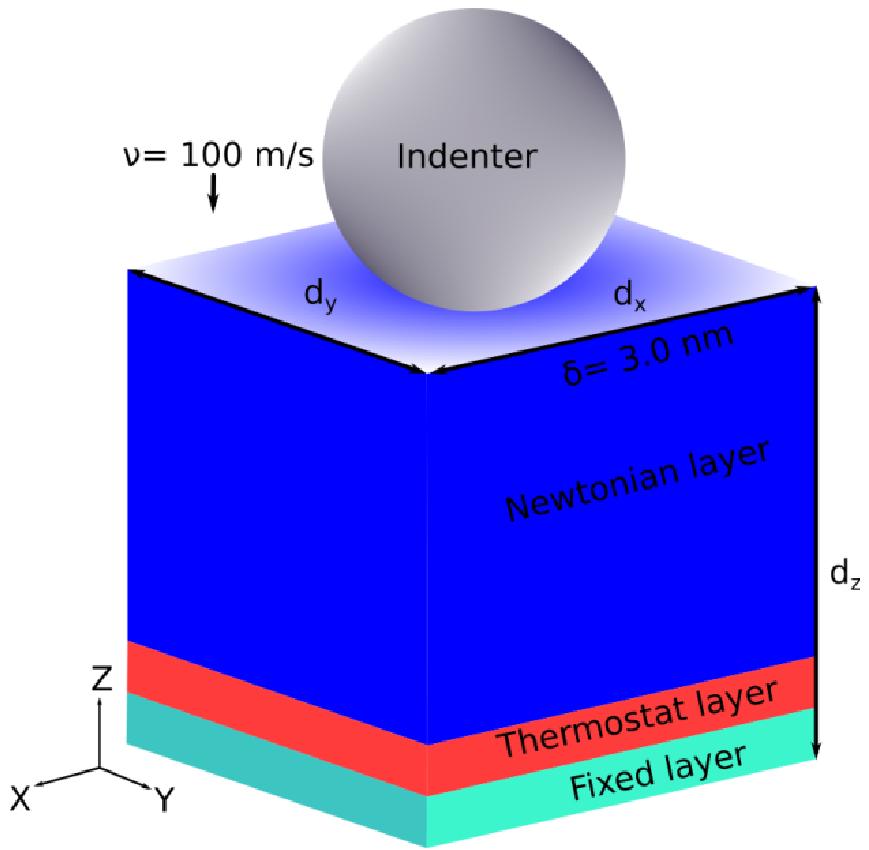 Fig 2: Scaling the physics: MD simulation model for the nanocontact between a spherical indenter and the amorphous alumina surface.
Key Results: Resilience Under Stress
The experiment successfully mapped the "Safe Zone" for these coatings:
- Thermal Stability: The amorphous phase is stable up to 650 °C. Crystallization only begins at 700 °C after a ~15-hour incubation period.
- Mechanical Evolution: Hardness decreases gradually, which actually makes the coating more compliant and potentially better matched to the expanding steel substrate at high temperatures.
- Young's Modulus: Stays constant at ~175 GPa, a result confirmed by both experiments and simulations—a rare alignment in nanomechanical research.
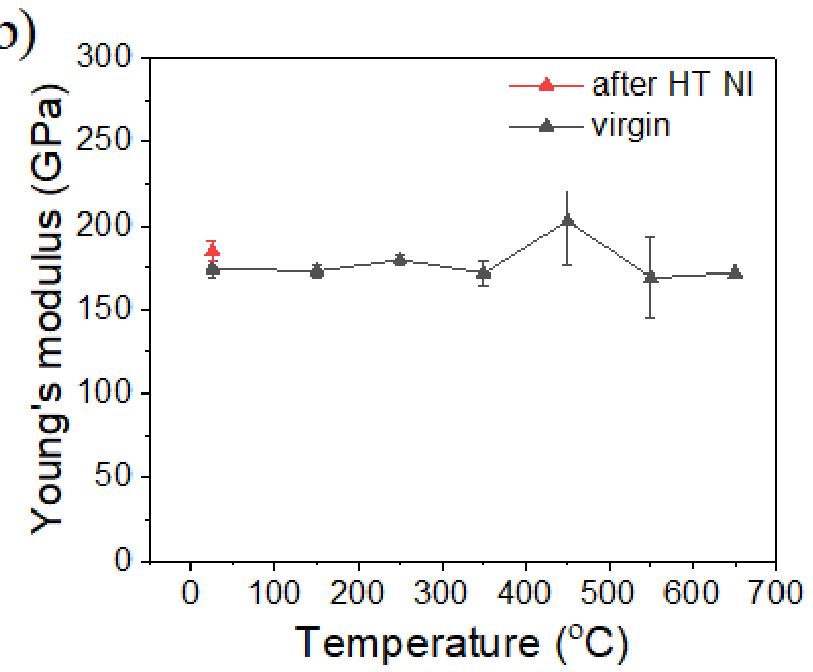 Fig 3: Quantifying the softening: Nanohardness drops significantly while Young’s modulus remains stable across the operational temperature range.
Critical Analysis: A Double-Edged Sword?
While the increased plasticity is a "win" for damage tolerance (preventing brittle delamination), the authors warn that phase control is critical. If the material crystallizes into θ or α phases, the properties shift abruptly. The transition at 700 °C is the "hard ceiling" for this material's current form.
Future Outlook: The next frontier is Elemental Stabilization. By doping the alumina with rare-earth elements or silicon, researchers hope to push the crystallization threshold even higher, ensuring the "ductile amorphous" advantage remains available at even more extreme temperatures.
Conclusion
This work bridges the gap between atomistic theory and nuclear engineering. It proves that for amorphous alumina, heat is not just a stressor—it’s a catalyst for an unexpected and beneficial boost in plasticity.