
High-Throughput DDR4 Command Trace Compression: Achieving 8 GB/s with Domain-Specific Huffman Hardware
2589_A High-Throughput Hardware Accelerator for Lossless Compression of a DDR4 Command Trace.
This paper presents a high-throughput hardware accelerator for the lossless compression of DDR4 memory command traces using an optimized Block Huffman coding scheme. By integrating unique preprocessing techniques and a pipelined architecture, the design achieves a massive 8 GB/s throughput with an average compression ratio of 40.13% on FPGA.
TL;DR
Analyzing memory access patterns is critical for DRAM optimization, but the resulting data traces are enormous. This paper introduces a specialized hardware accelerator that compresses DDR4 command traces losslessly at 8 GB/s. By combining an optimized Block Huffman architecture with memory-aware preprocessing (Don't Care Bits Override and Bits Arrange), the authors achieve a 40.13% compression ratio with significantly lower hardware cost than traditional SOTA methods like DEFLATE.
Problem & Motivation
In modern high-performance computing, understanding DRAM stress requires capturing every command the controller sends to the memory. At DDR4 speeds, this generates a firehose of data—32 bytes every clock cycle.
Current solutions face a "Trilemma":
- Lossless Requirement: Any data loss renders the trace analysis invalid.
- Real-time Throughput: Software-based compression is too slow; hardware must handle 8 GB/s (250 MHz @ 32B).
- Hardware Efficiency: Dictionary-based methods (LZW, LZ77) provide high ratios but require massive, complex hardware tables that struggle to meet timing at high frequencies.
The authors identified that raw DDR4 traces have high entropy (0.827), making them "hard" to compress. Their core insight was that by utilizing the specific physical characteristics of the DDR4 protocol, they could "flatten" this entropy before it ever hits the compression engine.
Methodology: The Core Architecture
The system is divided into three distinct stages: Preprocessing, Block Huffman Encoding, and Stream Merging.
1. Domain-Specific Preprocessor
The secret sauce lies in two techniques:
- Don't Care Bits Override: In DDR4, "Device Deselect" commands often contain "don't care" bits. Instead of leaving them as random noise, the preprocessor overrides them to fixed values (0 or 1) based on the frequency of other common commands like Read/Write, immediately lowering the data's entropy.
- Bits Arrange: Usually, commands are 32-bit blocks. The authors used K-medoids clustering to determine which specific bits across the 32-bit word are most correlated and reorganized them into four 8-bit groups. This ensures that the Huffman engine (which operates on 8-bit symbols) sees highly predictable patterns.
2. Block Huffman Hardware Optimization
Standard Huffman tree generation is computationally expensive (). The authors optimized this by:
- Using SRAM-based queues and bitmaps to reduce tree construction complexity to .
- Implementing a Block-based approach, which limits the maximum codeword length (to 19 bits in this case), drastically simplifying the hardware wire-width needed for the merging logic.
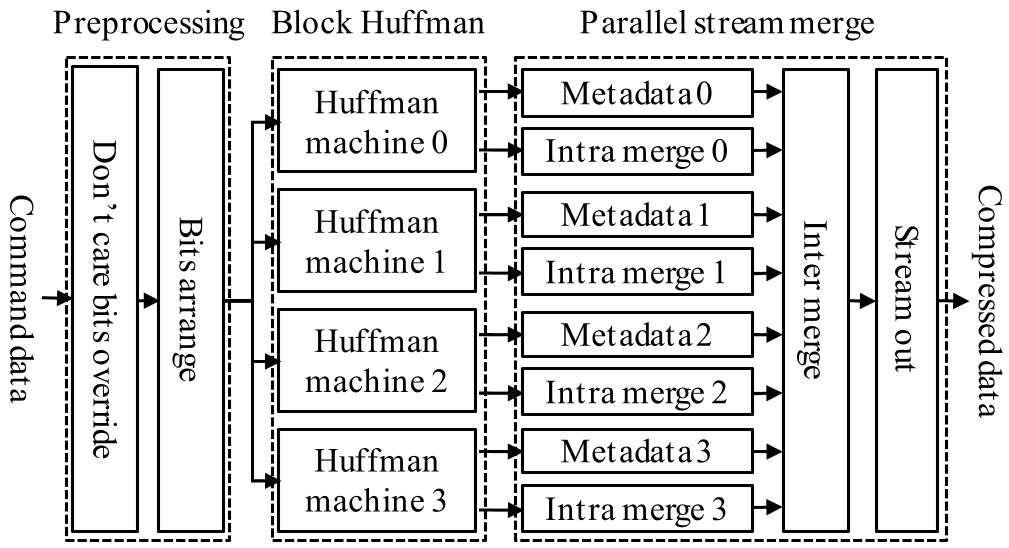 Figure 1: Overall structure of the proposed HW design including Preprocessing and Parallel Stream Merge.
3. Parallel Stream Merge
Merging variable-length codewords into a single bitstream is a bottleneck. The authors used a Resizer and FIFO-based architecture to handle the timing mismatch between metadata (tree info) and codeword data, allowing four parallel compression engines to output a single unified stream without stalling.
Experiments & Results
The design was validated on a Xilinx Virtex UltraScale VCU108 FPGA.
- Throughput: Stably maintained 8 GB/s at 250 MHz.
- Compression Ratio: While raw traces only compressed to ~83%, the preprocessed traces hit 40.13%. This actually beats Bzip2 (49.12%) which is significantly more complex.
- Hardware Efficiency: The total hardware resource per unit of throughput is roughly 27-50% lower than existing FPGA implementations of DEFLATE or X-MatchPro.
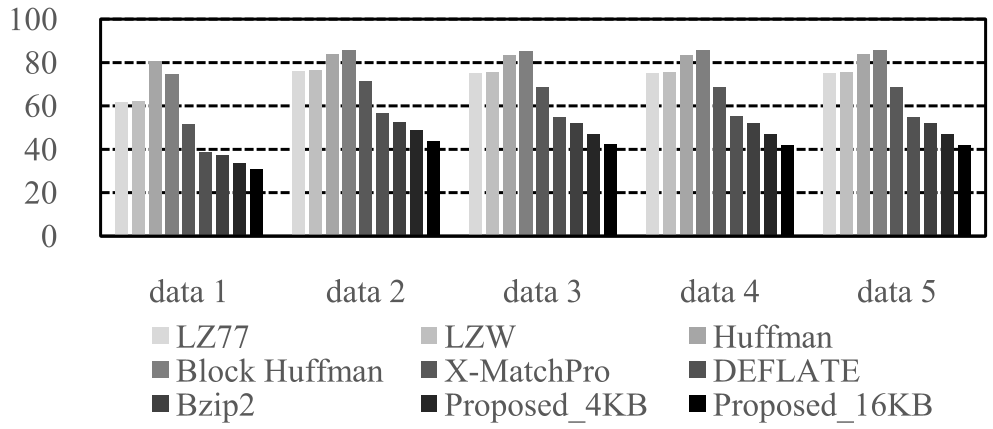 Figure 2: Compression ratio comparison against standard algorithms. The proposed method (last two bars) shows significant improvement.
Critical Analysis & Conclusion
Takeaway
The major takeaway of this work is that entropy reduction is just as important as the compression algorithm itself. By restructuring the input data to exploit "DDR4 semantics," a relatively simple Block Huffman engine outperformed much more sophisticated dictionary engines.
Limitations
The primary limitation is specialization. The "Bits Arrange" clustering was calculated offline based on specific DDR4 workloads. While the Huffman engine is scalable, the preprocessing logic might need to be "re-trained" or updated if applied to vastly different memory protocols (like HBM3 or specialized AI accelerators) where bit correlations differ.
Future Outlook
This architecture sets a benchmark for on-the-fly trace analysis. Future work could involve integrating these compression units directly into the Memory Controller IP, reducing the external pin count required for debugging and silicon validation.