
TiN/Ni Nanocomposites: Mastering the Hardness-Toughness Trade-off via High-Throughput Discovery
High throughput optimization of hard and tough TiN/Ni nanocomposite coatings by reactive magnetron sputter deposition
The paper presents a combinatorial synthesis and high-throughput analysis of TiN/Ni nanocomposite coatings with Ni content ranging from 0 to 20 at.%. By utilizing reactive magnetron sputtering with a well-defined composition gradient, the study identifies an optimum window (8-12 at.% Ni) that achieves SOTA mechanical performance, including a peak hardness of ~32 GPa and fracture toughness of 4.8 MPa·m1/2.
TL;DR
Researchers have successfully engineered a TiN/Ni nanocomposite coating that breaks the traditional trade-off between hardness and brittleness. Using a combinatorial high-throughput strategy, they identified an "optimal zone" of 8-12% Ni where the material attains a hardness of 32 GPa and enhanced toughness while virtually eliminating harmful residual stresses.
The "Ceramic Dilemma": Hard but Brittle
In the world of protective coatings, Titanium Nitride (TiN) is a staple. However, monolithic TiN is prone to brittle fracture due to its columnar grain boundaries. While adding Silicon (Si) to form nc-TiN/a-Si3N4 can push hardness to extreme levels (Superhardness), it often exacerbates brittleness.
The authors' insight was simple yet profound: Could a ductile metallic "tissue" (Nickel) replace the brittle ceramic tissue (Si3N4) to provide both strength and energy dissipation? To find out, they bypassed the slow "one-sample-at-a-time" method and used a combinatorial approach.
Methodology: The Power of Gradients
By keeping the substrate stationary during reactive magnetron sputtering, the team created a 100mm-long "material library" where the Ni content feathered from 0% to 20%.
Structural Evolution
The study utilized STEM (Scanning Transmission Electron Microscopy) to observe a critical phase transition:
- Pure TiN: Classic columnar grains (Zone T), high residual stress.
- TiN / 10% Ni: A disruption of columnar growth, leading to equiaxed nanograins (5-10 nm) of TiN swimming in a Ni-rich amorphous sea.
- TiN / 18% Ni: Over-saturation; the nanocomposite structure collapses into defective columns with voids.
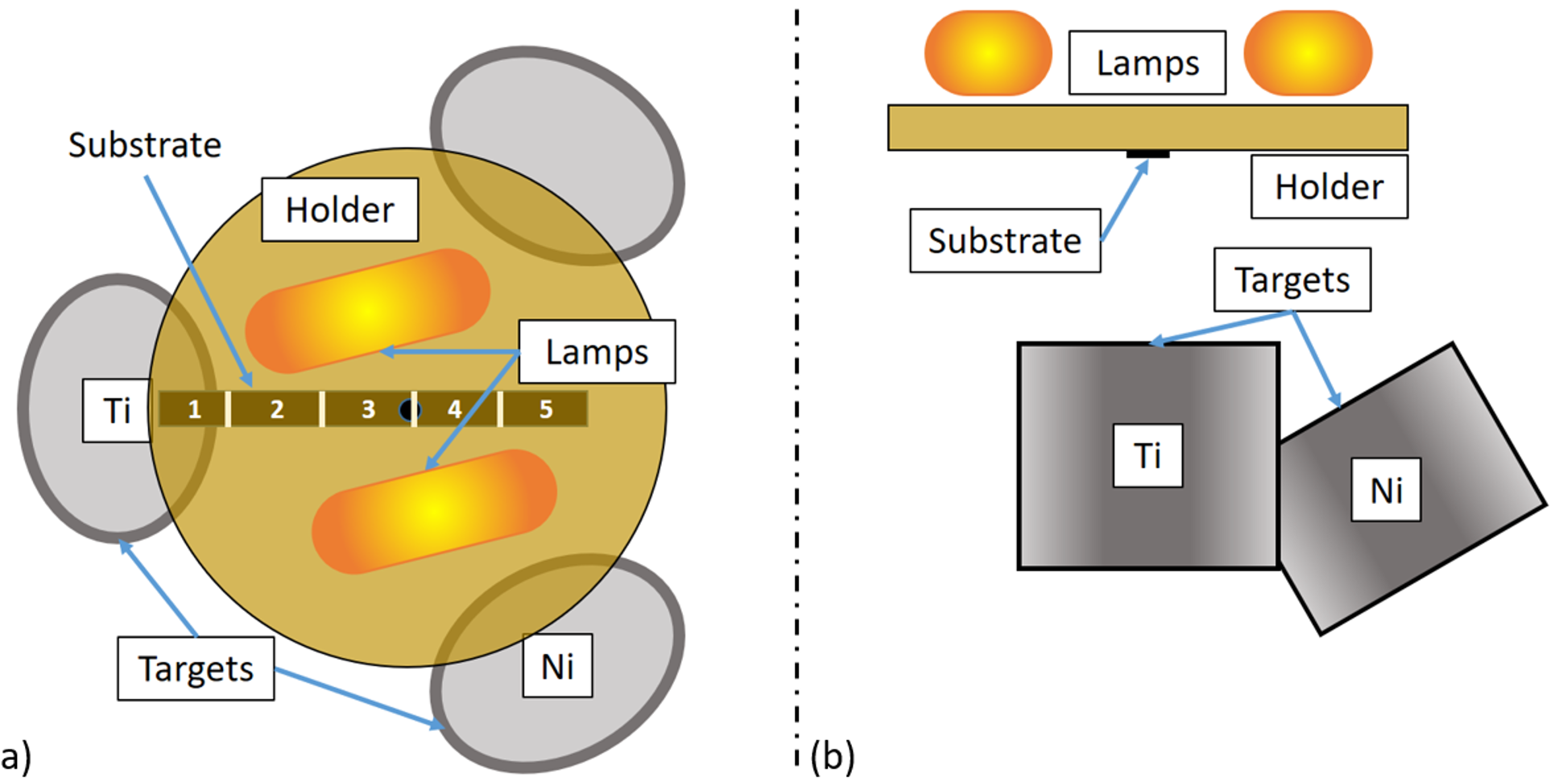 Figure 1: Combinatorial setup (left) and the resulting transition from columnar to equiaxed nanostructures (right).
Experimental Breakthroughs: Mechanical Mapping
The paper shines in its characterization rigor. By combining High-Speed Nanoindentation with Micropillar Splitting, they mapped the "property landscape" across the chemical gradient.
- Hardness & Toughness: Both properties peaked at ~10 at.% Ni. This suggests that the Ni-rich amorphous phase doesn't just "soften" the matrix; it creates strong interfaces that block grain boundary sliding while permitting just enough localized plasticity to stop cracks.
- Stress Relief: One of the most striking findings was the reduction of compressive strain from 1.5% to near zero. The Ni phase effectively acts as a "stress buffer," accommodating the atomic peening effects of ion bombardment.
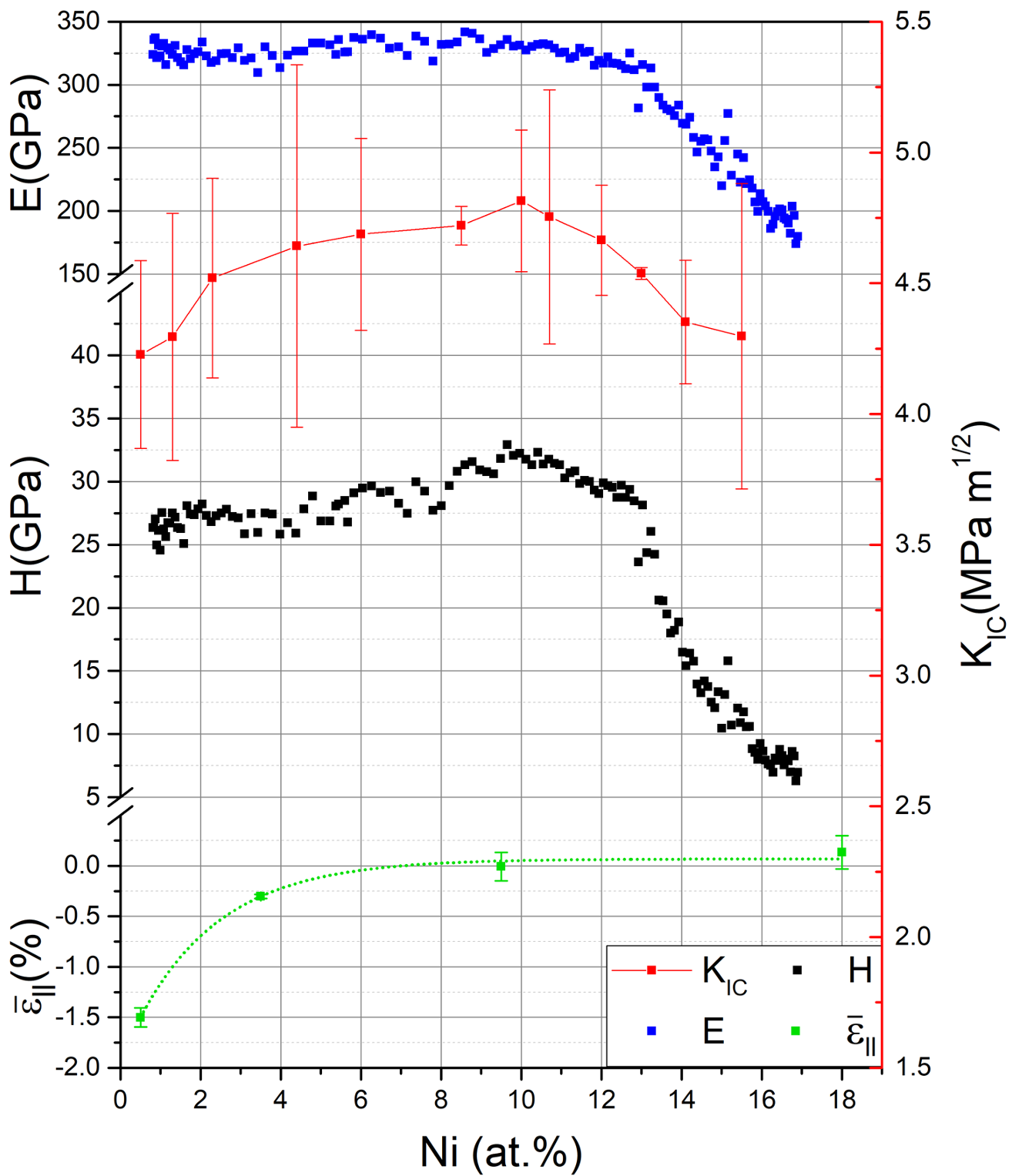 Figure 2: Correlated plots show the "sweet spot" at 8-12% Ni where Hardness, Modulus, and Toughness are optimized.
Critical Insight: Why Does it Fail After 13%?
Beyond 13 at.% Ni, the performance tanks. The researchers used XRD lattice parameter analysis to hypothesize that excess Ni forces the TiN phase to become highly over-stoichiometric or causes Ni to substitute for Ti in the lattice. These "defective" TiN grains have weaker atomic bonds, evidenced by a significant drop in the elastic modulus.
Conclusion & Future Outlook
This work provides a roadmap for "Materials by Design." It proves that the incorporation of a metal phase into a nitride matrix is a viable path for high-performance coatings in extreme wear environments.
Takeaway for the industry: To achieve maximum coating life, don't just chase hardness. A "balanced" nanocomposite microstructure—where a ductile phase suppresses brittle columnar boundaries—is the key to durability.
Limitations: While the high-throughput method is fast, the thermal stability of the Ni-rich amorphous phase under high-temperature service conditions (e.g., cutting tools) remains an open question for future study.