
Logic of the Purse: Do Higher Incentives Actually Buy Better Software?
Do Higher Incentives Lead to Better Performance? - An Exploratory Study on Software Crowdsourcing
This study explores the relationship between monetary incentives and worker performance in software crowdsourcing using data from TopCoder. It conceptualizes two pricing strategies—Proactive (overpricing) and Egocentric (underpricing)—and evaluates their impact on participation, velocity, and quality.
TL;DR
In the hyper-competitive world of software crowdsourcing, task requesters often struggle with a fundamental question: "If I pay more, will I get better code?" This study analyzes nearly a decade of TopCoder data to prove that while higher incentives boost participation and speed, they hits a "quality ceiling." Paradoxically, over-paying by too much can lead to a decline in submission scores, mirroring the economic phenomenon of moral hazard.
The "Pricing Paradox" in Crowdsourcing
In traditional markets, price is a signal of value. In crowdsourcing, it is a magnet for talent. However, previous research was split: does a higher bounty attract "experts" or just a "noisy crowd"? This paper moves beyond simple tasks (like clicking boxes) to the complex domain of software engineering, where skill variance is high and quality is harder to measure.
The authors identify two core behaviors:
- Proactive Pricing (Over-pricing): Paying more than the market average to secure talent.
- Egocentric Pricing (Under-pricing): Leveraging brand power (e.g., Google or FB) to pay less, assuming workers will join for the prestige.
Methodology: Finding the "Fair" Price
To determine if a task is over or under-priced, you first need a "Nominal Price." The researchers used an ensemble of 5 ML models (including Neural Networks and SVMs) to estimate what a task should cost based on 16 drivers (technology count, lines of code, requirement complexity, etc.).
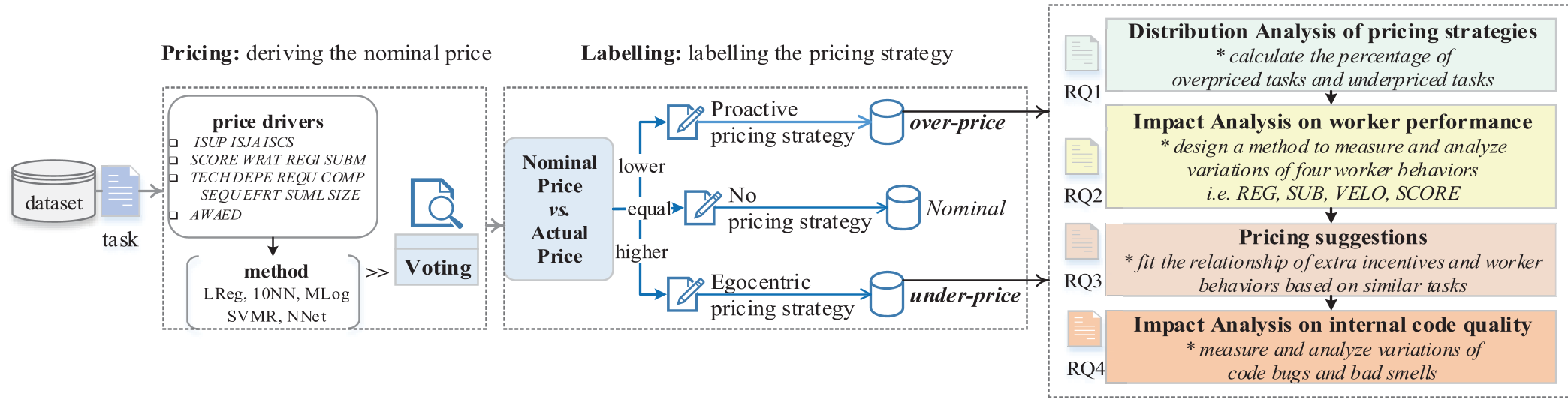
By comparing the Actual Price to the Nominal Price, the researchers could label each task and observe the resulting worker behavior.
High Incentives: A Double-Edged Sword?
The results provide a nuanced roadmap for anyone looking to outsource development:
1. Participation & Speed: The Linear Gain
As expected, the proactive pricing strategy works wonders for the "quantity" of work. Over-priced tasks saw a clear linear increase in:
- REG (Registrants): More people sign up to look at the spec.
- SUB (Submissions): More finished products are delivered.
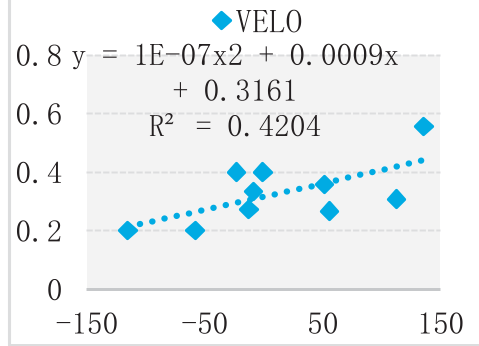
- VELO (Velocity): Tasks are completed faster.
2. The Quality Trap: Score vs. Code Health
This is where it gets interesting. The study split quality into External Quality (Submission Score) and Internal Quality (Bugs and Bad Smells).
- The Parabola of Scores: As incentives increase, scores go up—until they don't. After a certain threshold (~$100-150 extra), the score begins to drop. The authors attribute this to "Moral Hazard"—extreme rewards might attract participants who focus on gaming the scorecard rather than delivering robust engineering.
- Internal Code Health: Interestingly, higher pay always correlated with fewer bugs and "bad smells" detected by SonarQube, even when the overall score dipped.
Deep Insight: Efficiency and Fairness
The paper concludes with a call for "Market Efficiency."
- For Requesters: Don't just throw money at a problem. Increase awards modestly. Paying 500 task won't give you 4x the quality; it might actually give you a messier result.
- For Platforms: Platforms like TopCoder should intervene when they see "labor exploitation" (under-pricing) because it leads to higher bug density and slower turnaround.
Critical Analysis & Future Outlook
While the study is robust, it relies on TopCoder's competitive model. It doesn't necessarily apply to collaborative crowdsourcing (like Open Source). Furthermore, it focuses on monetary rewards, ignoring the "Glory" or "Social Recognition" factor which is massive in developer communities.
Takeaway: If you want your software delivered fast and with fewer bugs, pay a premium. If you want the "perfect" score, pay just enough to be competitive, but not so much that you attract the wrong kind of attention.