
Historical Geo-Social Query Processing: Decoding User Patterns Across Time and Space
Historical Geo-Social Query Processing
The paper introduces two novel historical geo-social queries: Spatio-Temporal Group of Interest (STGI) and Spatio-Temporal Group Life Pattern (STGLP). To handle these, it proposes two specialized indexing structures, HCKI and UTI, which extend HR-trees with Bloom Filters and user statistics to optimize retrieval in the spatial, temporal, and social dimensions.
TL;DR
This paper addresses the gap in historical analysis within Geo-Social Networks (GeoSN). The authors propose two new query types, STGI (Group Interest) and STGLP (Group Life Pattern), supported by two innovative indexing structures, HCKI and UTI. These indexes allow for efficient multi-dimensional filtering across space, time, keywords, and social behavior, outperforming traditional exhaustive search methods.
The Shift from Real-Time to Historical Geo-Social Analysis
In the current era of ubiquitous check-ins (e.g., Foursquare, Yelp, WeChat), Geo-Social Networks have become a goldmine for researcher. However, while most systems focus on "who is near me now," there is a lack of robust tools for historical group analysis.
The challenge is three-fold:
- High Dimensionality: Data involves spatial coordinates, timestamps, social links, and textual keywords.
- Temporal Sparsity: User trajectories are often fragmented.
- Group Constraints: Queries don't just look for individuals but for groups satisfying collective keyword coverage or movement patterns.
Methodology: HCKI and UTI Indexes
The core contribution lies in two specialized indexing structures that evolve the traditional HR-tree (Historical R-tree) concept.
1. HCKI (Historical Check-in Keyword Index)
Designed for the STGI query, which finds groups checking into POIs within a range and time that satisfy a keyword set .
- Architecture: It augments R-tree nodes with Bloom Filters (BF).
- Intuition: By checking the Bloom Filter at an internal node, the system can instantly prune entire subtrees if they don't contain the required keywords, avoiding expensive spatial-temporal calculations for irrelevant data.
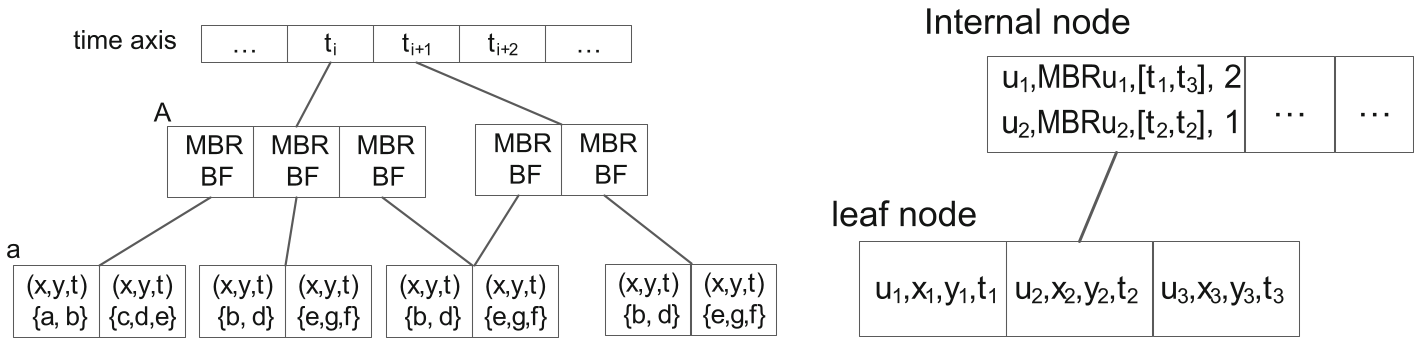
2. UTI (User Trajectory Index)
Designed for the more complex STGLP query, which identifies groups with specific "life patterns" (e.g., visiting a region times within every time slot ).
- Architecture: Internal nodes store an MBR and a set containing statistics .
- Mechanism: The algorithm calculates an "average count" () for users within a node. If a user's frequency in a specific segment is lower than , that user is pruned, and the node's MBR is effectively "shrunk" for that query branch.
Experimental Insights
The researchers tested their approach against a non-indexed baseline using a hybrid dataset.
- Scalability: As the spatial/temporal range increases, response time naturally grows, but HCKI maintains a significantly lower slope than the baseline.
- Pruning Power: In STGLP queries, the parameters (frequency) and (granularity) act as powerful filters. A larger allows the UTI to discard more users early in the tree traversal, leading to faster inference despite a more restrictive query.
- Keyword Load: Bloom Filters proved highly effective; as the number of queried keywords increased, the index successfully limited the search to only relevant POI clusters.
Critical Analysis & Future Work
Strengths: The paper provides a very practical bridge between theoretical spatial indexing and real-world social network requirements. The inclusion of Bloom Filters is a classic but highly effective optimization for textual-spatial data.
Limitations:
- The "social" aspect in the group formation phase is mentioned but less detailed than the spatial-temporal indexing logic.
- The evaluation uses a hybrid dataset; true performance on massive-scale, real-world global trajectories (like Twitter or Didi data) remains to be seen.
Conclusion: This work lays the groundwork for "Spatio-Temporal Social Mining," enabling applications ranging from targeted group marketing to historical behavioral modeling in urban environments.