
Mapping the Genesis: A Quantitative History of AI Applications (1984–1995)
15876_On the History of AI Applications, II IEEE Conference on Artificial Intelligence Applications.
This paper presents a quantitative historical analysis of the IEEE Conference on Artificial Intelligence Applications (CAIA) from 1984 to 1995. It identifies key contributors, organizational trends, and the international structure of the AI application field during its foundational decade.
TL;DR
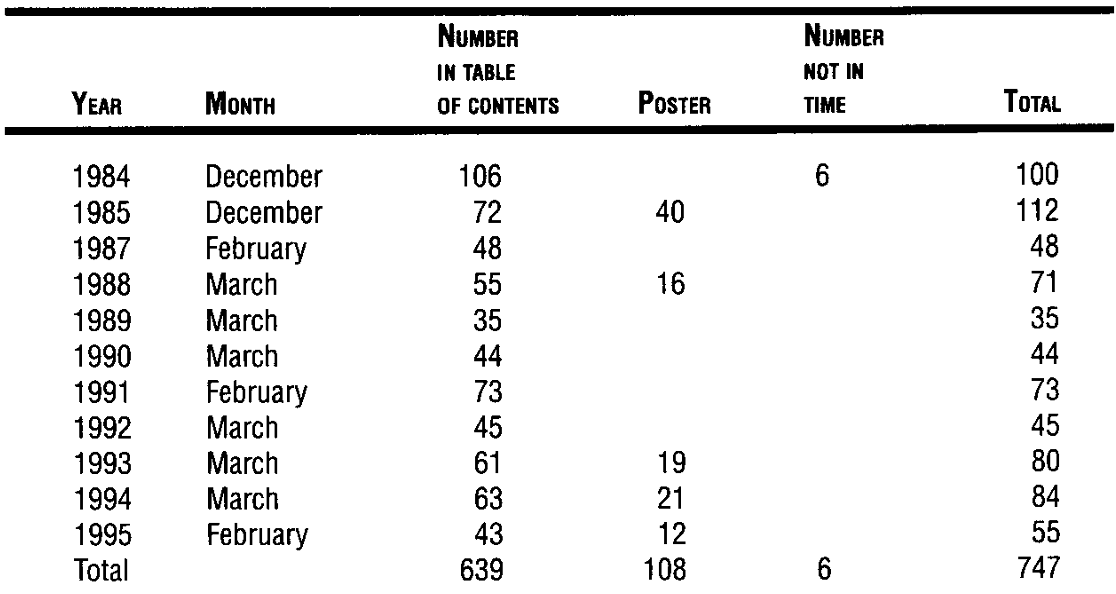
This article provides a data-driven autopsy of the IEEE Conference on Artificial Intelligence Applications (CAIA) during its first 12 years. By analyzing 747 papers and 1,715 author appearances, it reveals the "who's who" of AI pioneers, the dominance of industrial-academic partnerships, and the early internationalization of the field. It moves beyond "what" was built to quantify "who" built the foundation of modern AI applications.
Problem & Motivation: Beyond Anecdotes
Why look at the history of a conference from the 80s? In AI, historical perspective isn't just nostalgia; it’s about understanding the Inductive Bias of the industry. Prior to this analysis, the narrative of AI’s growth was largely qualitative. The author argues that a quantitative approach "brings the whole of evidence into intelligible focus," allowing us to identify:
- The "core" researcher group sustaining the field.
- The balance of power between Corporate R&D (Nonacademic) and University labs.
- The geographical distribution of AI innovation during the first "AI Autumn."
Methodology: The "Adjusted Appearance" Metric
The core of this paper’s insight lies in its data processing. Instead of just counting names, the author uses Adjusted Appearances.
- Actual Appearances: A simple count of how many times a name appears.
- Adjusted Score: Calculated as where is the number of co-authors. This prevents "guest authorship" from inflating stats and highlights researchers who were primary drivers of their work.
Methodology & Core Actors
The author identifies a "Core Group" of 95 authors responsible for nearly 15% of the research. Notably, Judea Pearl (the father of Bayesian networks) and Gautam Biswas emerge as pivotal figures.
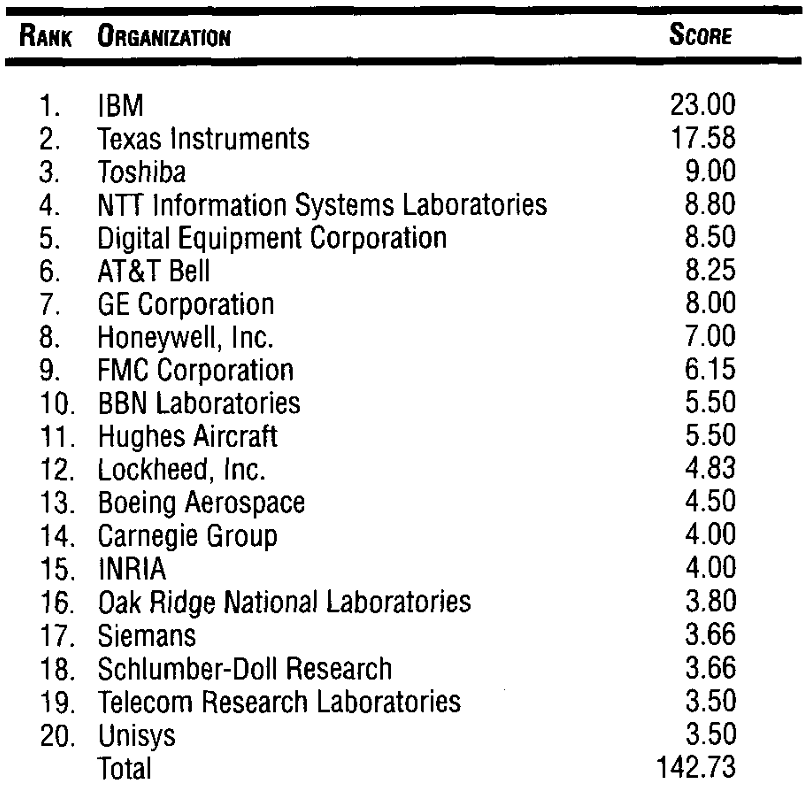
What is perhaps most striking for a modern reader is the industrial presence. Unlike today's landscape, where Big Tech (Meta, Google) dominates, the 1984-1995 era saw IBM, Texas Instruments, and Toshiba as the leading non-academic powerhouses.
Experiments & Results: The US-International Paradox
The quantitative results reveal a fascinating tension:
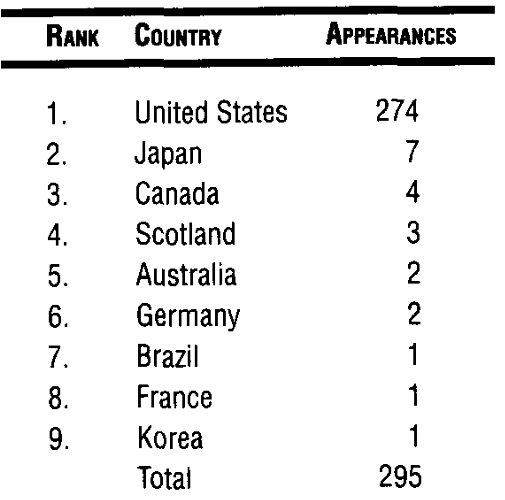
- Author Diversity: IEEE CAIA was remarkably international for its time. Nearly 30% of papers came from outside the US, with Japan and Canada leading the charge.
- Committee Concentricity: Despite the international author base, the "Gatekeepers" (Program Committee) were 92.88% US-based.
This suggests that while the ideas were global, the governance and organizational memory of AI applications were heavily concentrated in the US, particularly within institutions like USC, CMU, and Stanford.
Critical Analysis & Conclusion
Takeaway
The paper proves that the "Core" of AI applications research was a small, tight-knit community. Roughly 40% of all contributions came from just 40 institutions. This concentration has pros (rapid knowledge transfer) and cons (potential for echo chambers).
Limitations
- Quality vs. Quantity: The author explicitly ignores "quality issues," assuming the peer-review process is a flat filter. We know from hindsight that some papers in these proceedings were transformative (e.g., Pearl's work), while others were dead ends.
- Name Changes: The study fails to account for name changes (e.g., marriage), which could slightly undercount female pioneers in the field.
Future Outlook
As we look at the current LLM era, this paper serves as a reminder that AI progress is cyclical. The industrial titans of 1985 (Digital Equipment Corporation, etc.) are largely gone or changed, but the academic hubs (CMU, Stanford, Illinois) remain the bedrock. The "International Forum" aspect of CAIA was a precursor to today's hyper-globalized AI research community.