
History-Assisted Sensing: Slashing Energy Consumption in Cognitive Radio Networks
8589_History-Assisted Energy-Efficient Spectrum Sensing for Infrastructure-Based Cognitive Radio Networks.
This paper introduces a history-assisted energy-efficient spectrum sensing scheme for infrastructure-based Cognitive Radio (CR) networks. By utilizing a centralized Analytical Engine Database (AED) to store and process PU activity history, the scheme reduces the need for continuous spectrum scanning, significantly improving the energy efficiency of secondary users.
TL;DR
Spectrum sensing is the backbone of Dynamic Spectrum Access (DSA), but its energy cost is a death sentence for battery-powered devices. This paper presents a History-Assisted Spectrum Sensing scheme that uses a centralized database (AED) to help Secondary Users (SUs) "remember" rather than "sense." By leveraging historical patterns of Primary User (PU) activity, the framework achieves an impressive 60% boost in effective energy savings while reducing computational complexity.
Background: The Energy-Sensing Dilemma
In the world of Cognitive Radio (CR), SUs are the "uninvited guests" who must constantly check if the "host" (Primary User) has returned to the signal band. Traditionally, this requires continuous scanning using methods like:
- Energy Detection (ED): Simple but struggles with noise.
- Cyclostationary Feature Detection (CFD): Highly accurate but computationally brutal.
The problem? Continuous sensing consumes massive amounts of power. Most prior works focus on making the sensing algorithms better, but few address the frequency of sensing. This paper argues that if we know the PU's habits, we don't need to look at the spectrum every single millisecond.
Methodology: Intelligence via Memory
The core innovation is the Analytical Engine Database (AED). Instead of every CR device trying to learn the environment independently (which duplicates effort and wastes power), they report their findings to the AED.
The Architecture
The system follows a Markov Chain transition model for both PUs and SUs. The AED processes raw sensing data into a Scan Threshold ().
- Low : History is unreliable; the SU must perform full scanning.
- High : Frequent patterns detected; the SU can rely on history and skip the sensing phase to save power.
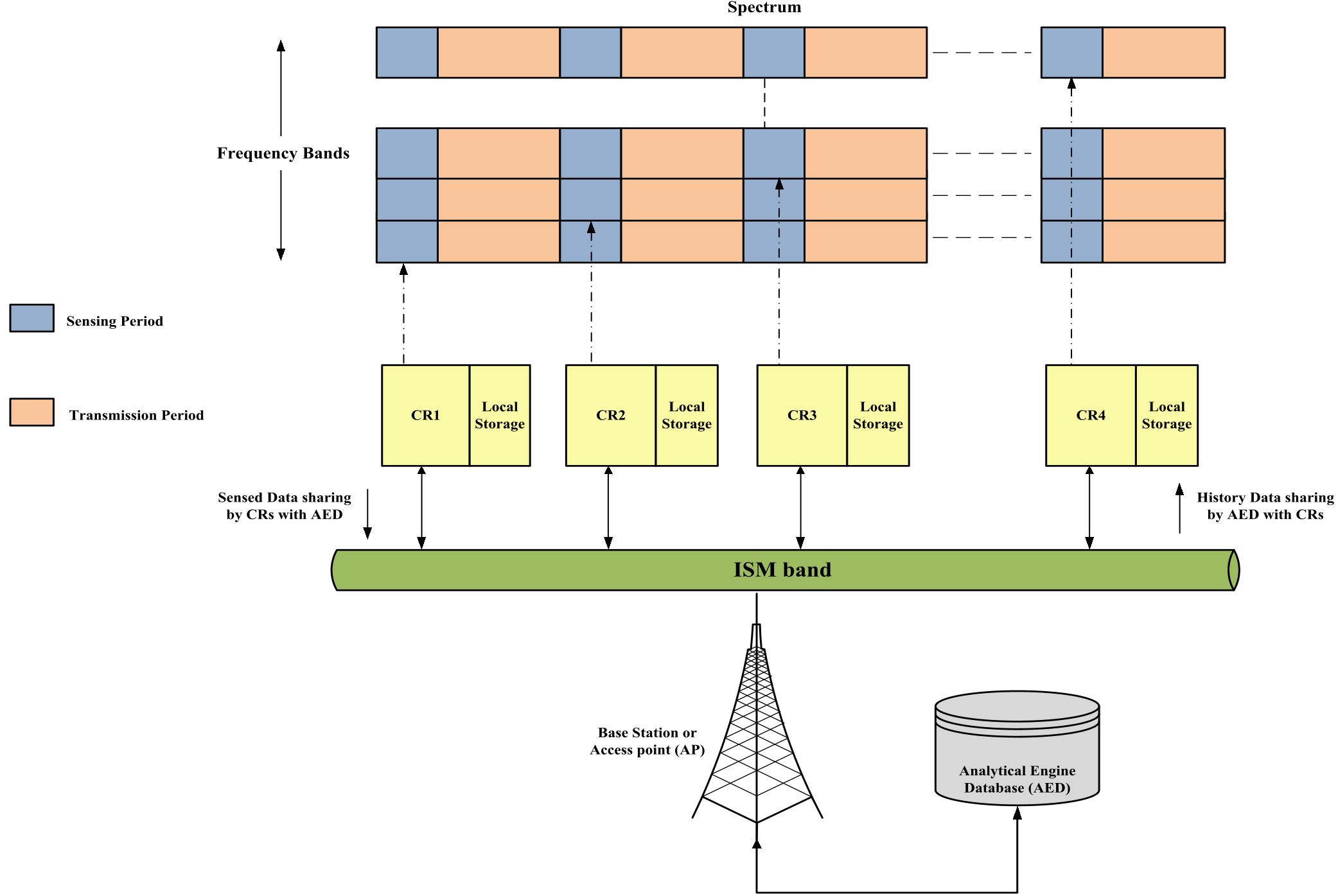 Fig 1. The complete architecture showing the interaction between SUs, the Base Station, and the AED.
Computational Efficiency
By delegating the "learning" to the infrastructure, the computational burden on the SU is minimized. The paper provides a rigorous comparison: CFD is approximately times more complex than ED. By reducing the frequency of CFD through history, the overall system energy consumption drops significantly.
Experimental Results & Optimization
The researchers didn't stop at just using history. They realized that sending data back and forth to the AED itself costs energy. They introduced Trigger Point Flags:
- Data Threshold: SUs only upload when they have 1MB of sensed data.
- Time Threshold: Hourly updates.
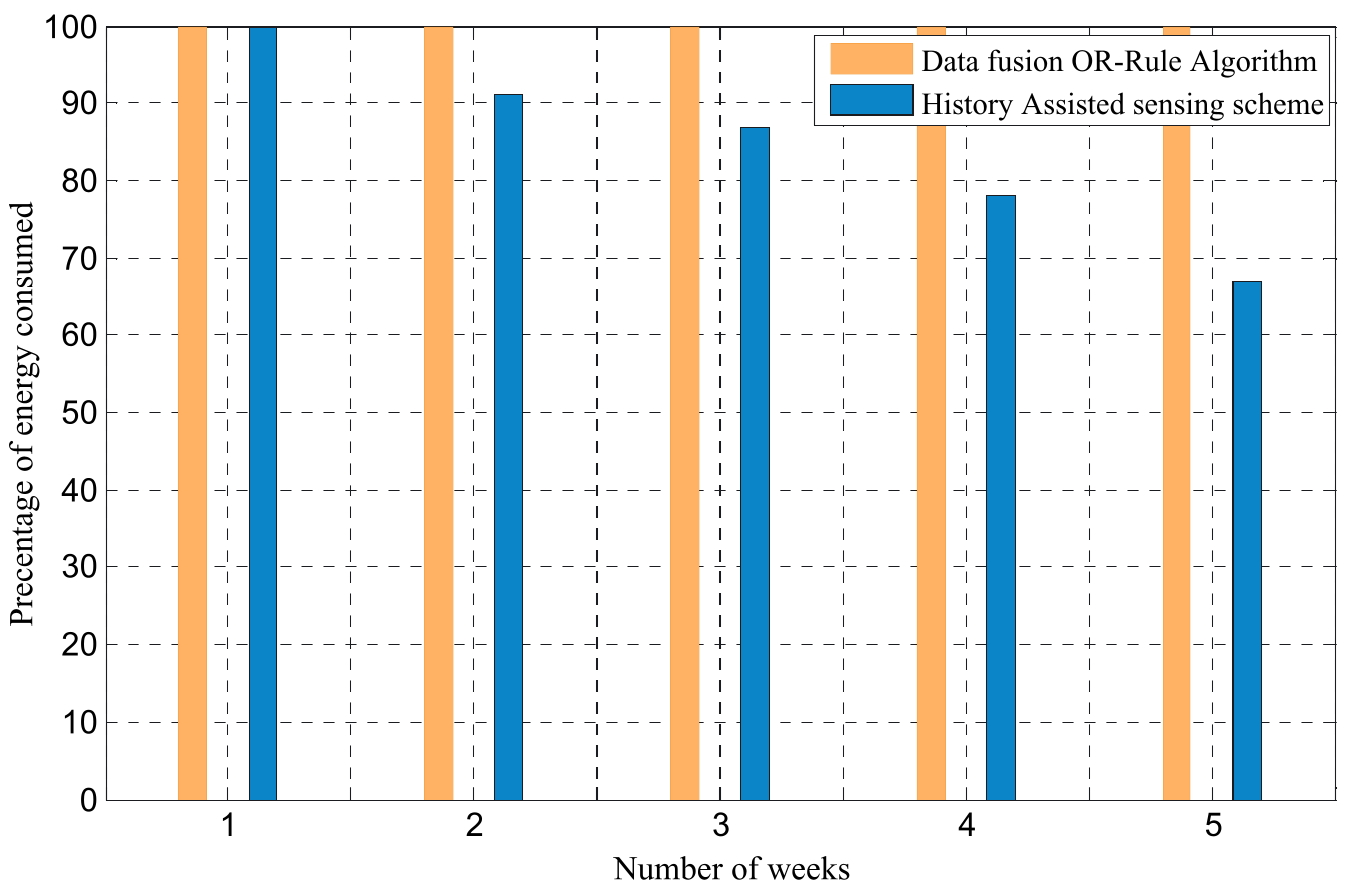 Fig 2. Energy consumption over time. Unlike the static OR-rule, the history-assisted scheme becomes more efficient as the database grows.
The results are striking:
- Effective Energy (T_ES) improved by 60% on average after trigger optimization.
- Compared to CUSF: 20% lower energy consumption.
- Time Sensitivity: The system gets smarter over time. As weeks pass, the energy saved increases because the history becomes higher-fidelity.
Critical Insight: The Trade-off
While the energy savings are undeniable, the authors acknowledge a critical trade-off: Latency. By only updating the database at specific trigger points, there is a risk that the history becomes "stale," potentially leading to interference with the PU if the PU changes its behavior suddenly. This is the classic "Exploration vs. Exploitation" dilemma in radio resource management.
Future Outlook
This work sets the stage for "Database-as-a-Service" in 5G and 6G cognitive networks. Future research could integrate Artificial Intelligence directly into the AED to predict PU behavior even in non-stationary environments, potentially pushing energy savings beyond the 80% mark.
Conclusion
The "History-Assisted" approach proves that in Cognitive Radio, Knowledge is Power—literally. By reducing the reliance on hardware-heavy scanning and moving to a data-centric model, CR devices can finally achieve the longevity required for massive IoT deployments.