
Wikipedia Quality Assessment: Bridging Feature Engineering and Deep Learning through History
History-Based Article Quality Assessment on Wikipedia
2018-01-01
Summary
Problem
Method
Results
Takeaways
Abstract
The paper introduces a history-based quality assessment model for Wikipedia articles that combines LSTM neural networks with manual feature engineering. By modeling the edit history as a temporal sequence, the method achieves 68.6% classification accuracy, matching end-to-end deep learning performance while remaining efficient enough for real-time deployment.
## TL;DR
Wikipedia's article quality is traditionally judged by the current text, but its true reliability lies in its "edit history." Researchers from BUPT have developed a hybrid model that uses **LSTM** to digest a sequence of revision metadata, combined with traditional content features. It matches the accuracy of heavy deep-learning models while being fast enough for a real-time browser extension.
## Background: The Hidden Value of Revision History
Most Wikipedia readers only see the "current version," but every article is a living document shaped by years of edits, reverts, and "edit wars." High-quality ("Featured") articles are characterized by stability—a trait that content-only models often miss. Existing solutions generally fall into two camps:
1. **Feature Engineering (ORES)**: Fast, but struggles to represent long-term history.
2. **End-to-End Deep Learning (Doc2Vec/RNN)**: Captures history well but is too slow for real-time use.
This paper's intuition is simple: Use **Lightweight Meta-features** (like timestamps and editor IDs) to represent the past through an LSTM, and use **Rich Text Features** only for the present.
## Methodology: The Hybrid "Combined Model"
The core contribution is the architecture that avoids the "Doc2Vec bottleneck." In the **Combined Model**, the system only needs to fetch the content of the *latest* revision, while fetching only the *metadata* for the previous 50-100 revisions.
### 1. The History Encoder (LSTM)
The model treats the edit history as a sequence, similar to words in a sentence. It takes 6 meta-features per revision:
* **Timestamp** (Timing of edits)
* **User ID** (Editor reputation/consistency)
* **Size** (Growth/reduction)
* **Minor flag** (Intensity of change)
* **Comment length** (Documentation quality)
* **Revert flag** (Conflict detection)
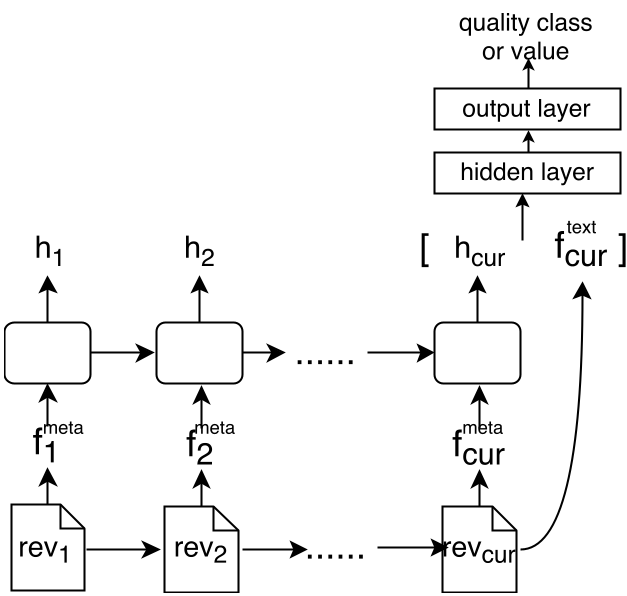
*Fig: The Practical Combined Model architecture.*
### 2. The Assessment Phase
The LSTM outputs a hidden representation $h_{cur}$ that summarizes the article's evolution. This is concatenated with 10 content features (like reference counts and link density) and fed into a final classification/regression layer.
## Experiments: Efficiency Meets Effectiveness
The authors tested their model on a dataset of ~30,000 Wikipedia articles across six quality classes (FA, GA, B, C, Start, Stub).
### Key Findings:
* **History Matters**: Accuracy improves as the sequence length increases, peaking and converging around **100 previous revisions**.
* **Hybrid Power**: The "Combined Model" (Meta-History + Current-Text) achieved **68.6% accuracy**, significantly higher than the ORES baseline (~64%) and comparable to heavy end-to-end models.
* **Real-time Potential**: Feature extraction and computation take roughly **2.1 seconds per article**, with the actual model computation taking only 0.007s.
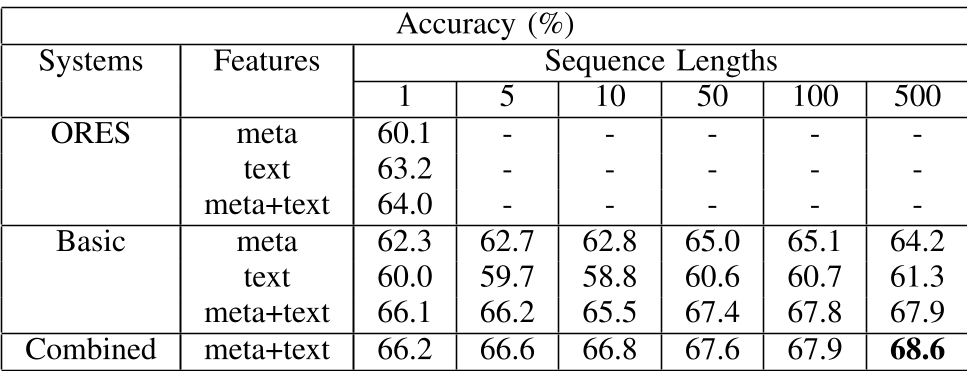
*Table: Accuracy comparison across different sequence lengths and feature sets.*
## Critical Analysis: Where Prediction Fails
One interesting exploration in this paper is **Quality Prediction**—trying to predict what the quality *will be* in 10 or 50 edits.
The results here were less stellar. As the "look ahead" distance increased, accuracy dropped sharply. This suggests that while history explains current quality well, the future of a collaboratively edited document remains highly stochastic and difficult to forecast using only metadata.
## Conclusion
This work provides a blueprint for deploying deep learning in production: don't throw away feature engineering. By using LSTM to handle the "heavy lifting" of temporal modeling via lightweight metadata, and reserving content analysis for the current state, we can build systems that are both academically rigorous and practically useful.
**Future Outlook**: The next step for this technology is a browser extension that provides users with a "trust score" for any Wikipedia page they visit, powered by this real-time history analysis.