
Smart Topology Prediction: Reducing the Energy Tax in Mobile Ad Hoc Networks
Using a History-Based Approach to Predict Topology Control Information in Mobile Ad Hoc Networks
This paper introduces a History-Based Prediction (HBP) approach for predicting Topology Control Information (TCI) in Mobile Ad Hoc Networks (MANETs). By utilizing past mobility patterns and TCI sequences, the method seeks to reduce redundant control packet traffic, thereby optimizing bandwidth and device energy consumption in collaborative mobile environments.
TL;DR
In the world of Mobile Ad Hoc Networks (MANETs), keeping track of "who is connected to whom" usually requires a massive amount of control traffic that drains batteries. This paper proposes a History-Based Prediction (HBP) framework that guesses network topology based on past movement patterns. By utilizing a Dynamic History-Depth (Tree) approach and a confidence mechanism, the authors successfully predicted up to 80% of topology information in low-density scenarios and maintained high accuracy in dense ones, significantly cutting down on energy-sapping network overhead.
The Problem: The Exponential Cost of Knowing Your Neighbors
Proactive routing protocols, such as OLSR (Optimized Link State Routing), are favored in mobile collaborative applications because they maintain a ready-to-use path for data, ensuring low latency. However, there is a catch: to keep this "map" updated, nodes must constantly flood the network with Topology Control Information (TCI).
As the number of nodes increases, this control traffic grows almost exponentially. For a device like a smartphone (represented as an iPhone 4 in this study), this means:
- Energy Depletion: Constant radio activity kills the battery.
- Congestion: Valuable bandwidth is wasted on "meta-info" rather than actual user data.
Existing solutions like OLSRp simply assumed the next state would be the same as the last one. This paper argues that we can do much better by looking further back into the node's history.
Methodology: The Power of Patterns
The core insight is that human movement—whether walking in a park or following a tour guide—is not entirely random. It follows patterns that repeat over time.
1. History-Based Prediction (HBP)
Each node maintains a local table of past TCI sequences. The researchers defined a metric called History Depth (HD), which represents how many past packets are used to identify a pattern.
- HD=0: Look at the current state only.
- HD=3: Look at a sequence of the last 3 packets to guess the 4th.
2. The Prediction Tree (Dynamic HD)
Instead of sticking to a fixed HD, the authors propose a Dynamic History-Depth strategy. If the system cannot find a match for a long sequence (e.g., HD=5), it doesn't just give up. It "backtracks" to a shorter sequence (HD=4, then 3...) until it finds a pattern it recognizes. This maximizes the Opportunity to Predict.
3. Confidence Mechanism
To prevent "hallucinating" a network topology that doesn't exist (which would cause routing failures), a counter-based confidence mechanism was added. A prediction is only "pushed" to the network if the system is statistically confident based on past successes.
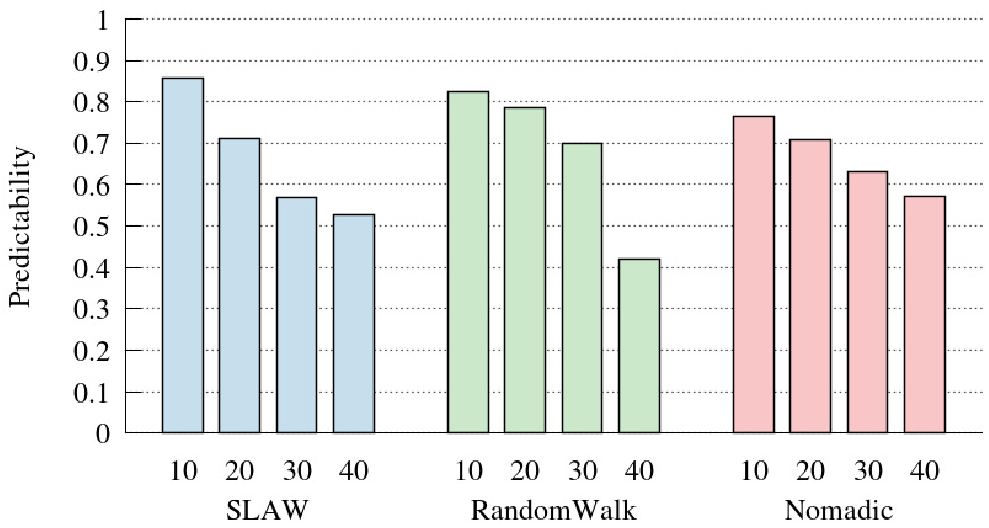 Figure 1: Upper-bound predictability limits showing that even in complex mobility, 50-80% of packets are theoretically predictable.
Experiments & Results
The authors tested their theory using the NS-3 simulator across three mobility models: Random Walk, Nomadic (group movement), and SLAW (self-similar human walks).
Key Findings:
- Predictability Limits: Regardless of the mobility model, the "predictability upper bound" remains remarkably high (above 50% even in dense 40-node networks).
- The Power of the Tree: The Dynamic History-Depth (Tree) method significantly outperformed fixed-depth methods. As seen in Figure 7, the Tree method minimizes "No Prediction" cases, effectively turning "unknowns" into "hits."
- Accuracy vs. Density: While density makes prediction harder, the subset of "most frequent packets" remains small. This means a node only needs to remember a few key patterns to cover most of its communication needs.
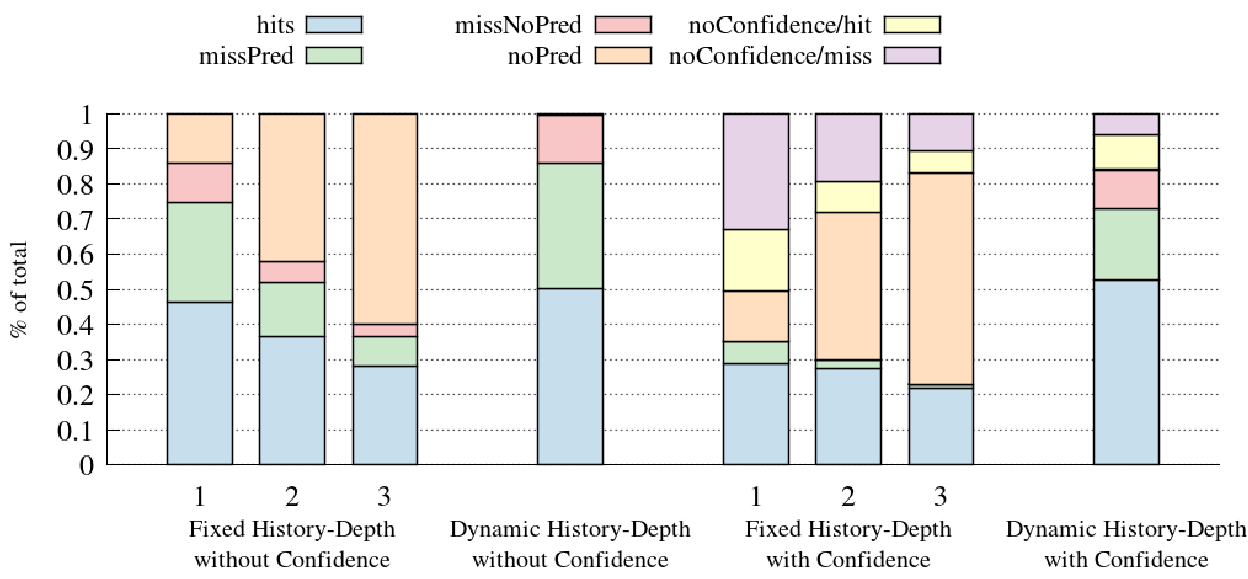 Figure 7: Comparison showing how the Dynamic (Tree) approach maximizes hits compared to fixed-history approaches.
Critical Insight: Why This Matters
This research shifts the paradigm of MANET management from reactive flooding to proactive estimation.
The Takeaway: By using only 30-50% of the usual TCI traffic, we can maintain an almost identical network map. For a user, this translates to a smartphone that stays connected to a local crowdsensing network for 3 hours instead of 1.
Limitations & Future Work
The study assumes "unbounded memory" for storing history, which might be unrealistic for tiny IoT sensors (though trivial for modern smartphones). The authors' next step is to explore more complex confidence mechanisms—perhaps using machine learning—to further bridge the gap between the current 30% hit rate and the 80% theoretical limit.
Conclusion
History-based prediction proves that in mobile networks, the past is indeed a prologue. By being "smart" about what information we actually need to broadcast, we can build collaborative mobile systems that are both highly responsive and energy-efficient.