
Rumors as Estimators: The Cost of Not Knowing Your Place in History
History-Independent Distributed Multi-agent Learning
This paper investigates "History-Independent Distributed Multi-agent Learning," where agents estimate the probability of a binary event by combining private signals with previous "rumors" (opinions). It proposes using Exponential Moving Average (EMA) as a history-independent strategy and establishes that strategic agents in a symmetric Nash Equilibrium can achieve convergence to the true probability without knowing their position in the sequence.
TL;DR
How much does it matter if you don't know where a "rumor" came from? This paper proves that even if agents are completely unaware of their position in an information chain, they can still converge to the truth using a simple Exponential Moving Average (EMA). While "history independence" only adds a small logarithmic penalty to error, strategic selfishness is the real culprit, slowing down learning from to .
The "Bob and Alice" Problem: Is Bob's Opinion Worth 10 Experts or Just Bob?
In traditional social learning models, if Bob tells Alice an opinion, Alice needs to know if Bob's opinion is based on 100 people's experiences or just his own. If she over-weights Bob, she ignores her own evidence; if she under-weights him, she loses the "wisdom of the crowd."
The core difficulty is Providence: most agents in a social network don't know their location () in the sequence. This paper asks: can we still learn efficiently if everyone uses the same simple rule, regardless of history?
Methodology: The EMA as a Social Lever
The authors propose that agents use an Exponential Moving Average (EMA): where is the current opinion, is a private binary signal, and is a fixed weight.
Three Levels of Learning
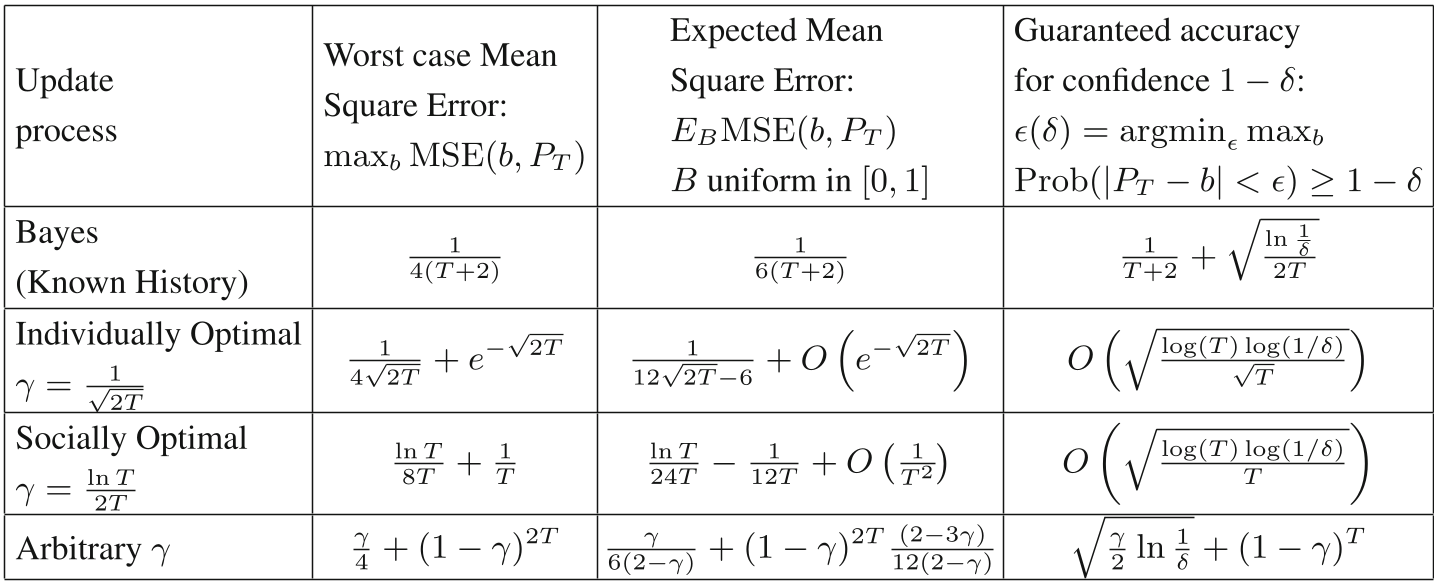
- The Bayes Benchmark (Known History): Every agent knows and uses . Error: .
- Socially Optimal (History Independent): Agents pick a single to minimize the group's total error. The optimal . Error: .
- Individually Optimal (Strategic Equilibrium): Each agent picks to minimize their own personal error, assuming others do the same. This leads to a Nash Equilibrium where . Error: .
Why Strategy Kills Speed
The most striking insight is the gap between the Socially Optimal and Individually Optimal results.
- The Logic of Selfishness: A strategic agent who doesn't know her position tends to over-trust her own signal. Because there is a chance she is the first or second agent, she keeps her relatively high.
- The Result: Because everyone over-trusts their own signal to protect themselves from being the "early adopter," the crowd doesn't aggregate information as effectively. The error drops much slower () compared to the cooperative case.
Key Experiments and Theorems
The authors provide a rigorous proof (Theorem 2) for the existence of a unique symmetric equilibrium. They show that while the lack of history knowledge is a hurdle, the process always converges.
High Probability Deviations
Using McDiarmid’s inequality, the paper proves that for the Individually Optimal strategy, the deviation from the true probability is: This means that even with strategic noise, we can be highly confident in the "final rumor" given enough agents.
Critical Analysis: Value of Knowledge
The paper also explores the "Value of Knowledge." If only one agent discovers their position in the sequence (becoming "Aware"), they can significantly reduce their loss. The "price" an agent should be willing to pay for this location information is roughly .
Limitations
- The Chain Assumption: The model assumes a linear chain. Real social networks are complex graphs where rumors can "loop," potentially leading to echo chambers not explored here.
- Linear Strategy Space: The authors focus on linear EMA updates. While mathematically tractable, human strategic behavior might be more complex (non-linear).
Conclusion: Rumors are (Eventually) Right
This research provides a powerful theoretical backing for the "wisdom of rumors." It suggests that as long as opinions are continuous (allowing for subtle adjustments), social learning is robust to history ignorance. However, for maximum efficiency in decentralized systems, cooperation (social optimality) is vastly superior to competition (individual Nash Equilibrium).
Future Work: The next frontier is applying these history-independent learners to State Space Models (SSMs) or decentralized AI training where the "sequence" of data contributors is unknown.