
What Can History Tell Us? Unlocking Relevance in Session-Based Recommendations
What Can History Tell Us? Identifying Relevant Sessions for Next-Item Recommendation
The paper proposes a novel deep learning framework for session-based next-item recommendation that identifies relevant historical sessions using a Nonlocal Neural Network (NLNN) and GRU. By distinguishing the importance of various past sessions, the model achieves SOTA results on Tmall and Gowalla datasets, effectively capturing both long-term and short-term user interests.
TL;DR
Static user profiles are no longer enough. Modern recommenders must understand the context of a user's current session while selectively remembering relevant history. This paper proposes a Two-Layer Nonlocal Neural Network framework that identifies which specific historical sessions are actually pertinent to the current click, achieving significant SOTA improvements (up to 7.4% Recall@10) by filtering out historical "noise."
The "History Noise" Problem
Most session-based recommendation systems (SRS) suffer from one of two extremes:
- Short-sightedness: Methods like GRU4Rec or NARM focus only on the current session, ignoring the rich context of past behavior.
- Indiscriminate Memory: Methods like HRNN or BINN consider history but treat all previous sessions as equally important or strictly sequential.
The Insight of Sun et al. is simple yet powerful: If a user is currently shopping for computer accessories, their historical purchases of groceries are likely irrelevant "noise," whereas their past brand preferences for electronics are "signals."
Methodology: The Nonlocal Architecture
The core of the paper is the application of the Nonlocal (NL) operation, originally popularized in Computer Vision, to model long-range dependencies in user behavior sequences.
1. Two-Layer Long-Term Modeling
Instead of a simple average of history, the model uses a two-layer NL structure:
- Layer 1 (Session-level): Identifies historical sessions relevant to the current session's average representation.
- Layer 2 (Refined): Factors in the very last item clicked to refine the historical importance, recognizing that the most recent action is a strong pivot for immediate intent.
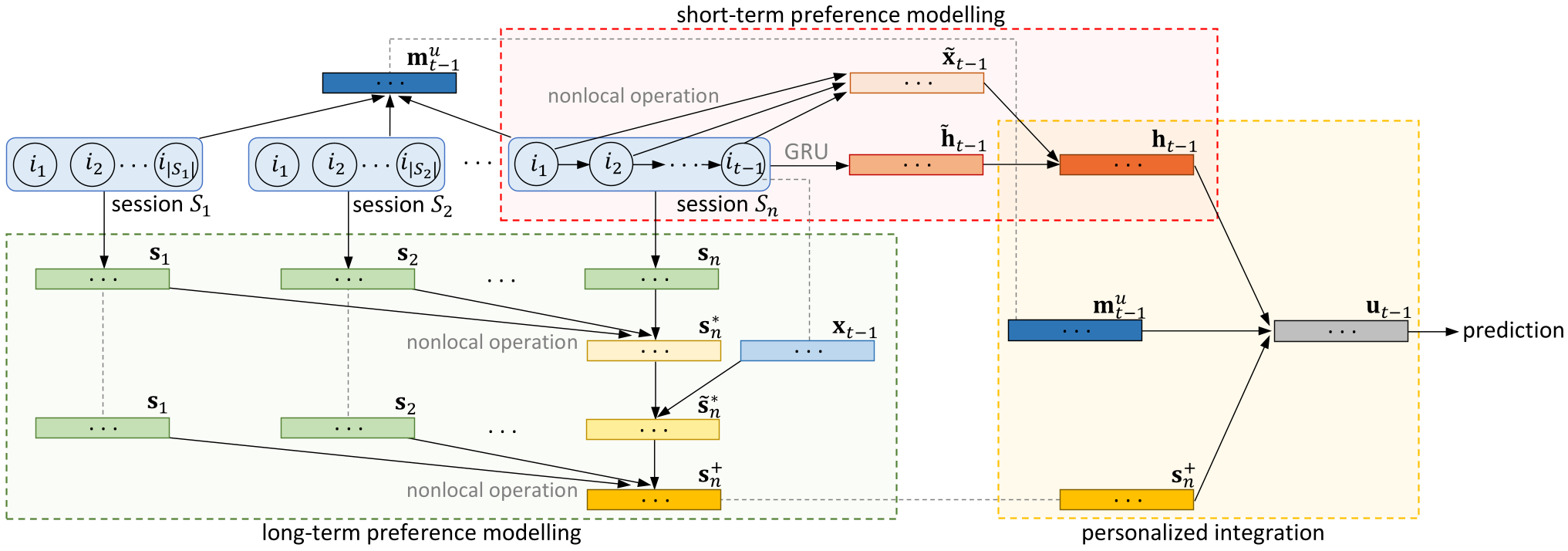
2. Parallel Short-Term Modeling
User behavior within a single session isn't always linear (e.g., looking at flour, then salt, then butter). To capture this, the authors use:
- GRU: To capture strict local sequential dependencies.
- Nonlocal Layer: To capture non-consecutive item relationships within the session.
Experimental Battleground: Tmall vs. Gowalla
The researchers tested their model on two very different environments: Tmall (E-commerce, high randomness) and Gowalla (Location-based, high regularity).
| Metric | Tmall (Ours) | Gowalla (Ours) | Improvement over best baseline |
|---|---|---|---|
| Recall@10 | 0.6228 | 0.3954 | +2~7% |
| MRR | 0.4757 | 0.2301 | Significant |
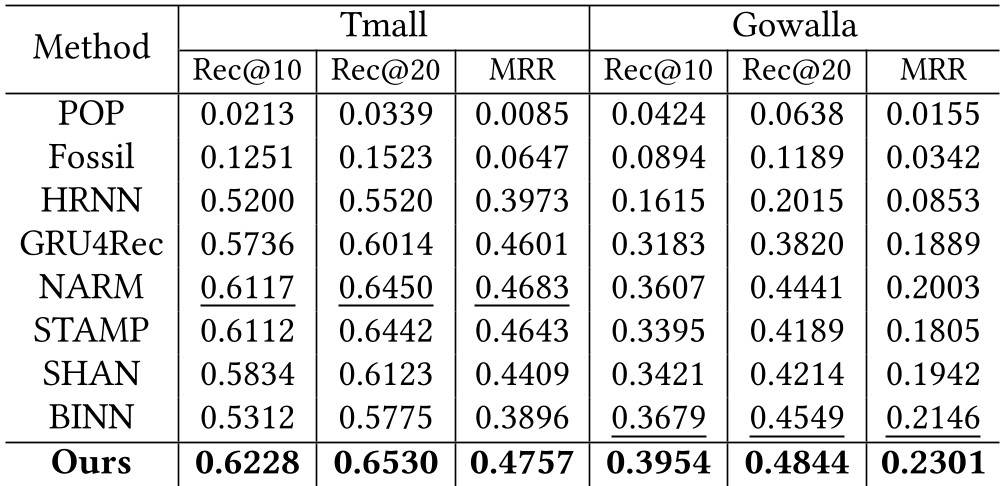
Key Findings:
- On Gowalla, history is king. Long-term preferences (modeling familiar activity areas) are the primary drivers of performance.
- On Tmall, the "Short-term" intent is more dominant, but the nonlocal filtering of history still provides a competitive edge over models that ignore history.
Visualizing Relevance
One of the most compelling parts of the study is the visualization of attention weights. The model successfully assigns high weights to historical sessions that share high Jaccard Similarity (overlap in item categories) with the current session, even if those sessions occurred a long time ago.
Critical Insight & Conclusion
This work demonstrates that Recency is not always Relevancy. While RNNs naturally bias toward the most recent inputs, the Nonlocal structure allows a model to "jump" back across time to find truly relevant context.
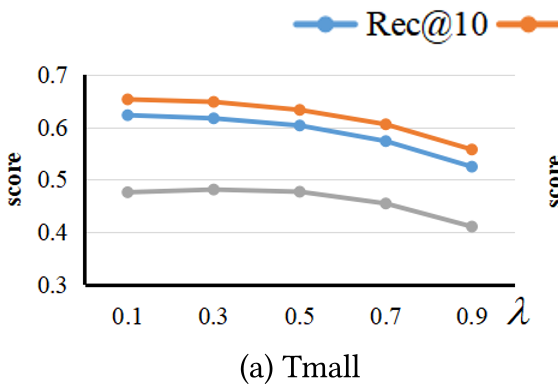
Limitations: The model relies on a hyperparameter to balance long and short-term preferences, which varies significantly between datasets (0.1 for Tmall vs 0.7 for Gowalla). Future work could likely automate this balancing act using a gating mechanism.
Takeaway: In the era of "Big Data," the challenge isn't having more history—it's knowing which parts of the history are worth listening to right now.