
From 'Lorenzo' to Networks: The Resilient Evolution of Computing in Chile (1961–1982)
History of Computing in Chile, 1961-1982: Early Years, Consolidation, and Expansion
This paper provides a comprehensive historical analysis of Chile's computing evolution from 1961 to 1982. It traces the journey from the arrival of the first digital computer to the emergence of a mature, decentralized discipline characterized by professional education, research communities, and widespread industrial application.
TL;DR
Chile's computing history is a saga of institutional ingenuity surviving political upheaval. Between 1961 and 1982, the nation transitioned from a single transistorized computer to a sophisticated landscape of public networks, PhD-level research, and decentralized industrial applications. This period proves that local academic and state coordination are as vital as the hardware itself.
Contextualizing the "Incognita": More than Just Diffusion
For many years, the global history of technology viewed the arrival of computers in Latin America as simple "diffusion"—rich countries sending machines to poor ones. This paper refutes that by showing a vibrant internal logic. Chile's journey was defined by a struggle to bridge two worlds: the administrative needs of the state and the scientific curiosity of universities.
Methodology: The Three-Stage Framework
The authors break down this 20-year span into a logical progression:
- Introduction (1961–1965): The era of "Lorenzo" (the ER-56 computer) and the 1401. Computing was fragmented, with no central plan and little specialized personnel.
- Convergence (1966–1975): A pivotal decade where the state created ECOM (National Computing Company) and universities launched the first formal degrees.
- Expansion (1976–1982): Despite the 1973 coup, the "inertia" of discipline-building led to a decentralized market, the return of foreign-trained PhDs, and the birth of a local software industry.
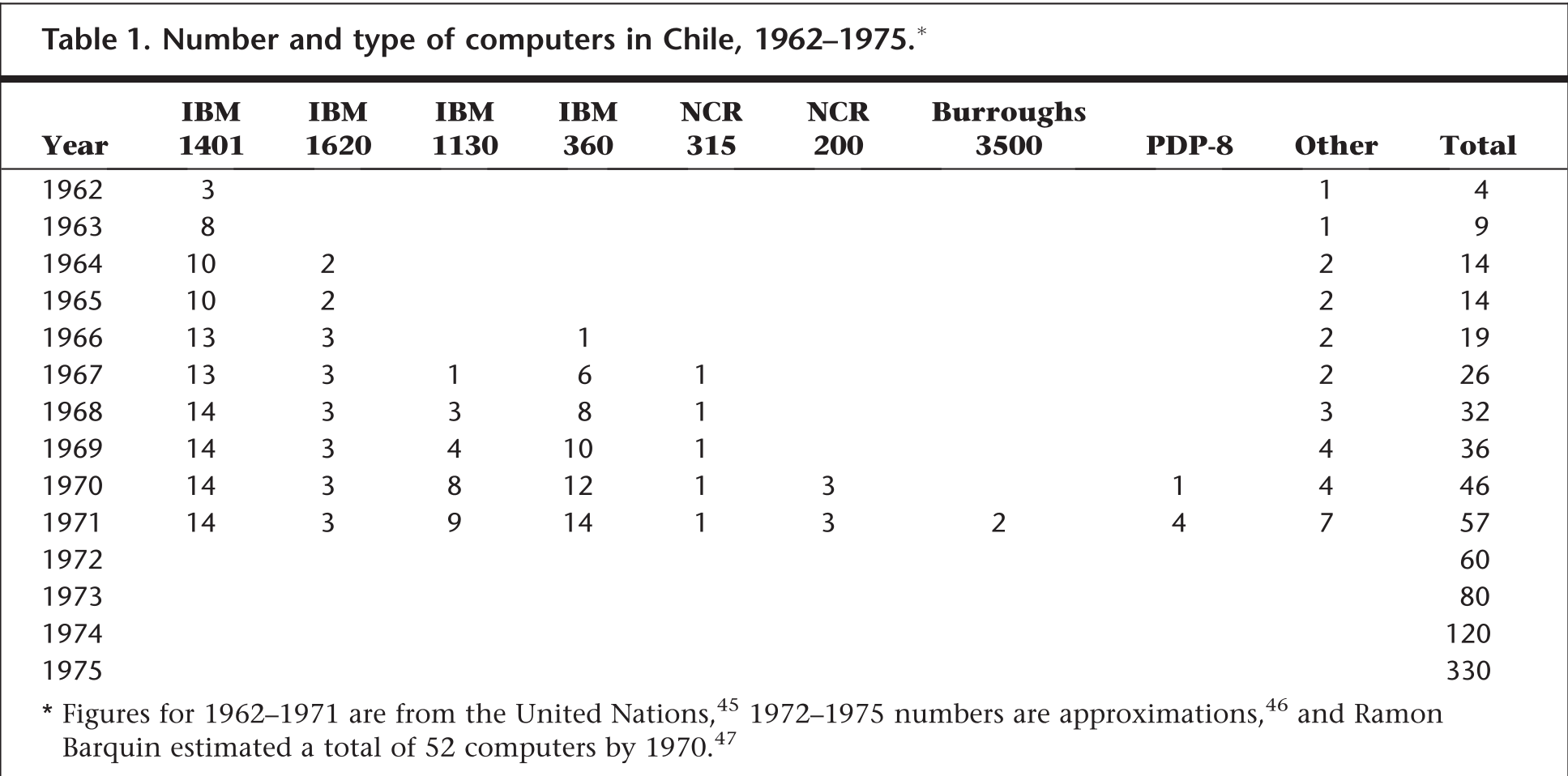 The table above illustrates the rapid growth from a handful of experimental machines to a diverse nationwide infrastructure.
The Core Insight: Political Tensions vs. Technological Inertia
The paper provides a fascinating look at Project Cybersyn, a revolutionary attempt by the socialist Allende government to manage the national economy via a real-time computer network. While the 1973 military coup violently ended Cybersyn and led to the firing of many academics, it couldn't stop the "discipline" itself. The military regime ironically relied on the "know-how" built during the previous democratic era to implement its neoliberal reforms.
Key Technical Landmarks
- The First Digital Leap: The installation of the German Standard Elektrik ER-56 (nicknamed "Lorenzo") at the University of Chile in 1961. It lacked an OS and required machine-language programming.
- Administrative Heavyweights: The 1969 State Bank teleprocessing system, which used an IBM System/360-40 and 89 terminals to manage 1 million accounts—a massive feat for the time.
- Local Software Success: The emergence of companies like ORDEN, which developed "DUNGA," a fourth-generation software product that found massive success in the banking sector.
Experiments & Results: Quantifying Maturity
By 1982, the discipline had reached "critical mass." The results were evident in:
- Educational Depth: Moving from "operator training" by vendors to the first PhD graduates returning from abroad (e.g., from Berkeley and Waterloo) to lead research.
- Market Diversification: The monopoly of IBM was broken as Burroughs, NCR, and DEC entered the market, particularly with the arrival of minicomputers that empowered medium-sized enterprises.
- Social Integration: Computing moved from "mysterious basement machines" to being used by the Catholic Church to document human rights violations—a stark example of technology's role in civil society.
Critical Analysis & Conclusion
The study concludes that by the early 1980s, the "Chilean Case" evolved from a scientific experiment into a consolidated professional discipline.
Takeaway: The real "product" of these 20 years wasn't the 300+ computers listed in the tables; it was the human capital. The return of PhDs and the creation of the Chilean Society of Computer Science (1984) ensured that even when state-centralized computing (ECOM) eventually faded, the nation was ready for the microcomputer and internet eras.
Limitations: The paper notes that a full, systematic evaluation of the coup d'état’s impact on scientific development is still pending, highlighting a gap between technological history and political science that future researchers must bridge.