
HistoryTracker: Revolutionizing Sports Data Retrieval with Historical Priors
HistoryTracker: Minimizing Human Interactions in Baseball Game Annotation
HistoryTracker is a human-computer interaction (HCI) framework designed for the efficient manual annotation of baseball tracking data. By utilizing a "warm-start" strategy, it retrieves historically similar plays to provide an initial trajectory that users can refine, achieving SOTA-level accuracy for manual systems while significantly reducing the human workload.
TL;DR
HistoryTracker is an innovative annotation system that solves the "blank canvas" problem in sports tracking. Instead of manually drawing player paths frame-by-frame, users describe the play's outcome to retrieve a similar historical trajectory, which serves as a "warm-start." This approach reduces annotation time by minutes and improves accuracy by 20% compared to traditional manual methods.
Context & Positioning
In the hierarchy of sports analytics, tracking data is the gold standard. While professional leagues spend millions on Radar and RFID-based systems like Statcast, the broader community—amateurs, college teams, and historians—is left with a choice: expensive hardware or grueling manual labor. HistoryTracker positions itself as a middle ground, leveraging the wealth of existing "Professional Data" to empower "Manual Annotators."
The "Warm-Start" Intuition: Why Start from Scratch?
The core insight of the authors is that baseball plays, while unique, follow predictable patterns. A "ground ball to first base" in 2024 looks geometrically similar to one from 1980.
Current SOTA manual systems (like SoccerStories or Vondrick’s crowdsourcing methods) focus on splitting the work into micro-tasks. HistoryTracker shifts the focus to Information Retrieval. By asking "Who ran?" and "What was the hit type?", the system treats the annotation task as a search problem first and a drawing task second.
Methodology: The Three-Step Pipeline
1. Fast Play Retrieval
The user identifies the play via a video feed. Instead of marking coordinates, they answer categorical questions. These answers are converted into a bit sequence (index), which is matched against a historical database using a weighted similarity metric.
2. Automatic Tuning & Audio Alignment
To solve the temporal alignment problem, the system uses the Superflux algorithm. It listens for the distinct "crack" of the bat (impulsive sound) to synchronize the video frame with the retrieved trajectory's start point.
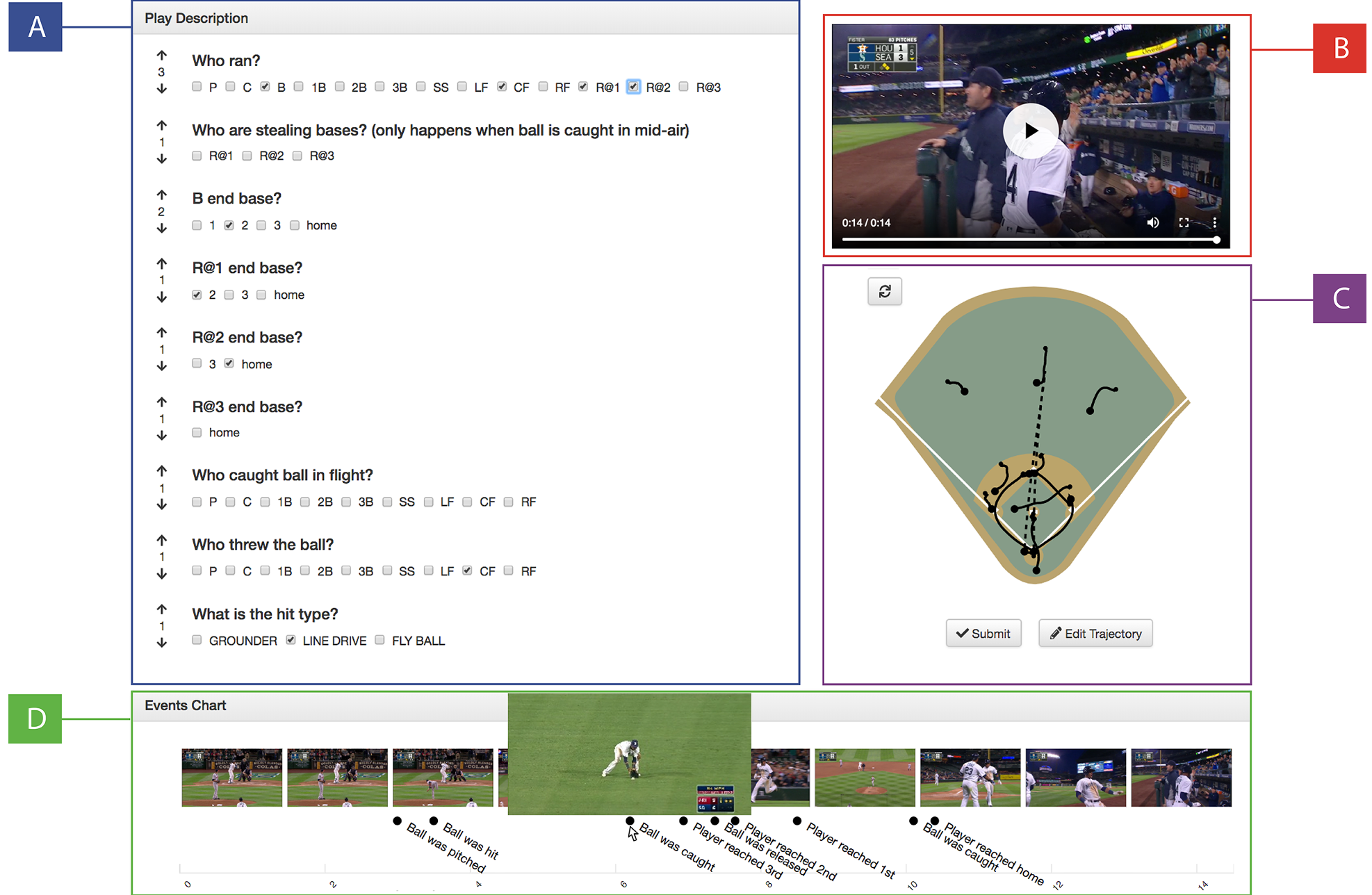 Figure: The HistoryTracker interface, showcasing the query panel (A), video playback (B), and event-based alignment tool (D).
3. Refinement on Demand
Once a trajectory is loaded, the user only edits segments where the "historical proxy" deviates from the "current reality." This "Refinement on Demand" ensures that common movements (like the pitcher’s wind-up) require zero manual input.
Experimental Results: Faster and Better
The authors conducted a study with 8 experienced baseball followers, comparing HistoryTracker against a "Baseline" (manual input from scratch).
- Accuracy: HistoryTracker showed a 20% reduction in median error compared to the baseline. Because the starting point was a "real" physical trajectory from a pro game, the interpolated paths were more natural and physically plausible.
- Efficiency: The median time saved was 1.5 minutes per play. In a sport with hundreds of plays per game, this efficiency gain is transformative.
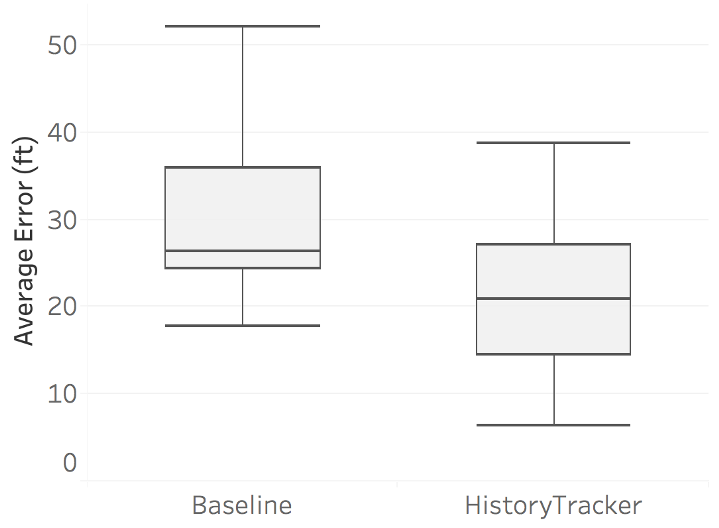 Figure: Error distribution showing HistoryTracker (left) outperforming the Baseline (right).
Critical Insight: Beyond the Diamond
While the paper focuses on baseball, the HistoryTracker philosophy holds significant promise for general Computer Vision:
- Inductive Bias: By using real trajectories as priors, we inject physics-based constraints that human annotators often fail to maintain (e.g., consistent player velocity).
- User Experience: User feedback indicated the system was "more enjoyable," likely because it eliminated the most repetitive parts of the task.
Limitations & Future Work
The system currently relies on a pre-existing "Corpus" of tracking data. If the play is truly unique (e.g., a rare fielding error not seen in the database), the retrieval might fail to provide a helpful start. Future iterations could integrate Active Learning to identify when the retrieval is poor and prompt the user for more detailed manual input immediately.
Final Takeaway
HistoryTracker proves that in the age of Big Data, we shouldn't be asking humans to act like sensors. Instead, we should use humans as curators who refine existing knowledge, making the "reconstruction of sports reality" accessible to everyone.