
Measuring the Social Pulse: A Multilevel Approach to Engineering Forum Participation
Assessment of online participation through social network measures: A HLM approach
This paper proposes a multilevel assessment framework for online participation in the "All About Circuits" engineering forum. The authors introduce a Hierarchical Linear Modeling (HLM) approach that integrates Social Network Analysis (SNA) measures across individual and group levels to quantify the quality of learner interaction.
TL;DR
Educational researchers are moving beyond simple post counts to evaluate student success. This paper introduces a sophisticated framework using Hierarchical Linear Modeling (HLM) and Social Network Measures to analyze participation in AllAboutCircuits.com. By treating sub-forums as nested environments, the researchers provide a more mathematically rigorous way to understand how "Social Capital"—one's position in a network—correlates with active learning.
The Motivation: Why Counting Posts Isn't Enough
In the domain of Electrical and Computer Engineering (ECE), informal learning spaces like forums are massive, sometimes hosting hundreds of thousands of members. However, educators face a "contextual blind spot." Standard Ordinary Least Squares (OLS) regression assumes all data points are independent. In a forum, this is false: users in a "Homework Help" sub-forum behave differently than those in a "General Science" section.
The authors identify two critical gaps:
- Structural Hierarchy: Data is nested (posts → threads → sub-forums).
- Social Context: Learning is a "situated" process. Being the person who bridges two disconnected groups (a structural hole) is more valuable than just posting many messages.
Methodology: Social Capital Meets HLM
The core innovation lies in the transition from flat analysis to multilevel analysis. The authors leverage Social Capital Theory, specifically Burt's theory of structural holes, to define three individual-level predictors:
- Betweenness Centrality: Acts as a bridge between groups.
- Closeness Centrality: Efficiency in reaching others in the network.
- Degree Centrality: The sheer number of direct ties.
The Mathematical Framework
The HLM architecture split the analysis into two levels:
- Level 1 (Individual): Models how a learner's central position affects their participation frequency.
- Level 2 (Group): Accounts for the environment, using Network Density and Group Size as predictors.
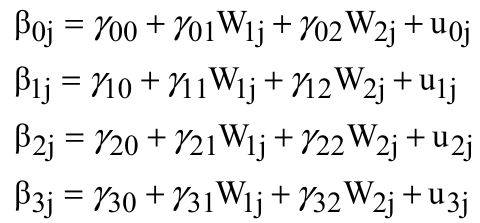 Figure 1: The Level 2 model illustrating how group-level predictors () influence individual-level intercepts and slopes.
Data Extraction and Structure
Using a Python-based web crawler, the team harvested over 87,000 pages of data. This "Big Data" approach allowed them to map the interaction hierarchy across different ECE sub-domains.
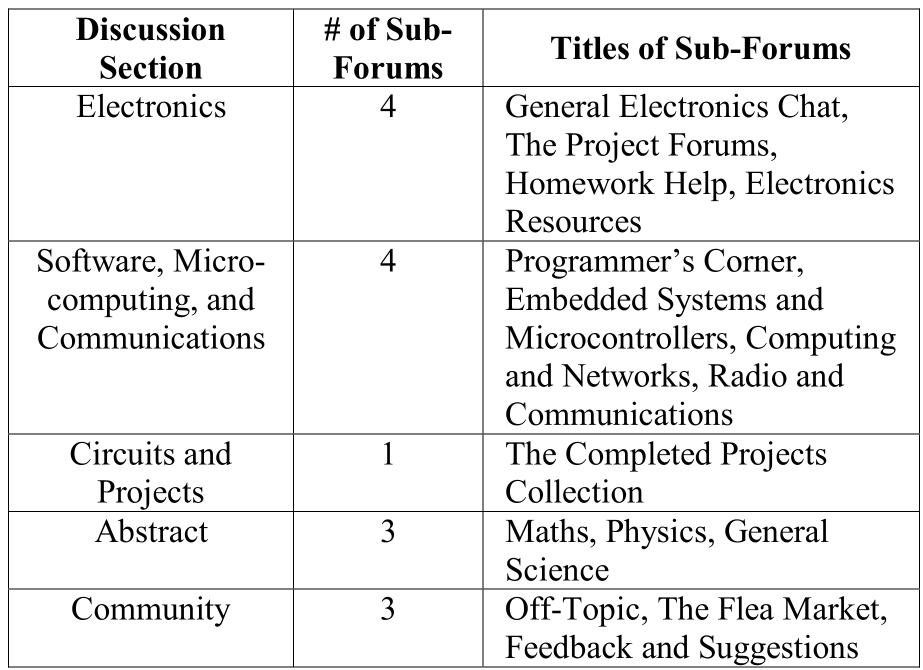 Figure 2: The organizational structure of AllAboutCircuits.com used for the nested HLM analysis.
Dataset at a Glance
The scale of the study is impressive, providing a robust foundation for statistical significance:
- Members: ~192,000
- Messages: >500,000
- Timeline: 8 years of historical data
Critical Analysis & Future Outlook
The strength of this work-in-progress is its methodological rigor. By using HLM, the authors avoid the pitfalls of "aggregation bias"—where group-level trends are incorrectly applied to individuals—and vice-versa.
Limitations: As a "work-in-progress," the paper focuses heavily on the conceptualization and model building rather than the final coefficient results. The next step will require validating if high social capital actually translates to better pedagogical outcomes (like problem-solving skills) rather than just "more participation."
Takeaway for Educators: In the age of MOOCs and AI-driven forums, we must stop looking at learners in isolation. The "Social Capital" a student builds by helping others is a measurable asset. This HLM approach provides the toolkit to turn messy forum data into actionable educational insights.
Conclusion
By bridging Social Network Analysis with Hierarchical Linear Modeling, this research offers a blueprint for assessing the "invisible" learning that happens in engineering communities. It treats the forum not just as a database of text, but as a living, structured social ecosystem.