
HMM-based Synthesis: Bringing Emotional Intelligence to Synthetic Talking Heads
3119_HMM-based synthesis of emotional facial expressions during speech in synthetic talking heads.
This paper presents a Hidden Markov Model (HMM)-based system for synthesizing emotional facial expressions in speech-driven Talking Heads. By training Continuous Density HMMs (CDHMM) on expert motion-capture data, the method generates MPEG-4 compliant Facial Animation Parameters (FAPs) for realistic emotional display.
TL;DR
Researchers have developed a system that uses Hidden Markov Models (HMMs) to synthesize facial expressions that aren't just lip-synced, but emotionally "alive." By training on 3D motion-capture data of a professional actor, the system generates dynamic facial movements for Embodied Conversational Agents (ECAs) that mirror human-like nuances in emotions like surprise, happiness, and anger.
Context: Beyond the "Uncanny Valley"
In the realm of Human-Computer Interaction (HCI), the "Uncanny Valley" is often paved with good intentions but static rules. Most early ECAs relied on rule-based systems (like the Facial Action Coding System - FACS) to trigger expressions. While mathematically sound, these systems often feel "dead" because they produce the exact same movement every time.
The authors of this paper argue that humans never express the same emotion identically twice. To capture this inherent variability, they pivot from rigid rules to HMM-based stochastic modeling, treating facial expressions as a dynamic, probabilistic sequence of states rather than a fixed set of coordinates.
Methodology: The Probabilistic Face
The core of the system is the Continuous Density Hidden Markov Model (CDHMM). Here is how the "magic" happens:
- Data Acquisition: Using the Elite opto-electronic system, 28 reflective markers were placed on an actor's face to track 3D movements (XYZ coordinates) while they spoke non-sense Italian words with varying emotional intensities.
- HMM Architecture: Each emotional state (e.g., Surprise) and viseme (speech sound) is modeled as a 21-state left-to-right Markov chain.
- Observation Space: The model doesn't just record a point; it models the probability of a marker being at a certain location using a mixture of eight diagonal-covariance Gaussians.
- Synthesis: Once trained, the system acts as a generator. It "walks" through the hidden states to produce a sequence of feature vectors, which are then converted into MPEG-4 Facial Animation Parameters (FAPs).
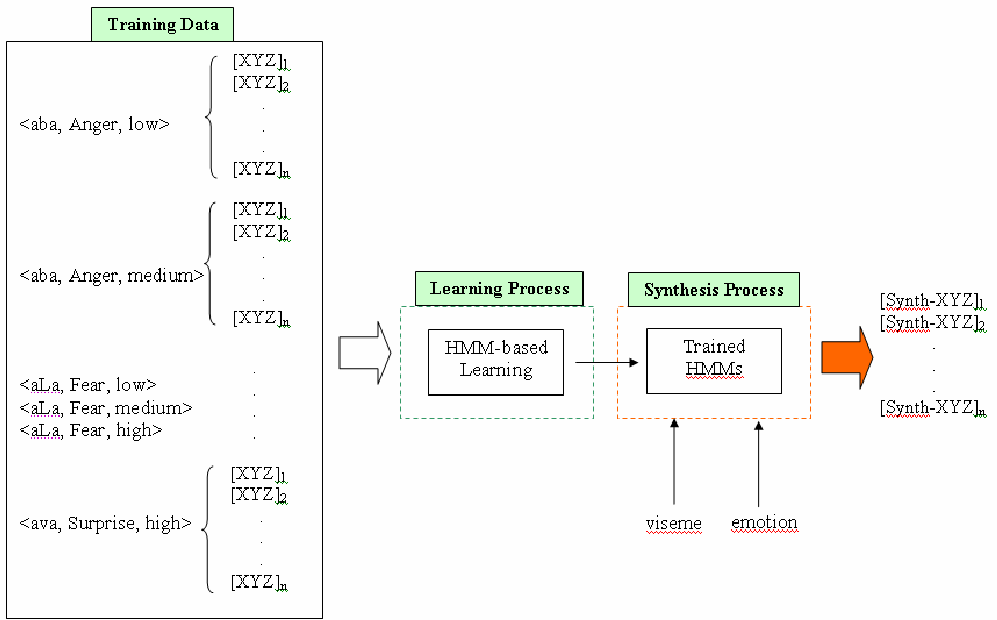 Figure: The HMM-based generative process for facial coordinates.
Why it Works: The Physics of Emotion
The research reveals a fascinating "prototypical behavior" for different emotions. For instance, in "Surprise," the system captures the simultaneous rising of the eyebrows (Marker 2) and the dropping of the lower lip (Marker 24).
The mathematical beauty lies in the HMM's ability to handle temporal warping. Because human speech and expressions vary in speed, the authors used Dynamic Time Warping (DTW) to compare synthetic sequences with natural ones.
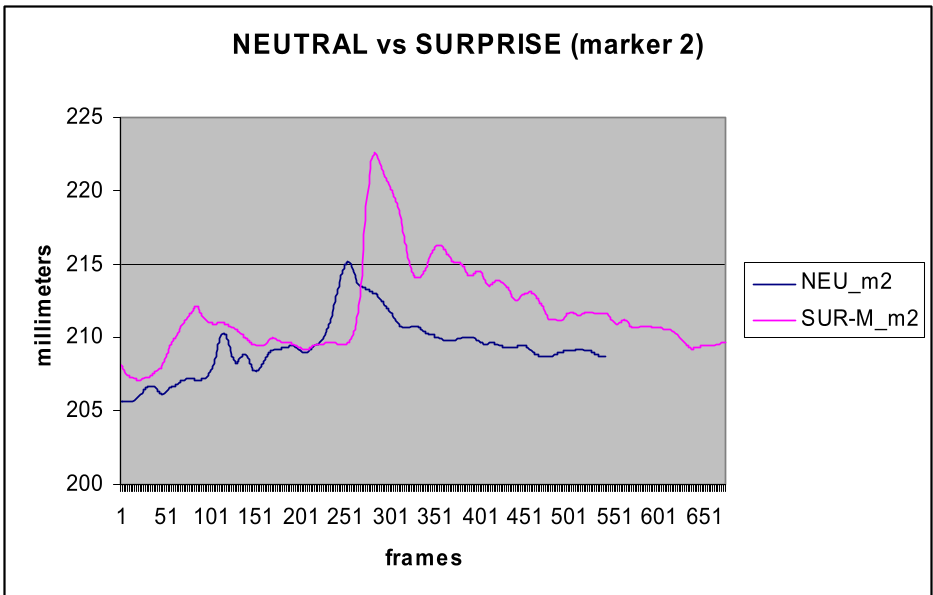 Figure: Graphical comparison showing how closely the HMM-synthesized "Surprise" (Marker 2) tracks the natural actor's movement.
Experiments and Visual Evidence
The system was tested using the "Alice" 3D model via the Xface toolkit.
- Qualitative Result: Graphs showed that while the HMM output was slightly "piecewise" (due to the stationary nature of HMM states), the movement was highly accurate in capturing peak intensities.
- Visual Result: Crucially, the authors found that at 25 frames per second, the human eye filters out the "steppy" nature of the HMM transitions, resulting in an animation that feels remarkably natural.
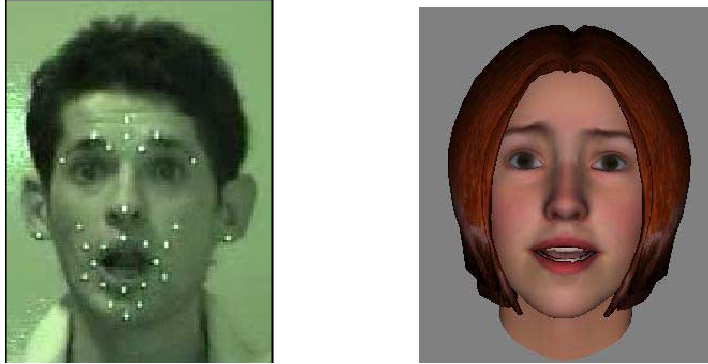 Figure: Side-by-side comparison of the actor and the synthetic "Alice" model expressing surprise.
Critical Insight: Limitations & Future
The "piecewise behavior" is the primary technical debt of using traditional HMMs—it stems from the assumption that the output probability within a state is static. To fix this, future iterations could look toward Trajectory HMMs or Deep Generative Models that allow for smoother transitions.
Takeaway: This work bridges the gap between signal processing and psychology. By moving from "What does a face look like?" to "How does a face behave?", it sets a foundation for future ECAs that can truly empathize and interact with human users in real-time.