
HO-OTSVD: Orchestrating Knowledge Discovery in Cyber-Physical-Social Networks
HO-OTSVD: A Novel Tensor Decomposition and Its Incremental Decomposition for Cyber–Physical–Social Networks (CPSN)
This paper introduces High-Order Orthogonal Tensor Singular Value Decomposition (HO-OTSVD), a novel tensor decomposition framework designed for Cyber-Physical-Social Networks (CPSN). By utilizing the Einstein product and a high-order bidiagonal Lanczos algorithm, it achieves state-of-the-art results in multi-mode knowledge discovery and recommendation systems.
TL;DR
The rise of Cyber-Physical-Social Networks (CPSN) demands a way to process massive, multi-dimensional interactions between users, locations, behaviors, and digital objects. This paper introduces HO-OTSVD, a high-order orthogonal tensor decomposition that captures latent relationships more accurately than HOSVD. By leveraging a High-Order Bidiagonal Lanczos algorithm, it slashes computational costs while providing an incremental update mechanism for dynamic real-world data.
The Problem: The Complexity of Heterogeneity
In modern CPSNs, data isn't just a simple table; it is a high-dimensional structure. For example, a single interaction might involve {User, Location, Behavior-Type, Time, Item, Origin}. Traditional Matrix Factorization (SVD) or even basic Tensor SVD (HOSVD) treats these dimensions independently. This fails because:
- Contextual Loss: Relationships and dependencies between modes (e.g., how specific locations influence specific behaviors at specific times) are often ignored.
- Computational Bottlenecks: Standard orthogonalization is , which is prohibitive for systems with millions of users.
- Static Constraints: Real-world networks are dynamic, but most tensor methods require a full "stop-and-recalculate" approach when new data arrives.
Methodology: Eigentensors and the Einstein Product
The core innovation lies in shifting from "eigenvectors" to "eigentensors."
1. Multi-Mode Unfolding
Unlike HOSVD which unfolds a tensor into a matrix mode-by-mode, HO-OTSVD unfolds the tensor based on combinations of modes. This allows the model to preserve the "geometry" of multi-modal interactions.
2. The Einstein Product & HOBL
The authors utilize the Einstein product (a generalized multi-mode product) to define the decomposition. To solve the orthogonalization problem efficiently, they adapted the Bidiagonal Lanczos method. This reduces the process of finding singular values from cubic execution time to quadratic, a massive win for scalability.
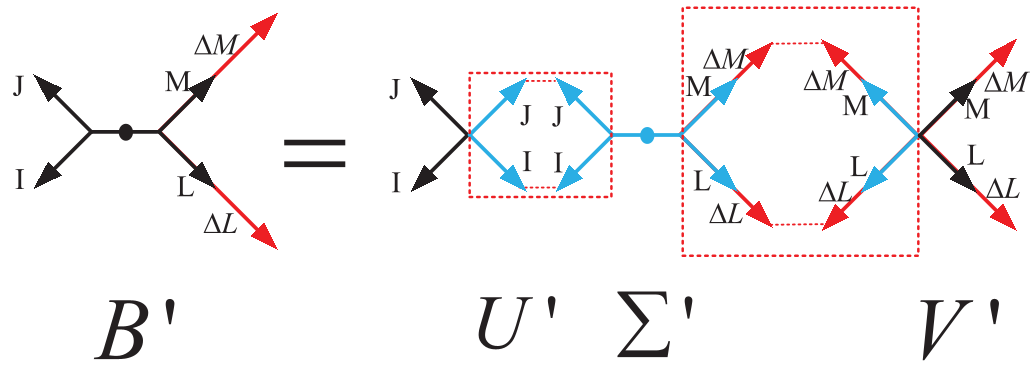 Fig 1. The incremental update logic where new subtensors (red) are fused with original tensor bases (dark).
3. Incremental Updating (IHO-OTSVD)
When new user data flows in, IHO-OTSVD doesn't re-crunch the old data. It updates the existing orthogonal tensor basis and the core tensor by calculating only the new data's projection, as outlined in their proposed Algorithm 3.
Performance: Beyond SOTA
The team tested their framework on the Tmall purchase dataset (11.18-12.18), involving millions of records.
Recommendation Quality
In a Top-N recommendation task, HO-OTSVD demonstrated clear superiority:
- F1-Index: HO-OTSVD (0.43) vs. HOSVD (0.33) vs. CF (0.25).
- Insight: The gain comes from capturing "wider shapes" of user actions—HO-OTSVD "sees" the interplay between cyber and physical constraints that other models miss.
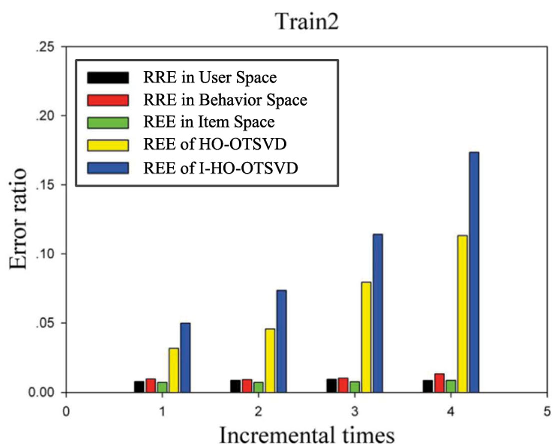 Fig 2. Execution time comparison: Incremental HO-OTSVD remains remarkably efficient as data scales.
Critical Insight & Conclusion
The most profound takeaway is that orthogonality in multi-mode spaces is a powerful inductive bias for social network modeling. While the incremental version slightly increases reconstruction error over time (due to error accumulation), the trade-off for speed makes it the only viable choice for live systems.
Future Outlook: The adoption of the Einstein product opens doors to more sophisticated Latent Semantic Analysis (LSA) and clustering in multi-modal environments. As we move toward 6G and pervasive sensing, HO-OTSVD provides the mathematical backbone for truly understanding the "social" in Cyber-Physical systems.