
HO-OTSVD: Mastering Multi-Mode Latent Relationships in Cyber-Physical-Social Networks
HO-OTSVD: A Novel Tensor Decomposition and Its Incremental Decomposition for Cyber–Physical–Social Networks (CPSN)
This paper introduces HO-OTSVD, a high-order orthogonal tensor singular value decomposition method designed for Cyber–Physical–Social Networks (CPSN). It establishes a service framework that models heterogeneous network data as high-order adjacency tensors and incorporates a fast High-Order Bidiagonal Lanczos (HOBL) algorithm alongside an Incremental (IHO-OTSVD) variant to handle dynamic, large-scale data streams.
TL;DR
The integration of cyber, physical, and social networks (CPSN) creates massive, heterogeneous datasets that traditional matrix methods cannot capture. This paper introduces HO-OTSVD, a novel tensor decomposition framework that uses multi-mode orthogonal bases and a high-order Lanczos algorithm to reduce complexity from cubic to quadratic. By supporting incremental updates, it handles dynamic data streams efficiently, outperforming standard HOSVD and Collaborative Filtering in recommendation accuracy by over 30%.
Problem & Motivation: The Geometry of Heterogeneity
In a modern CPSN, data isn't just a table of "User-Item" interactions. It involves locations (physical), time (temporal), social circles, and web behaviors (cyber). Representing this as a 2D matrix loses the complex "geometric" relationships between these factors.
While High-Order SVD (HOSVD) exists, it treats each dimension (mode) independently. The authors argue that this is insufficient: the interaction between a user-location pair and a time-behavior pair represents a higher-level semantic unit. Furthermore, CPSNs are never static; users are always clicking, and sensors are always reporting. Recomputing a full HOSVD every time a new data point arrives is computationally impossible for platforms the size of Facebook or Tmall.
Methodology: The Core Architecture
The proposed framework shifts from vector-based decomposition to tensor-basis decomposition.
1. Multi-mode Unfolding
Instead of unfolding a tensor into a single-mode matrix, HO-OTSVD groups modes together (e.g., combining user and location). This allows the model to capture joint latent features that single-mode HOSVD ignores.
2. High-Order Bidiagonal Lanczos (HOBL)
The bottleneck of orthogonal decomposition is the cubic execution time. The authors adapt the Lanczos method—typically used for sparse matrices—to the tensor domain. By utilizing the Einstein product, they bidiagonalize the tensor, dropping the computational cost to quadratic levels.
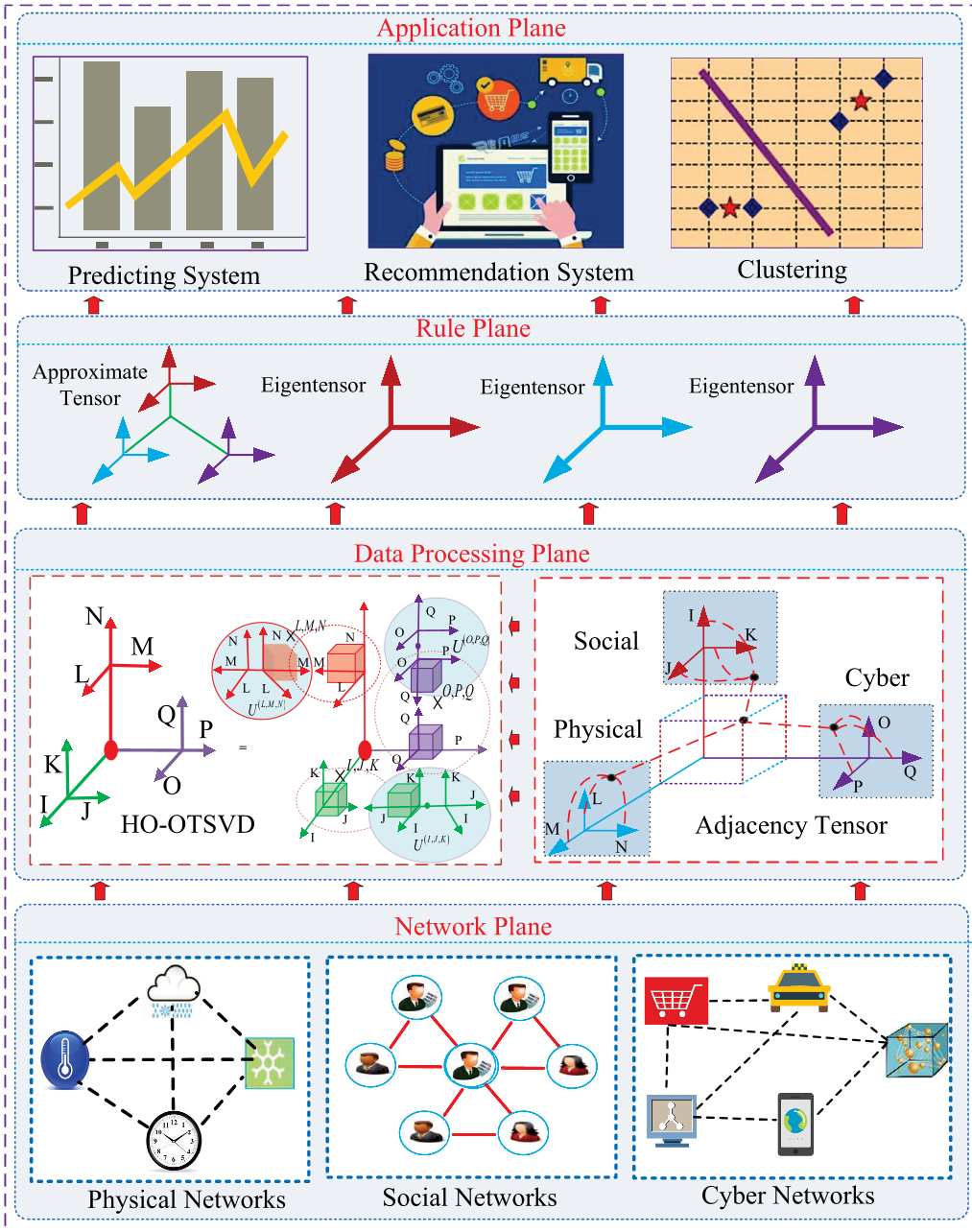 Fig: The CPSN-based service framework utilizing HO-OTSVD for knowledge discovery.
3. Incremental Updates (IHO-OTSVD)
When new data () arrives, the system doesn't restart. It uses the previous orthogonal bases () and only processes the "new" slice to update the core tensor. This makes the system "live" and responsive to real-time stream data.
Experiments & Results
The authors put HO-OTSVD to the test using a massive real-world dataset from Tmall. The task was to recommend items based on a 6th-order tensor (User, Location, Behavior, Time, Item, Origin).
SOTA Comparison
- HO-OTSVD: Peak F1-index of 0.43.
- HOSVD: Peak F1-index of 0.33.
- Collaborative Filtering: Peak F1-index of 0.25.
The superiority of HO-OTSVD stems from its ability to capture a "wider range of geometries and shapes" within the data.
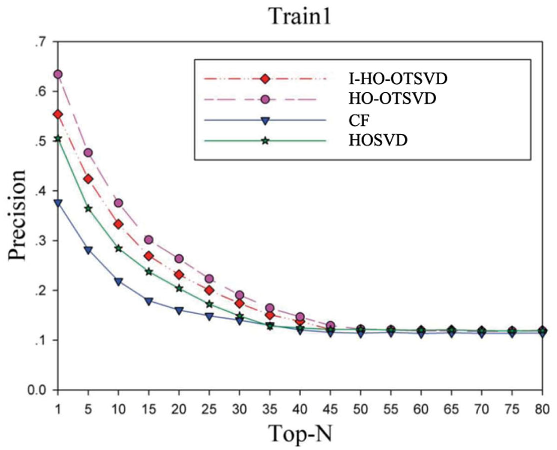 Fig: Performance comparison on larger scale datasets. HO-OTSVD maintains better precision-recall balance as Top-N increases.
Efficiency Gains
The incremental approach (IHO-OTSVD) showed nearly flat execution time growth regardless of data accumulation, whereas non-incremental HOSVD saw an exponential rise in time-to-compute.
Critical Analysis & Conclusion
Takeaway
HO-OTSVD bridges the gap between sophisticated multidimensional modeling and practical computational constraints. The move from single-mode eigenvectors to multi-mode eigentensors is a significant step forward for Latent Semantic Analysis (LSA) in complex systems.
Limitations & Future Work
The current approach shows an accumulated error over many incremental steps, as evidenced by the Relative Reconstruction Error (RRE) plots. Future research should focus on "error-reset" mechanisms or more robust orthogonalization to mitigate this drift. The authors also aim to extend this to multi-mode clustering and dimensionality reduction in other domains like computer vision or autonomous sensing.
In conclusion, for developers and researchers working on hyper-scale recommendation engines or CPSS environments, the HO-OTSVD framework offers a roadmap for balancing mathematical depth with algorithmic speed.