
Sentiment Analysis of Hollywood Movies: Deciphering the Global Pulse on Twitter
Sentiment analysis of Hollywood movies on Twitter
This paper presents a sentiment analysis framework for Hollywood movies using Twitter data, employing supervised machine learning to categorize tweets into positive, negative, and cognitive classes. Using a dataset of approximately one million tweets across four countries, the study identifies MaxEnt (Maximum Entropy) with Unigrams as the superior classification model for this task.
TL;DR
This paper explores the transition from traditional word-of-mouth to electronic word-of-mouth (e-WOM) by analyzing over one million tweets regarding Hollywood blockbusters. By leveraging Machine Learning—specifically the Maximum Entropy (MaxEnt) algorithm—the research successfully categorizes global opinions into positive, negative, and cognitive statements, achieving an 84% accuracy rate and highlighting distinct regional behavioral patterns in social media engagement.
Problem & Motivation: Beyond the Survey
In the era of instant digital communication, the "supplier-centric" marketing model is dead. Consumers now control the narrative through social media. However, the sheer volume and velocity of Twitter data make manual monitoring impossible.
The author identifies a critical gap: traditional surveys are too slow to influence marketing strategies during a movie's opening weeks. Furthermore, existing sentiment analysis often ignores Cognitive Statements—purely informational tweets that still influence market behavior (e.g., box office records). The challenge lies in extracting signal from noise across different geographies where English is spoken through various cultural lenses and slangs.
Methodology: The Sentiment Pipeline
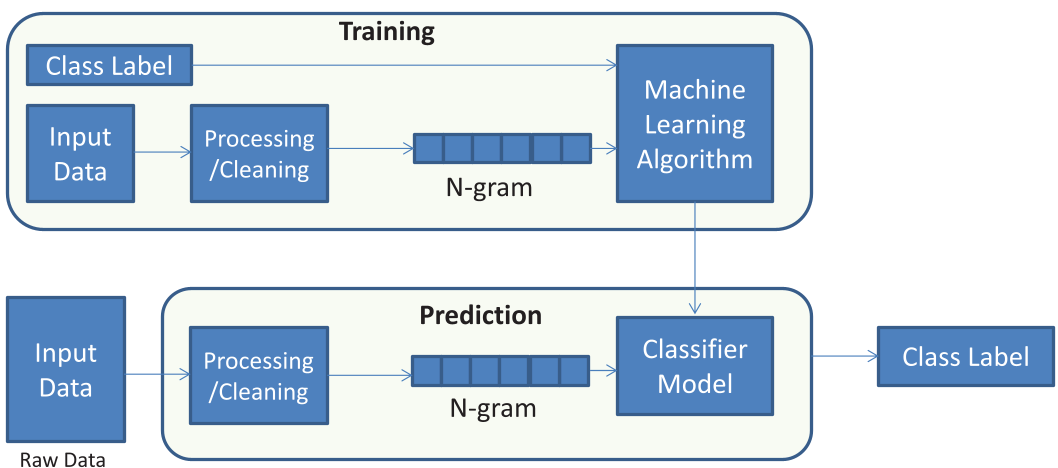
The researcher constructed a systematic pipeline to move from raw "tweets" to actionable market intelligence.
- Data Acquisition: Using the Twitter API, the study gathered ~1,000 tweets per movie per location daily across nine cities (including New York, London, Melbourne, and Mumbai).
- Preprocessing & UH-Filter: To handle the "noise" of Twitter, an "UH-filter" was applied to remove meaningless or irrelevant content before classification.
- The Classifier Duel: The study compared two heavyweights in statistical NLP of the time:
- Naive Bayes: Based on probabilistic independence.
- MaxEnt (Maximum Entropy): A model that makes no assumptions beyond the given constraints, often more robust for text classification.
Experiments & Results: MaxEnt Takes the Lead
The experimental results proved that "more complex" isn't always "better." While Bigrams (two-word sequences) were expected to capture more context, Unigrams (single words) coupled with MaxEnt yielded the highest accuracy.
Key Performance Metrics:
- MaxEnt + Unigram: 84% Accuracy.
- Naive Bayes + Unigram: 79% Accuracy.
- Naive Bayes + Bigram: 64% Accuracy (suffered from data sparsity).
The research also uncovered fascinating regional "slang signatures." For instance, Indian tweets frequently used "bindaas" and "superb," while UK users leaned toward "brilliant" and "favourite," and US users favored "badass" and "awesome."
Regional Behavior Analysis
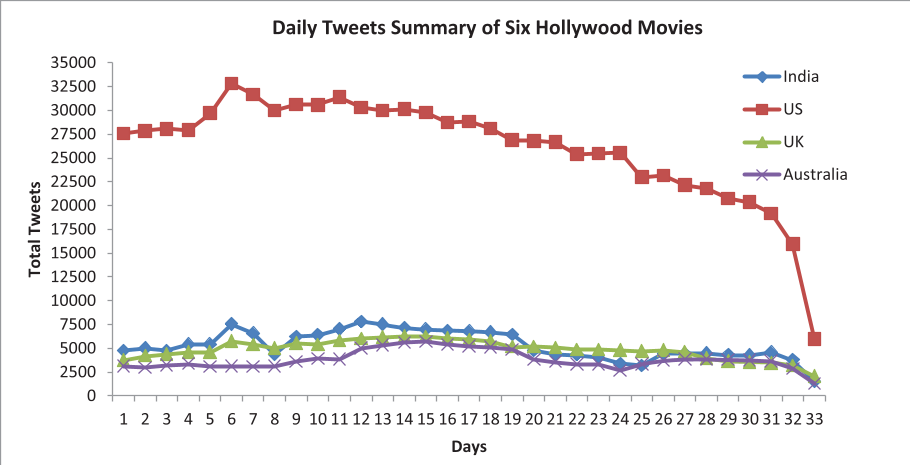
The study found that Twitter activity in the US and UK remains consistent, whereas, in India and Australia, it follows a linear growth pattern post-release before tapering off. This suggests that marketing "hype" cycles operate differently across global time zones.
Critical Analysis & Conclusion
Takeaway
The paper validates that automated sentiment analysis can provide a high-fidelity "mood map" of a global audience. For Hollywood studios, this means the ability to pivot promotional strategies within hours of a premiere based on regional feedback.
Limitations & Future Work
While the 84% accuracy is impressive for 2013, the study relies on manual labeling for training data, which is difficult to scale. Additionally, the reliance on Unigrams means the model may struggle with sarcasm—a notorious hurdle in sentiment analysis where a "positive" word is used in a "negative" context.
Future iterations of this research would benefit from Deep Learning (LSTMs or Transformers) and a deeper dive into "Interpersonal Stances" (cold vs. warm) to better understand the emotional nuance behind the binary of positive/negative.