
Evolving the Scheduler, Not the Schedule: A Holonic Multiagent Approach to Job Shop Complexity
6841_Holonic Job Shop Scheduling Using a Multiagent System.
This paper presents a Holonic Multiagent System (MAS) for Job Shop Scheduling that utilizes Evolutionary Algorithms to evolve mixed-heuristic scheduling rules rather than static schedules. The approach leverages the PROSA and MetaMorph architectures to create a dynamic, reconfigurable environment tested against the 20/4/G/* benchmark problem.
TL;DR
In the high-stakes world of manufacturing, scheduling is a "wicked" problem where the search space grows exponentially. This paper from the University of Calgary shifts the paradigm: instead of using AI to find a single perfect schedule, they use Evolutionary Algorithms to find the perfect logic (a mix of heuristics) to generate schedules on the fly. By wrapping this in a Holonic Multiagent System (MAS), they create a factory floor that "learns" how to prioritize tasks dynamically.
The "Static Schedule" Trap
Conventional scheduling research often focuses on finding the optimal sequence of operations. However, in a real factory, "optimization" is an illusion. A tool breaks, a worker calls in sick, or a rush order arrives, and your "optimal" schedule becomes obsolete immediately.
The authors argue that the problem with standard Genetic Algorithms (GA) is that they lack accumulated equity. Every time you run a GA for a specific schedule, you start from scratch. When the shop floor state changes, the evolution is wasted.
Methodology: Holons and Evolutionary Equity
The system is built on the philosophy of Holonic Manufacturing Systems (HMS). A "holon" is an entity that is simultaneously a whole and a part (e.g., a machine is a holon, but it is also part of a work cell holon).
1. The Multiagent Logic
The architecture utilizes specialized agents:
- Order Agents (OA): Represent the customer's needs and job constraints.
- Resource Agents (RA): Manage individual machines.
- Resource Scheduling Dynamic Mediator Agents (RSDMA): The "brain" that brokers the interaction and runs the scheduling algorithm.
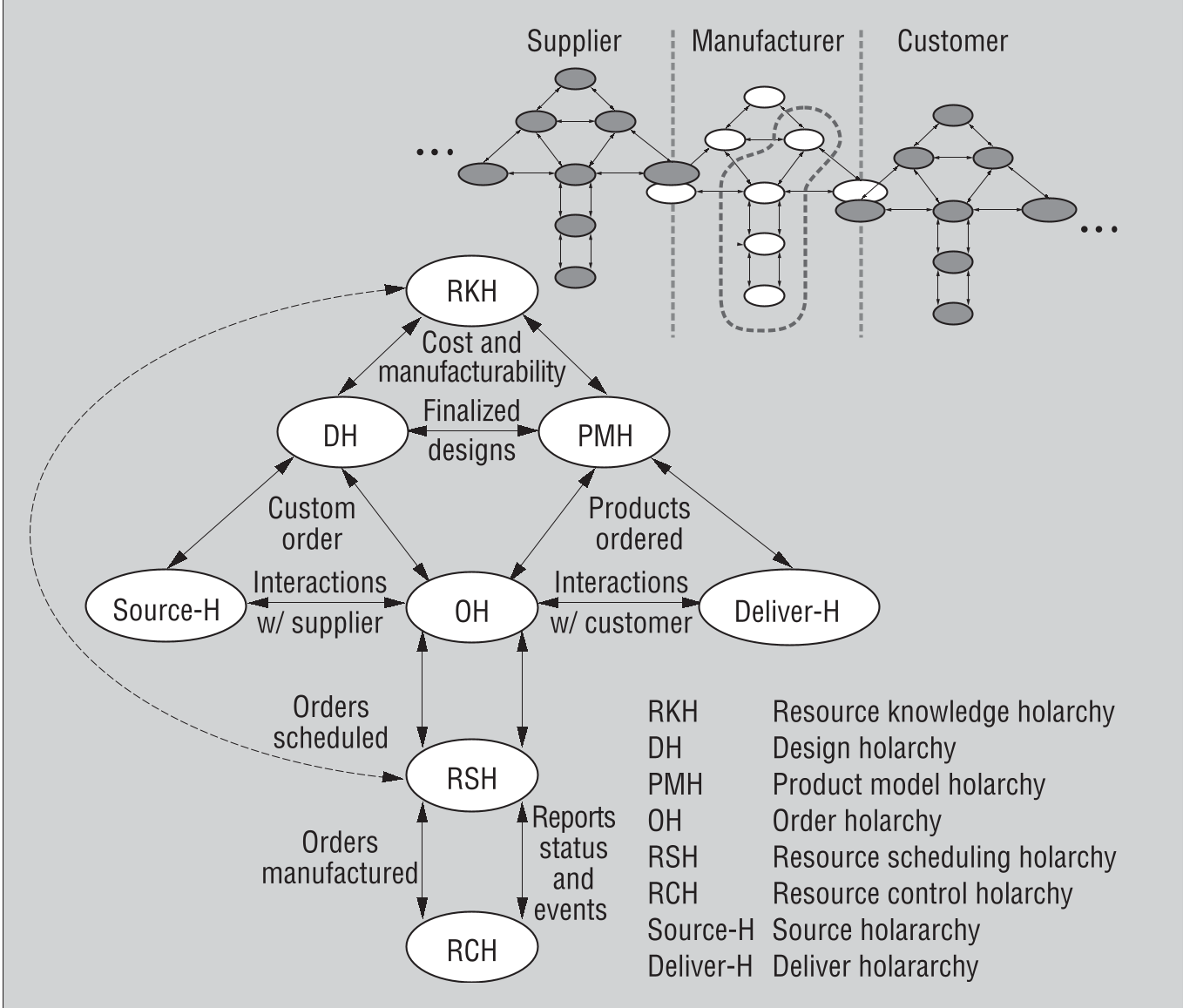 Figure 1: The recursive holonic decomposition showing how product, order, and resource holarchies interact.
2. Evolving the Rules
Instead of a fixed rule like "Always do the shortest job first," the RSDMA calculates a precedence value for each job using a weighted sum of six core heuristics:
- Operations Completed/Remaining/Slack
- Time Completed/Remaining/Slack
The "DNA" of the agent is the set of real-valued weights assigned to these rules. The Evolutionary Algorithm tunes these weights over generations. This results in a "Learning Intelligence" that recognizes patterns in shop floor behavior.
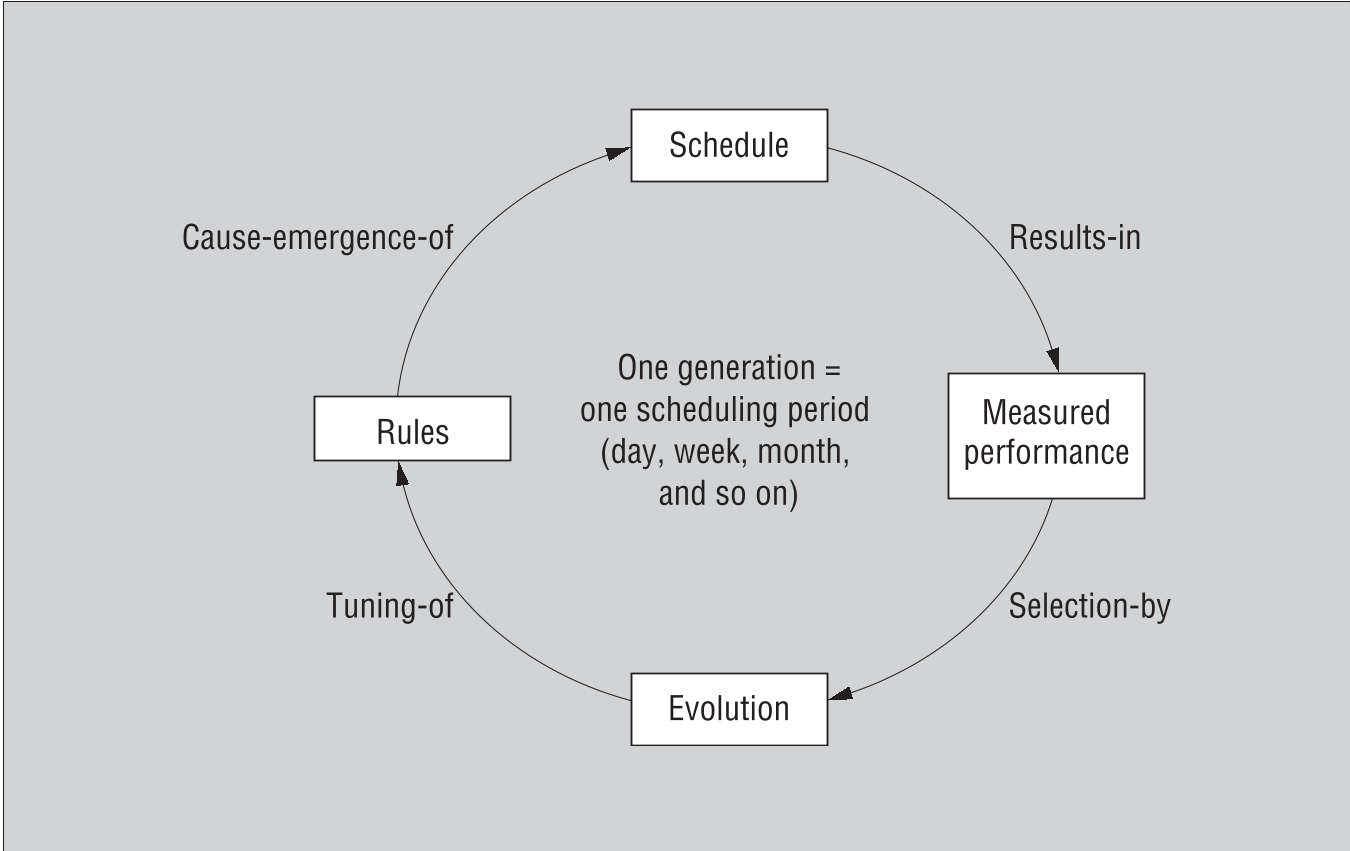 Figure 2: The intelligent scheduling loop where the scheduler itself is evolved to improve cumulative system performance.
Experimental Insights
The authors tested their system against a standard benchmark (20 jobs, 8 resources). They monitored a conflict between Schedule Efficiency (keeping machines busy) and Flowtime (getting jobs to customers quickly).
The results showed that:
- Convergence: The algorithm effectively converged within 32 generations.
- Versatility: The evolved "Evolve4" scheduler consistently outperformed random and pure heuristics by finding a better trade-off between competing metrics (Makespan vs. Customer Dissatisfaction).
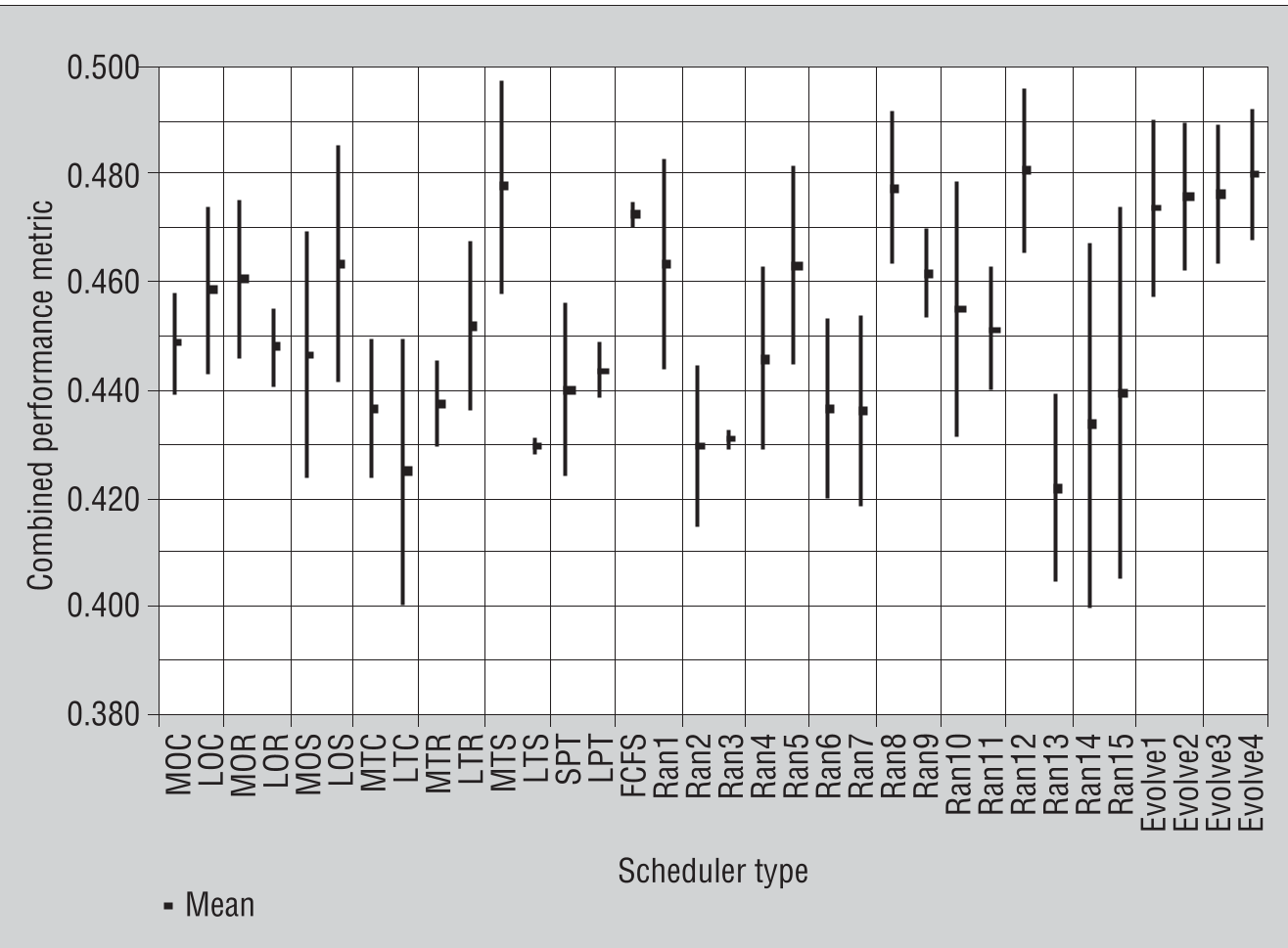 Figure 3: Performance of evolved schedulers compared to standard heuristics. The evolved agents show higher combined fitness and lower variance.
Critical Analysis & Conclusion
The Takeaway
The core value of this work is the shift from Product-oriented optimization to Process-oriented learning. By evolving the weights of a mixed heuristic, the system becomes robust to the "computationally intractable" nature of job shops. It transforms the scheduler from a calculator into a strategy-maker.
Limitations & Future Path
A significant bottleneck identified by the authors was the Multiagent Implementation Paradox. Building a "pure" MAS from day one is notoriously difficult to debug and test due to the asynchronous nature of agent communications. They suggest that future researchers build a pure Object-Oriented model first before adding the "agent" layer.
Furthermore, while effectively tackling deterministic scenarios, the true test lies in scaling this to stochastic environments with frequent machine breakdowns—a challenge the authors have paved the way for with this adaptive architecture.