
Homing Spread: Leveraging Social "Homes" for Optimal Zero-Knowledge Routing
Home-Based Zero-Knowledge Multi-Copy Routing in Mobile Social Networks
This paper introduces Homing Spread (HS), a zero-knowledge multi-copy routing algorithm designed for Mobile Social Networks (MSNs). HS prioritizes "community homes" (frequently visited locations) for message replication to minimize delivery delay without requiring prior knowledge of node contact probabilities or social ties.
TL;DR
Mobile Social Networks (MSNs) are often chaotic, but human movement is surprisingly predictable: we spend most of our time in a few "home" locations. The Homing Spread (HS) algorithm exploits this skew, using these homes as high-priority message hubs. This "zero-knowledge" approach outperforms traditional Spray&Wait by focusing replication where nodes actually go, rather than spraying blindly across the network.
Problem: The Blind Spots of Random Mobility
Current routing in Delay Tolerant Networks (DTNs) typically falls into two camps:
- Knowledge-based: Efficient but requires a global or historical view of everyone’s contact probabilities—data that is hard to get and maintain.
- Zero-knowledge: Simple (like Epidemic or Spray&Wait) but inefficient because they assume a "Random Waypoint" model. In reality, nodes don't wander aimlessly; they gravitate toward specific communities.
The authors identify a missed opportunity: existing zero-knowledge protocols treat a park, a coffee shop, and a random street corner as having equal delivery value. In an MSN, the coffee shop (a community home) is infinitely more valuable for spreading data.
Methodology: The Three Phases of HS
The Homing Spread algorithm is structured around the lifecycle of a message, prioritizing stationary locations (homes) equipped with real or virtual "throwboxes."
1. The Homing Phase
When a source has a message, its first goal is to get those copies to a community home as fast as possible.
- Binary Homing: If you meet anyone on the way to a home, give them half your copies. Now you both are racing to find a home.
- Proportional Homing: In heterogeneous networks where some nodes are "homing experts" (they visit more homes), the algorithm splits copies proportionally to the nodes' home-visiting capabilities.
2. The Spreading Phase
Once a message hits a home's throwbox, the home becomes a high-intensity broadcaster. It gives a copy to every node that visits, turning the community's natural foot traffic into a distribution network.
3. The Fetching Phase
The destination node doesn't need to hunt for the source; it simply needs to visit any home or encounter any node that has passed through a home recently.
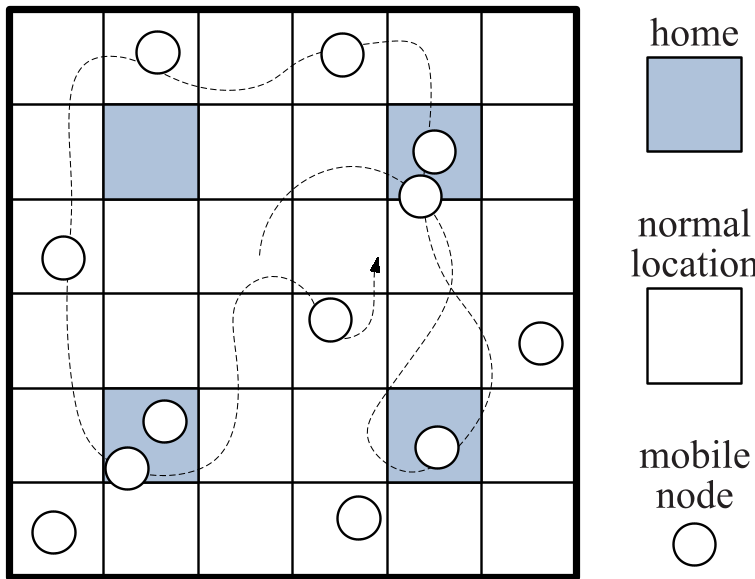 Figure 1: The architecture of community homes acting as message hubs.
Why It Works: The Physics of "Homing"
The mathematical core of the paper proves that if we assume node meetings follow an exponential distribution, the fastest way to reach a destination is to "park" copies at the most-visited vertices. The authors use a Continuous-Time Markov Chain to model the state transitions of message copies across the network.
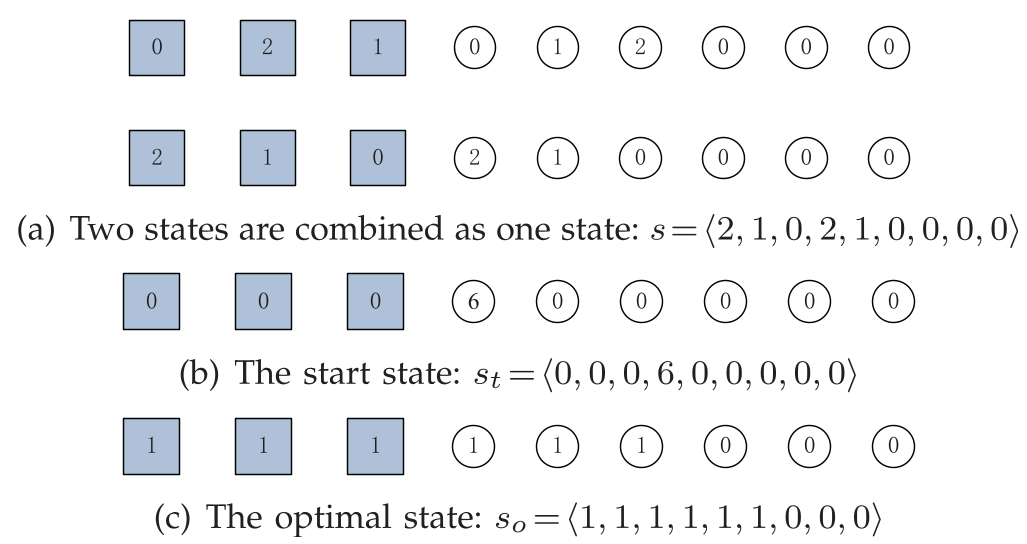 Figure 2: State transition graph (st to se) showing the progression of copies through the network.
Experimental Results
Using the Time-Variant Community Model (TVCM), the researchers compared HS against the industry standards.
- Latency: HS consistently achieved lower delivery delays than Spray&Wait. In some configurations, HS performance approached that of "Epidemic Unlimited" (the theoretical maximum) while using only a fraction of the bandwidth.
- Scalability: As the number of homes increases, the "home-based" advantage grows exponentially compared to random-walk protocols.
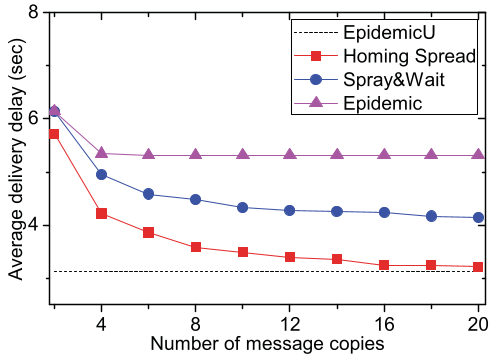 Figure 3: Comparisons of average delivery delay versus number of message copies.
Critical Insight & Conclusion
The genius of Homing Spread lies in its structural simplicity. By acknowledging that nodes are not identical and locations are not neutral, the authors created an algorithm that is "socially aware" without needing to monitor "social" metadata.
Limitations: The model assumes that homes can support throwboxes (or nodes willing to act as them). If a community home is a "dead zone" with no storage, the protocol reverts to standard Spray&Wait performance levels.
Future Outlook: This approach is ripe for integration into Edge Computing and Vehicular Networks (VANETs), where RSUs (Road Side Units) can serve as the fixed "homes" for transient vehicle nodes.