
Digital Survival: How Homeless Youth Navigate the Paradox of Social Media
Homeless young people on social network sites
This paper investigates the use of Social Network Sites (SNS), specifically Facebook and MySpace, by homeless young people (aged 18-30). Through qualitative discussion groups with 23 participants, it examines how this vulnerable population navigates identity exploration, social ties, and impression management to survive and potentially exit homelessness.
TL;DR
Social Network Sites (SNS) are far more than just entertainment for homeless young people; they are vital tools for survival, identity shielding, and pathfinding. This CHI '12 study reveals that while Facebook and MySpace offer "life-changing" opportunities to reconnect with pro-social support, they also create "extra-ordinary" risks by forcing the convergence of incompatible social worlds—street life and mainstream society.
The "Extra-Ordinary" Mirror
We often think of social media as a place for "ordinary" experiences—posting photos or checking in with friends. However, for homeless youth, these ordinary features are magnified into tools for survival. The researchers argue that "extra-ordinary needs are only exaggerated ordinary needs."
The core tension lies in Context Collapse. For a college student, having a parent comment on a party photo is embarrassing. For a homeless youth, having a street associate comment on a profile seen by a case worker or a "straight-edged" grandmother can lead to a loss of housing, employment opportunities, or total social ostracization.
Methodology: Human Portraits
Instead of dry statistics, the authors provide deep qualitative "portraits" of eight participants.
These stories reveal a sophisticated, albeit messy, technical literacy:
- Bernie: A "tech-savvy" survivor who hacked her father’s computer to maintain digital autonomy.
- Lulu: Found her birth mother after 21 years via Facebook, describing the platform as "life-changing."
- Sheri: Meticulously maintains multiple profiles—a "pagan/street" profile and a "Christian/business" profile—to keep her "black sheep" status hidden from her military family.
Key Insights: Why It Works (and Why It Fails)
1. Identity as a Shield
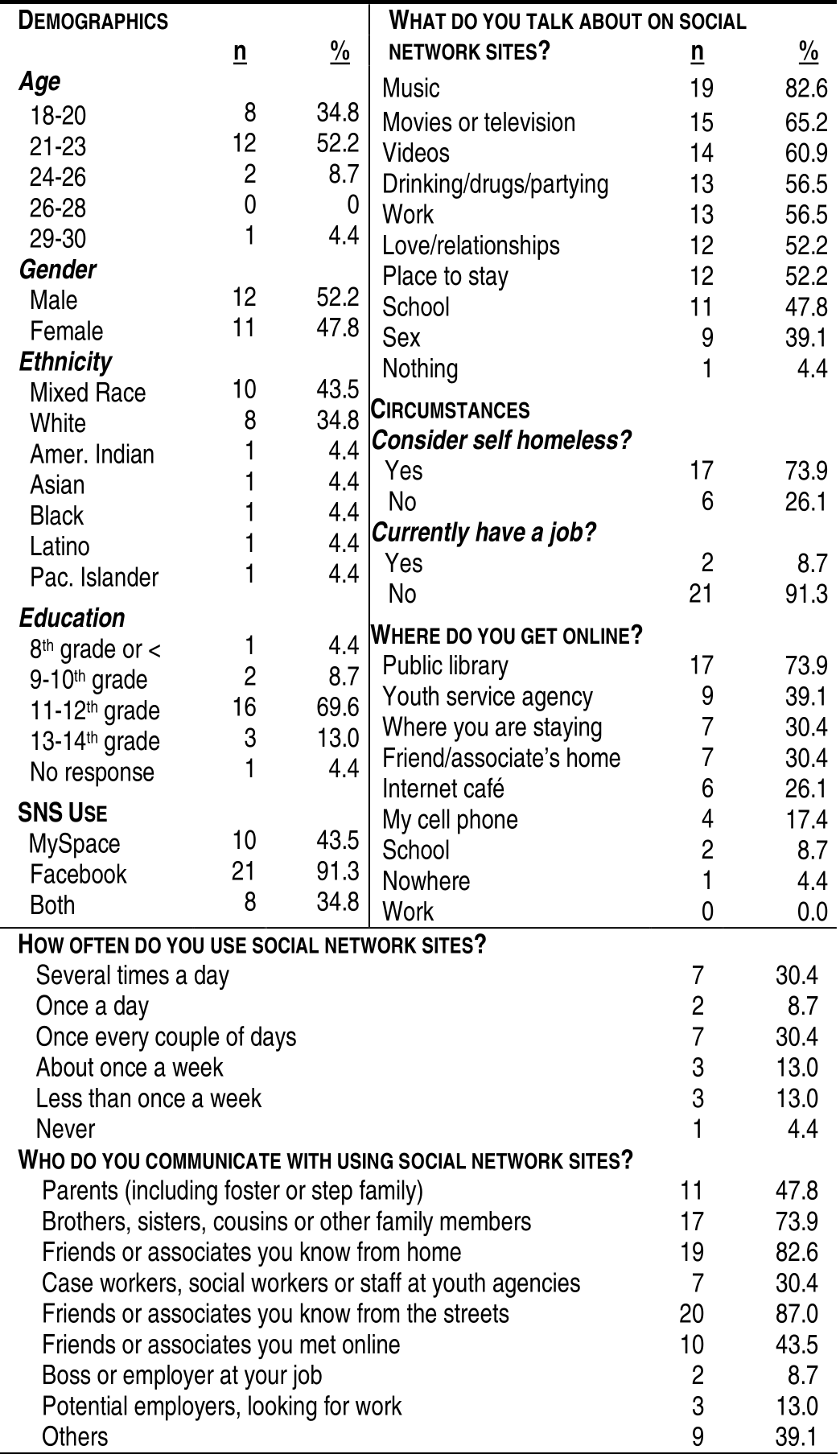
The study found that 7 out of 23 participants maintained multiple profiles. This wasn't just for fun; it was a strategy for Impression Management. By using "street names" on one account and "legal names" on another, they created a digital fire-wall between their survival persona and their professional/family persona.
2. The "Crack" of Connectivity
Roger, one participant, described Facebook as "like crack." The platform acts as a double-edged sword: it provides a "virtual-physical" tool to find a couch to sleep on (as Chip did with his 400+ friends), but it also archives a past that some youth are desperately trying to delete. Facebook’s refusal to "truly delete" data (merely deactivating it) poses a structural risk to those undergoing radical life transitions.
3. Radical Transitions
Unlike a typical user who might "unfriend" an ex, a homeless youth transitioning off the street may need to break ties with their entire social circle to avoid falling back into substance abuse or danger. The platform’s architecture—designed to increase engagement and connectivity—actively works against this need for social distancing.
Implications for Design and Social Policy
The paper concludes with a call to action for both social workers and technical designers:
- Social Intervention: Librarians and case managers should encourage "pro-social" ties (family/teachers) while helping youth understand the "digital footprint" they leave for employers.
- Technical Design: There is a desperate need for Pseudonymity support. Current "real-name" policies (like those of Facebook) are fundamentally at odds with the safety requirements of vulnerable populations.
Note: The study emphasizes that design should support tenuous connections and radical tie-breaking.
Critical Perspective: A Decade Later
Writing from the vantage point of 2026, it is clear that the "extra-ordinary" needs identified in 2012—identity shielding and context management—have become mainstream concerns in the age of data privacy and algorithmic surveillance. What was once unique to homeless youth is now a universal struggle: how do we remain "social" without losing control of who sees which "us"?
Conclusion: This work reminds us that technology is never neutral. For those on the margins, a "Friend Request" is not just a notification—it is a negotiation of safety, identity, and the hope for a different life.