
Birds of a Feather Flock Together: Deciphering F2F Homophily at Academic Conferences
Homophily at Academic Conferences
The paper investigates face-to-face (F2F) homophily at academic conferences using RFID wearable sensors across four venues (HT 2011 and LWA 2010-2012). It employs the JANUS Bayesian method to quantify how personal attributes and prior professional relationships (DBLP/ResearchGate) drive scientific networking.
TL;DR
Why do you talk to the people you talk to at conferences? This study uses RFID sensors to track real-world face-to-face (F2F) interactions at four scientific venues. The findings show that while "who you already know" (co-authors) is the strongest predictor of interaction, "where you are from" and "who you work for" are the most significant broad-stroke drivers of social clustering.
Problem & Motivation
Academic conferences are supposed to be "melting pots" of ideas, but in reality, they often feel like a collection of isolated bubbles. The researchers wanted to move beyond static co-authorship maps to understand the living network of a conference. Specifically, they aimed to test the Homophily Principle: the tendency of individuals to associate with others who are similar to themselves.
The challenge is capturing this "dark matter" of professional networking—the spontaneous hallway conversations that never show up in a citation index. By quantifying these interactions, we can understand if conferences are truly fostering new diverse connections or simply reinforcing existing social circles.
Methodology: Tracking the Invisible
The researchers deployed the Conferator system, utilizing active RFID proximity tags worn by participants at four conferences (Hypertext 2011, LWA 2010, 2011, and 2012).
The Data Stack:
- F2F Contacts: Detected within 1.5 meters by wearable sensors.
- Professional Metadata: Cralwed from DBLP (co-authorship) and ResearchGate (social follows).
- Personal Attributes: Gender, Academic Status, Country, and Institutional Affiliation.
The JANUS Framework
Instead of simple p-values, the authors used JANUS, a Bayesian approach. They created "Belief Matrices"—mathematical representations of hypotheses (e.g., "People from the same country are twice as likely to talk"). They then calculated Bayes Factors to see which hypothesis best matched the actual sensor data compared to a random (uniform) model.
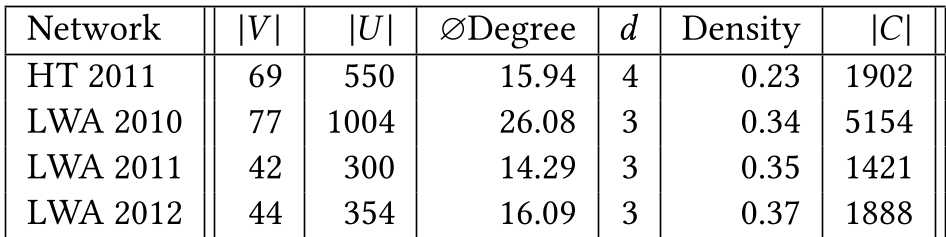 Table 1: Summary of the four conference contact networks analyzed.
Key Insights from the Data
1. The Power of "Prior Knowledge"
Unsurprisingly, the strongest predictor of a contact was a previous professional link. If two people had co-authored a paper (DBLP) or followed each other on ResearchGate, the Cx/Ex ratio (Contacts observed vs. Expected) soared. At HT 2011, DBLP links resulted in nearly 17x more interaction than random pairings.
2. The Identity Driver: Country and Affiliation
While prior knowledge is strong, it only explains a small fraction of total networking. When looking at the broader community, Country of origin and Affiliation were the next biggest drivers. At Hypertext 2011, the "Same Country" hypothesis was the most plausible according to the Bayesian assessment.
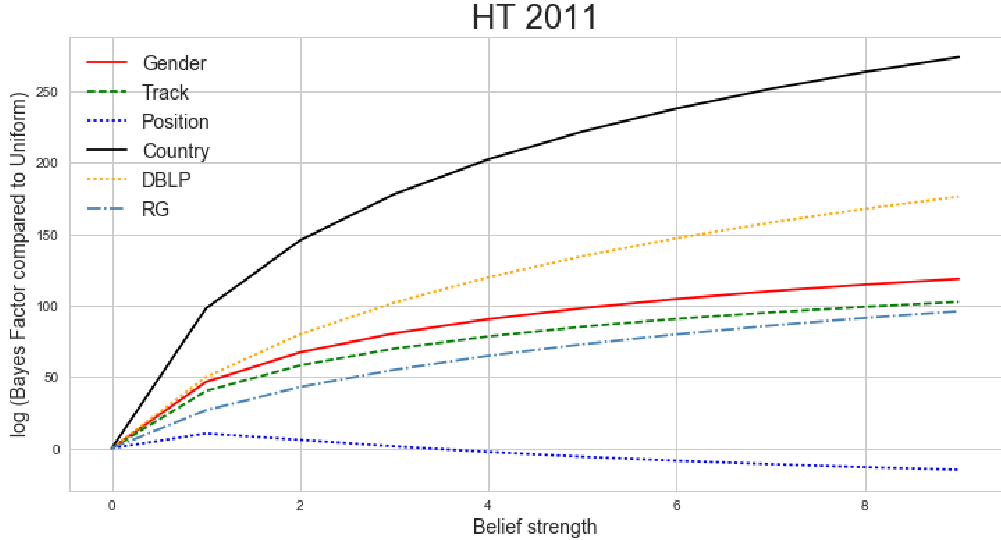 Figure 1: Comparison of hypotheses for HT 2011. Note how 'Country' (red line) consistently outperforms 'Gender' and 'Track' in plausibility.
3. The "Academic Status" Surprise
Interestingly, homophily based on Academic Position (e.g., Professor talking to Professor) was often less significant than other factors. This suggests that while we tend to stick with our countrymen, we are surprisingly willing to talk across hierarchical boundaries (Student to Professor), which is a positive sign for the scientific community's health.
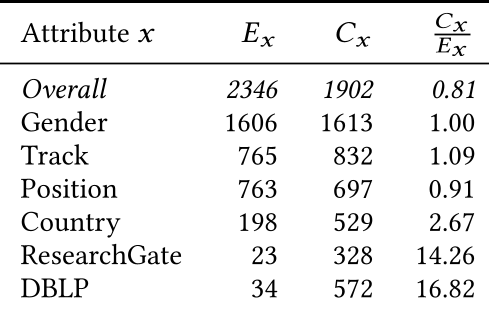 Analysis of HT 2011: Highlights the massive gap between 'ResearchGate' impact and 'Gender' impact on F2F contact.
Critical Analysis & Future Outlook
This work provides a rare quantitative lens into our professional social biases. It highlights a critical limitation: scientists are highly prone to "proximity homophily"—talking to people from the same lab or country simply because it is comfortable.
Takeaway for Organizers: If you want to break "echo chambers," you cannot rely on free-time networking. Since "Track" and "Affiliation" drive clustering, organizers might need to implement randomized "speed-networking" or interdisciplinary workshops to bridge these homophilic gaps.
Future Work: The authors suggest incorporating Network Dynamics. Does homophily get stronger as the conference progresses (people retreating to what they know), or does it weaken as they become more comfortable? That remains the next frontier in understanding the sociology of science.