
Beyond Explicit Circles: Mining Implicit Social Networks for Better Recommendations
Exploiting homophily-based implicit social network to improve recommendation performance
The paper proposes a general framework to construct a homophily-based implicit social network for non-social e-commerce platforms like Amazon. By extracting user relationships from ratings and text reviews through four distinct strategies, it enables the application of Social Recommendation algorithms (e.g., SoReg, SoRec) to platforms lacking explicit friend graphs, achieving SOTA performance in recommendation accuracy.
TL;DR
Social recommendation is powerful, but what if your platform has no "Follow" or "Friend" button? This paper introduces a scalable framework that constructs implicit social networks from raw ratings and text reviews. By leveraging homophily—the tendency of similar people to cluster—the authors turn a standard e-commerce dataset into a rich social graph, boosting recommendation accuracy where traditional methods fail.
Background: The Social Gap in E-commerce
Social Recommender Systems operate on a simple intuition: we trust our friends more than strangers. However, giant platforms like Amazon or eBay lack explicit social communities. We are left with two major hurdles:
- Data Sparsity: Available ratings often cover less than 1% of products.
- Missing Graphs: Without an explicit social network, powerful "Social Recommendation" algorithms (which use social constraints to regularize latent factors) cannot be deployed.
The authors argue that social links exist implicitly. If two users write similar reviews about the same niche movies, they are "implicit friends" even if they don't know each other.
Methodology: Four Ways to Find Your "Implicit Friends"
The core innovation lies in how the authors define and extract these hidden relationships. They propose a modular framework that plugs into existing models like SoRec, SoReg, and SocialMF.
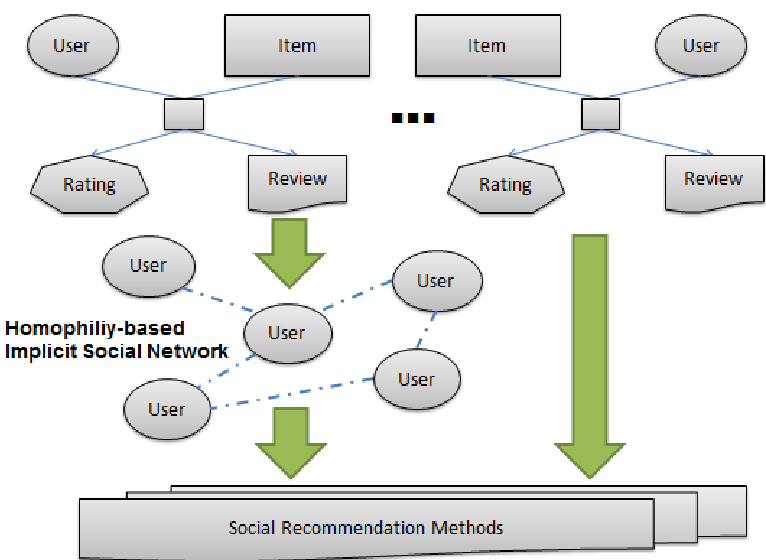 Fig 1: The general framework for transforming non-social data into social recommendations.
1. Common Rating & PCC
The simplest methods look at behavioral overlap. If users rate the same items similarly (measured via Pearson Correlation), a link is formed. While useful, this ignores the rich context hidden in the reasons why they liked or disliked a product.
2. Topic Similarity (The NLP Core)
The authors use an Author-Topic Model (ATM) to map a user's entire review history into a topic distribution (e.g., a "horror movie" topic vs. a "romantic comedy" topic).
3. Fine-grained Topic Analysis (The "Eureka" Moment)
The researchers observed that a 5-star review for Titanic and a 5-star review for Man of Steel represent very different interests (Romance vs. Action). Conversely, a 1-star review tells us what a user hates.
They separated comments by rating levels (1 through 5) and calculated similarity vectors for each level. By assigning higher weights to extreme ratings (1 and 5), they captured the most passionate preferences and dislikes.
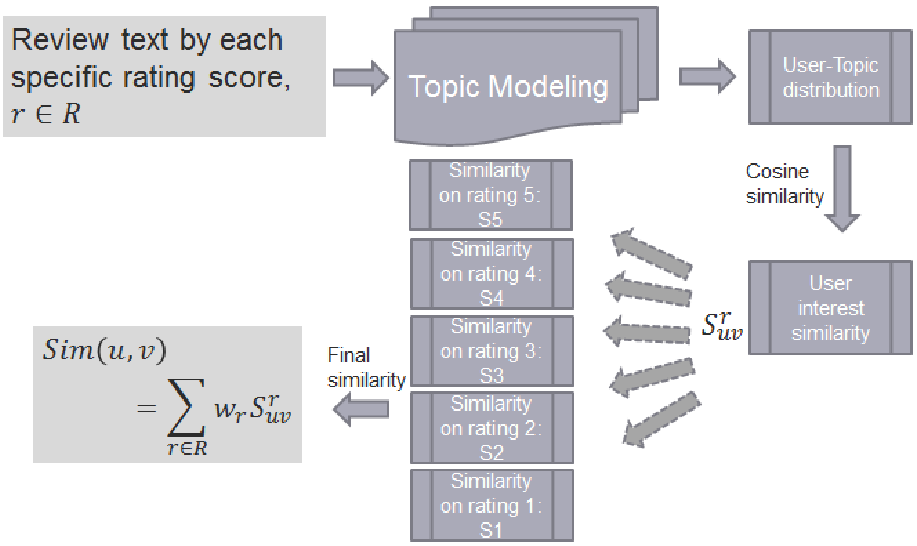 Fig 2: Strategy for Fine-grained Topic Similarity.
Experiments: Proving the Implicit Connection
The team tested their methods on 8 million Amazon movie reviews. They compared standard PMF (Probabilistic Matrix Factorization) against social models (SocialMF, SoReg) fueled by their implicit links.
Key Findings:
- The Improvement: All social-based methods using implicit links outperformed non-social baselines.
- Text Matters: "Topic Analysis by Rate" (Method 4) yielded the lowest Error (RMSE/MAE). This proves that the semantic content of a review is a highly reliable proxy for a social connection.
- Optimization: The paper found that a social regularization weight () of 0.01 was the "sweet spot" for balancing individual preference and implicit social influence.
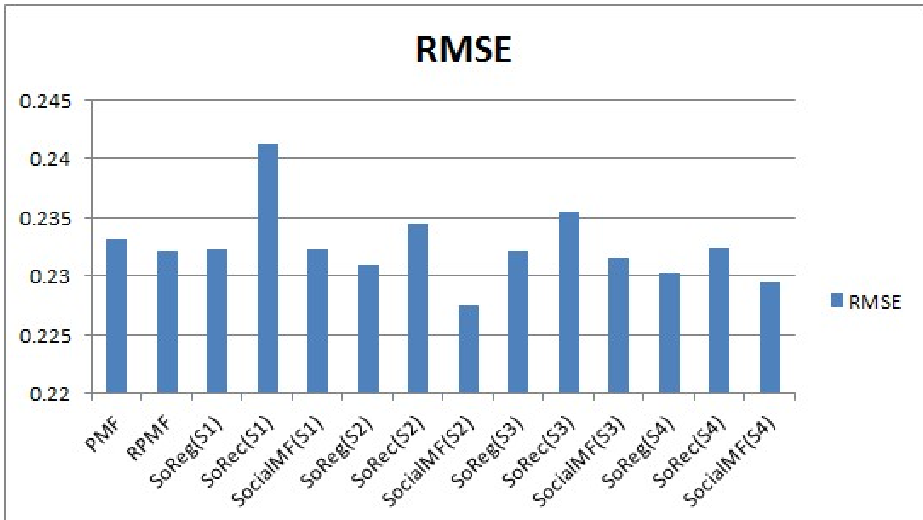 Fig 3: RMSE performance across different strategies. Combining topics and ratings yielded the best results.
Critical Insight & Future Outlook
This work demonstrates that social information is a latent property of interaction data, not just a feature of UI design. By treating similarities in "latent taste" as a network, we can apply graph-based regularization to nearly any dataset.
Limitations: The computational cost of calculating pairwise similarities for millions of users () remains a challenge. Future work should look into Graph Neural Networks (GNNs) or approximate nearest neighbor searches to make this framework even more scalable for real-time production environments.
Conclusion
By mining the "Implicit Social Network," the authors have bridged the gap between traditional Collaborative Filtering and Social Recommendation. For product managers and AI engineers, the message is clear: your user reviews are not just for display; they are the blueprint of a hidden community that can drive the next generation of personalized experiences.