
Type Assortativity: Decoding Nationality Bias Among Elite Researchers
Homophily and Nationality Assortativity Among the Most Cited Researchers' Social Network
The paper introduces "Type Assortativity," a novel metric to measure homophily at the individual group level within social networks. Applied to a co-authorship network of the most-cited ACM researchers, the study reveals significant nationality-based clustering even among global top-tier scholars.
TL;DR
Is the "global village" of science truly borderless? This paper challenges the notion of a perfectly integrated academic elite by introducing Type Assortativity—a metric that measures how specific groups within a network prefer their own kind. By analyzing the ACM Digital Library's most-cited authors, the authors prove that nationality-based cliques persist even at the highest levels of computer science research.
The "Invisible" National Borders in Science
We often assume that top-tier research is purely meritocratic and globally collaborative. However, social networks inherently exhibit Homophily—the tendency of individuals to associate with similar others.
While traditional network science uses Modularity to tell us if a whole network is clustered, it fails to answer a crucial question: Which specific groups are driving this clustering? Is the network segregated because "Group A" is highly insular, or because everyone is slightly biased? Current tools lack the granularity to differentiate between the behavior of specific types (like different nationalities) in weighted, complex social structures.
Methodology: Beyond a Single Number
The authors propose a shift from global metrics to Type Assortativity (). This allows researchers to isolate the contribution of a single type to the total modularity.
Key Innovations:
- Normalization for Groups: Type assortativity is normalized so we can compare the "insularity" of a small nationality (e.g., Jewish) directly against a large one (e.g., English), despite their different population sizes.
- Handling Dual Identities: Recognizing that researchers often have multi-national backgrounds, the authors use Cosine Similarity on probability vectors to calculate similarity between nodes with multiple types.
- Weighting Interactions: Collaboration isn't binary. An edge between two authors who have co-authored 50 papers is "heavier" than a one-time collaboration. The authors extend modularity to account for these weights.
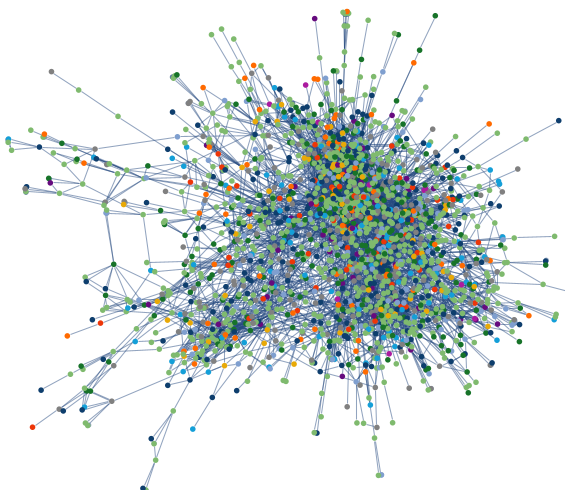 Fig 1: The colored nodes represent different nationalities in the top-2000 cited authors network, visually suggesting clusters of similar colors.
Experimental Insights: Comparing Elite Sub-networks
The researchers tested their metric on ACM Digital Library data, focusing on the "heavy hitters" (the top 1K to 32K most-cited authors).
The Weighted Advantage
The study found that homophily values were significantly higher when the network was treated as weighted and multi-typed () compared to a simple unweighted graph (). This suggests that deep, repeated collaborations are even more likely to happen within the same nationality than casual ones.
Visualizing Homophily
To prove that these numbers represent real-world social silos, the authors compared real sub-networks against "Random Configuration Models"—networks where edges are shuffled but degrees are kept the same.
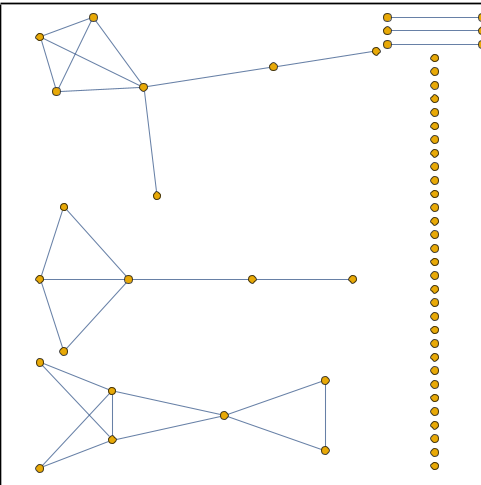 Fig 2: Real sub-networks (left) show dense interaction compared to the sparse, uniform distribution of the random model (right), highlighting strong ethnic homophily.
Key Findings:
- Size Matters: As the size of a nationality group grows within the top-cited list, its homophily level tends to increase.
- Consistent Rankings: Certain groups consistently show higher levels of homophily than others, regardless of the overall network size being analyzed.
Critical Analysis & Conclusion
This work provides a necessary mirror for the scientific community. While we celebrate global conferences, the data suggests that national identities still heavily influence who we choose to work with, even when we are at the top of our field.
Takeaway: The introduction of Type Assortativity acts as a "microscope" for social scientists, allowing them to pinpoint exactly which groups are integrating and which are remaining in silos.
Limitations: The paper relies on a name-based classifier (NamePrism) for nationality, which might introduce noise for researchers who have immigrated or have culturally ambiguous names. Future work could incorporate actual institutional affiliation history to refine the "nationality" definition.
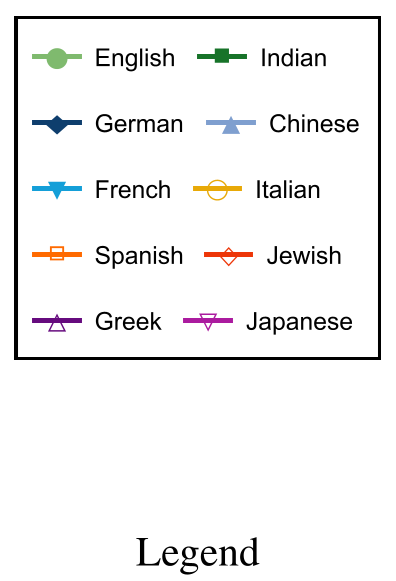 Fig 3: Type Assortativity () across different nationalities, showing how different groups maintain distinct homophily levels as the network scales.