
Spreading Activation: Boosting Relational Classifiers by Reimagining Graph "Neighborhoods"
8928_Homophily of Neighborhood in Graph Relational Classifier.
The paper proposes replacing direct neighborhood methods in Simple Relational Classifiers with a "Spreading Activation" local graph ranking algorithm. This approach aims to enhance collective inference by increasing the degree of homophily in the classified graph.
Executive Summary
TL;DR: This paper challenges the standard practice of using direct neighbors for graph-based classification. By employing Spreading Activation—a recursive local ranking algorithm—the authors demonstrate that they can artificially "increase" the homophily of a graph, leading to massive improvements in classification accuracy (from 30% to over 70% in real-world datasets).
Context: In the landscape of graph mining, this work sits between traditional collective inference (like Simple Relational Classifiers) and modern graph ranking, providing a bridge that shows how where you look in a graph matters more than how many neighbors you have.
The Problem: The Fragility of Direct Neighbors
Most relational classifiers operate on the Homophily Assumption: "Birds of a feather flock together." If your friends are all lawyers, you are likely a lawyer.
However, real-world graphs are messy. Direct neighbors might be:
- Noisy: A single "wrong" connection can skew the probability.
- Sparse: Many nodes have too few neighbors to make a statistically significant prediction.
- Weakly Correlated: Direct links may not capture the deep structure of the community.
The authors argue that the "Basic Neighborhood" method is too narrow. It acts like a "local filter" that is easily blinded by local noise.
Methodology: Beyond Direct Links
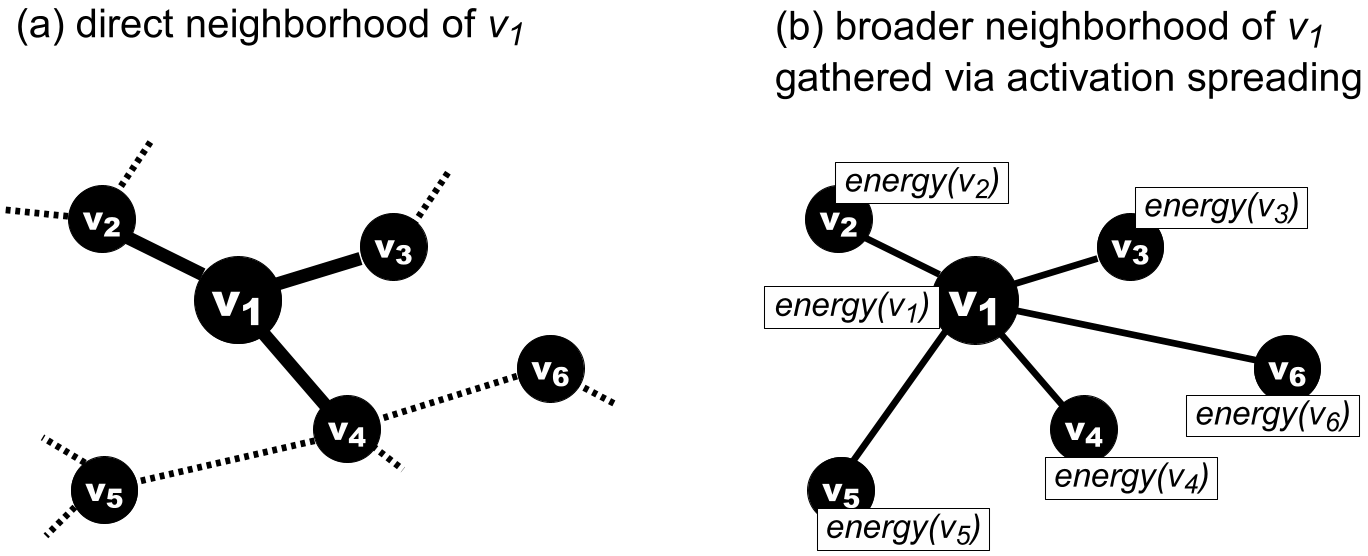
The core innovation is replacing the standard edge-based neighborhood with Spreading Activation.
1. Spreading Activation Algorithm
Instead of just looking at immediate neighbors (), the algorithm "pumps" energy into the starting vertex. This energy flows through edges to neighbors, and then to neighbors-of-neighbors, decaying at each step based on a threshold .
The result is a weighted set of neighbors where:
- Weights (): Reflect the "affinity" or proximity in the graph structure.
- Reach: The neighborhood can include vertices multiple hops away if they are structurally significant.
2. Redefining Homophily via Entropy
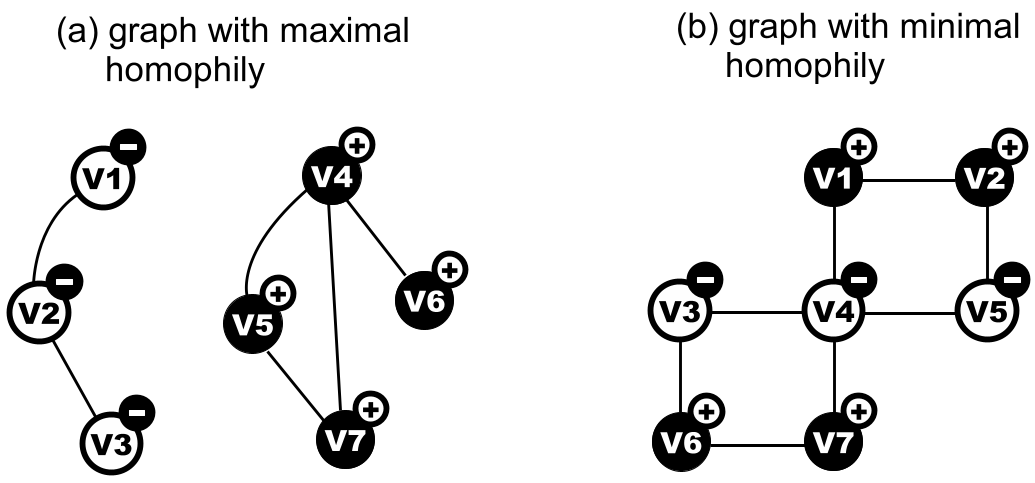
The authors don't just claim it's better; they prove it using a novel entropy-based metric: This formula yields a value between 0 (random class distribution) and 1 (perfect class purity).
Experiments: The Slovak Company Network
The authors tested their hypothesis on a massive bipartite graph of Slovak Companies and Persons (350k people, 168k companies). The task was to predict if an entity was located in the capital city, Bratislava.
Key Performance Leap
The results were stark. By expanding the neighborhood via Spreading Activation, the classifier became significantly more robust:
| Metric | Basic Neighborhood | Spreading Activation |
|---|---|---|
| Accuracy | 30.0% | 71.9% |
| Precision | 18.2% | 59.5% |
| RMSE (Homophily) | 0.360 | 0.219 (Lower is closer to optimal) |
The graph above shows that Spreading Activation (the curve closer to the top-left/top-right corners) follows the "Optimal Homophily" distribution much more closely than the basic method.
Critical Analysis: Why It Works
Why does looking farther away make the classifier better?
The authors demonstrate that Spreading Activation acts as a "structural smoother." In cases where a node is caught between conflicting classes (e.g., 50/50 split in direct neighbors), spreading the energy helps discover the broader "community consensus."
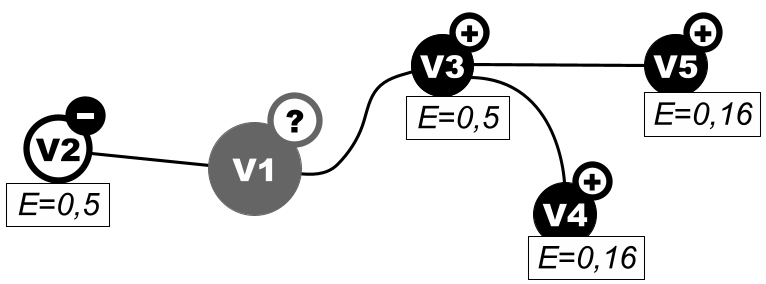 Fig 4: Even if immediate neighbors are split, neighbors-of-neighbors can provide the deciding vote, raising homophily from 0.0 to a functional predictive value.
Limitations & Future Work
While effective, the method introduces a computational trade-off. Spreading activation is a recursive process. While the authors claim quick convergence with their threshold , on massive billion-scale graphs, this could be significantly more expensive than direct lookups.
Conclusion
This paper provides a vital insight for anyone working with Graph Neural Networks or Relational Classifiers: The definition of a "neighbor" should be fluid. By using local ranking to weigh neighborhood influence, we can overcome local noise and achieve SOTA-level performance on sparse real-world social networks.