
Beyond Preference: How Time Allocation Drives Social Homophily
Homophily in Online Social Networks
The paper presents a parsimonious dynamic network formation model that explains homophily and degree distributions in social networks through overlapping social groups and time allocation. Applying a mean-field approximation, the authors achieve a high-fidelity fit to Facebook student data from 10 American colleges, matching complex structural properties like clustering coefficients.
TL;DR
Why do we befriend people similar to ourselves? While many point to internal biases, this paper argues that the structure of our environment—where we spend our time—is the primary driver. By modeling time spent in overlapping social groups (like classes or dorms), the authors create a 3-parameter model that accurately predicts the complex friendship patterns and "clustering" seen in real-world Facebook data.
The Problem: The Hidden Mechanics of Similarity
"Birds of a feather flock together"—this concept of homophily is a cornerstone of sociology. However, in technical network modeling, researchers often face a dilemma:
- Anonymous Models: These ignore node characteristics, failing to explain why certain groups cluster.
- Preference-Based Models: These assume agents have an innate bias for "sameness," which is hard to prove and often obscures the role of institutional structures.
- Complexity Trap: Affiliation networks that do account for traits usually require dozens of parameters, making them impossible to solve analytically.
Methodology: The Time-Allocation Framework
The authors suggest that agents are not actively "filtering" for similar friends. Instead, they are placed in social categories (e.g., Gender, Class, Year).
An agent allocates a proportion of time to a specific social group . While in that group, they form friendships uniformly at random. Homophily emerges because if two people are in the same "Math Class" group, they have a higher cumulative probability of meeting than if they only shared the "Human" category.
Mathematically Tractable Dynamics
To avoid the "simulations-only" trap, the authors use a Mean-Field Approximation. This treats the growth of an agent's degree (number of friends) as a deterministic system. The core equation for the expected duration until an agent links with everyone in a sub-partition is:

This allows the researchers to derive a closed-form solution for the degree distribution , making it possible to "fit" the model to massive datasets using simple grid searches.
Experimental Results: Fitting the "Harvard" Network
The authors tested their model against 2005 Facebook data from 10 US colleges. Despite the model's simplicity (adjusting only time ratios and an activity probability ), the results were startlingly accurate.
Key Discoveries:
- Class over Dorms: Students consistently spent more time socializing within "class" categories than "dorms."
- Emergent Clustering: Even though the model didn't explicitly optimize for "clustering coefficients" (the "friend of a friend is my friend" phenomenon), the simulations closely matched the empirical data. This suggests that overlapping social groups are sufficient to create high-clustering networks.
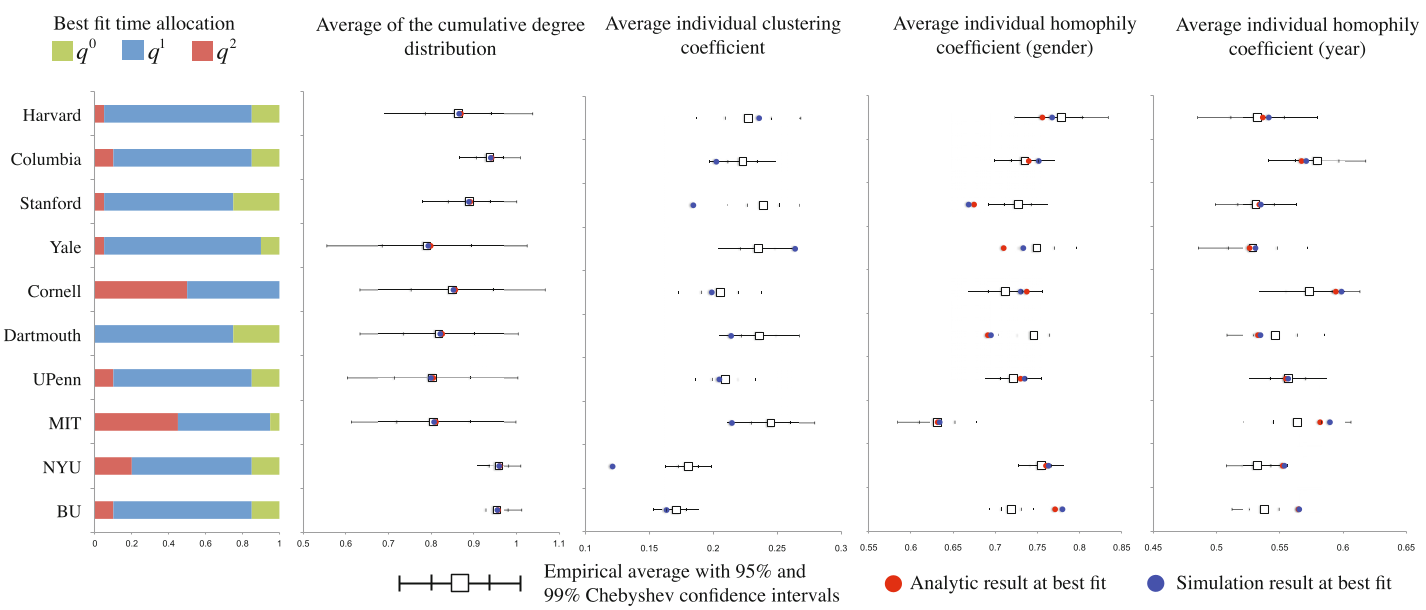 In the figure above, the red analytical curve and blue simulation almost perfectly overlap with the black empirical data for degree and homophily.
Critical Insights & Conclusion
This paper offers a powerful structuralist perspective on social networks. It suggests that if you want to reduce segregation or change the "echo chamber" nature of a network, you shouldn't just focus on changing individual "preferences"—you should change the institutional categories where people spend their time.
Limitations: The model assumes a "random meeting" within groups, which might not hold in very large categories. Furthermore, it treats characteristics as static, ignoring how people might change their majors or habits based on their current friends (the "feedback loop").
Final Takeaway: By shifting the focus from who we like to where we are, the authors have provided an elegant, mathematically sound tool for understanding the invisible forces of homophily in our digital lives.